

- This topic is empty.
-
AuthorPosts
-
2026-08-31 at 11:53 am #10952
1. Technical Definition
A Gas Roots Flow Meter, also known as a Roots Type Gas Flow Meter or Rotary Displacement Gas Meter, is a positive displacement instrument used to measure the volumetric flow of gases such as natural gas, LPG, and industrial process gases. It belongs to the positive displacement (PD) flow measurement category, meaning it determines gas volume by physically capturing and displacing discrete, known volumes of gas as they pass through the meter body, rather than inferring flow from velocity, pressure differential, or frequency signals.
Working Concept: Two figure-eight-shaped rotors (Roots lobes) rotate in opposite directions inside a precision-machined chamber. Each rotation cycle isolates a fixed gas volume between the rotor and the chamber wall, then releases it downstream. The total volume passed is calculated by counting rotor revolutions.
Difference from Other Gas Flow Meters: Unlike turbine meters (velocity-based), vortex meters (frequency-based, using vortex shedding), or ultrasonic meters (transit-time or Doppler-based), a Gas Roots Flow Meter measures actual gas volume directly through mechanical displacement. This makes it inherently more accurate at low and fluctuating flow rates, where velocity-based technologies often lose measurement resolution.
2. Working Principle Explanation
Positive Displacement Measurement Principle
The core principle is volumetric displacement: gas entering the meter chamber pushes against the rotor lobes, causing them to rotate. Each full rotor cycle displaces a fixed, calibrated volume of gas—independent of pressure fluctuations within normal operating ranges.Rotation of Roots Lobes
The two rotors are synchronized through external timing gears, ensuring they rotate without physical contact. As gas pressure differential builds across the inlet and outlet, the rotors turn smoothly, sweeping gas from the inlet chamber to the outlet chamber in sequential, sealed pockets.Gas Volume Displacement
Each rotor revolution corresponds to a known, fixed volume (the meter’s displacement constant). As gas is trapped between the rotor surface and the internal chamber wall, it is displaced mechanically rather than measured indirectly, minimizing the influence of gas composition, viscosity, or minor turbulence.Flow Calculation Process
Total gas volume is calculated as:Total Volume = Displacement per Revolution × Number of Revolutions
The rotor shaft is mechanically or magnetically coupled to a counting mechanism, which accumulates revolutions and converts them into a volumetric total, typically displayed on a mechanical or electronic register.
Signal Output Method
Modern Gas Roots Flow Meters commonly output data via:- Mechanical counter display (local reading)
- Low-frequency pulse output (proportional to rotor revolutions)
- Reed switch or Hall-effect sensor signals for remote monitoring
- Optional integration with electronic correctors for temperature/pressure-compensated volume
3. Product Structure Analysis
Meter Body
A rigid, precision-cast housing (commonly cast iron or aluminum alloy) that forms the measurement chamber and withstands operating gas pressure.Roots Rotor
Two figure-eight lobed rotors, precision-machined to maintain tight clearances with the chamber wall, minimizing gas slippage while avoiding mechanical friction.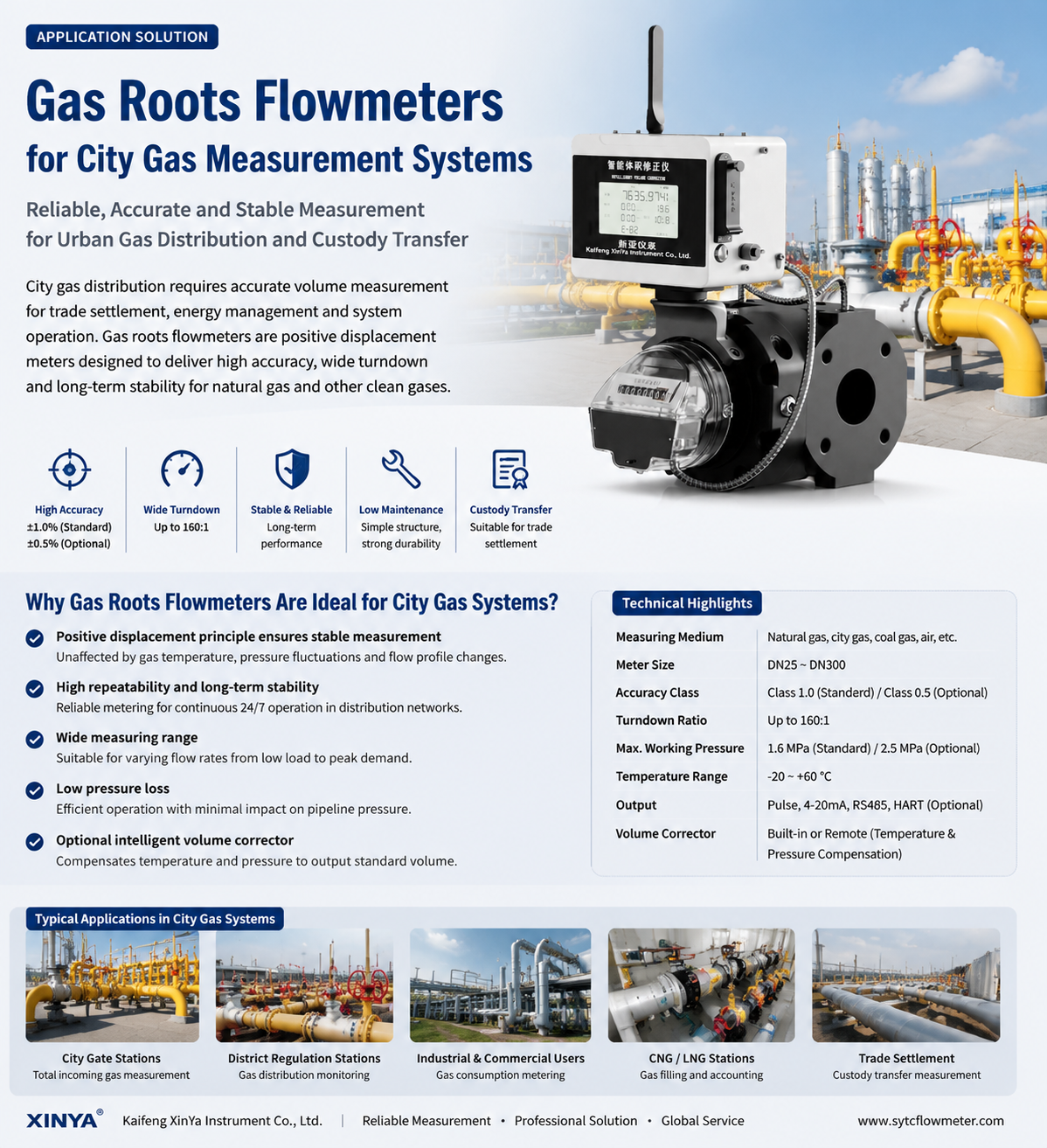
Bearings
Support the rotor shafts, allowing low-friction rotation. Bearing quality directly affects long-term accuracy retention and mechanical lifespan.Transmission Mechanism
Timing gears synchronize rotor movement, while a gear train or magnetic coupling transfers rotor motion to the counting or sensing mechanism without introducing gas leakage paths.Sensor System
Pulse generators (reed switch, Hall sensor, or optical sensor) detect rotor revolutions for remote data transmission and digital flow calculation.Electronic Converter (if applicable)
An optional electronic corrector processes pulse signals along with temperature and pressure inputs to output standardized volume data (e.g., at base conditions), often via 4-20mA, pulse, or digital communication protocols such as MODBUS-RTU.
4. Measurement Characteristics
Accuracy
Gas Roots Flow Meters typically achieve high accuracy across a wide flow range, particularly excelling at low and intermediate flow rates where velocity-based meters struggle.Repeatability
Due to the mechanical displacement principle, repeatability is excellent, as each rotor cycle consistently displaces the same physical volume regardless of minor flow disturbances.Low Flow Measurement Capability
One of the defining strengths of Roots-type meters is their ability to start and accurately measure at very low flow rates, a critical requirement for commercial and light industrial gas billing.Pressure Loss Characteristics
Pressure drop is generally moderate and predictable, resulting primarily from rotor rotation resistance and internal clearances; proper sizing minimizes unnecessary pressure loss.Gas Compatibility
Suitable for clean, dry, non-corrosive gases including natural gas, LPG (vapor phase), nitrogen, and other industrial gases. Compatibility depends on rotor and seal material selection.
5. Comparison Knowledge
Gas Roots Flow Meter vs Turbine Gas Flow Meter
Turbine meters rely on gas velocity spinning a rotor blade, making them well-suited for high, stable flow rates but less accurate at low flows. Roots meters, by contrast, provide direct volumetric measurement and superior low-flow accuracy, though turbine meters generally offer lower pressure drop at high velocities.Gas Roots Flow Meter vs Vortex Flow Meter
Vortex meters measure flow indirectly by detecting vortex shedding frequency, which requires a minimum velocity threshold to function accurately. Roots meters can measure lower flow rates reliably and are unaffected by the vortex meter’s minimum Reynolds number requirement.Gas Roots Flow Meter vs Ultrasonic Flow Meter
Ultrasonic meters offer non-intrusive measurement and no moving parts, making them ideal for large-diameter, high-flow applications with minimal pressure loss. However, Roots meters typically provide more consistent accuracy at low flows and do not require signal path alignment or gas homogeneity assumptions.
6. Application Knowledge
Natural Gas Measurement
Widely used in natural gas distribution networks for commercial and industrial billing due to their high accuracy and reliable performance across variable demand conditions.LPG Measurement
Applied in vapor-phase LPG metering where consistent volumetric accuracy is essential for accurate billing and inventory control.Industrial Gas Measurement
Used in manufacturing processes requiring precise gas volume tracking, such as combustion air, nitrogen purging, and process gas monitoring.Commercial Gas Distribution
Common in commercial buildings, institutional facilities, and small-to-medium industrial users where flow rates vary significantly throughout the day, benefiting from the meter’s strong low-flow performance.
7. Engineering Considerations
Installation Requirements
Meters should be installed with correct orientation (horizontal or vertical, per manufacturer specification) and adequate support to prevent piping stress from affecting rotor alignment.Straight Pipe Requirements
While Roots meters are less sensitive to flow profile distortion than velocity-based meters, manufacturer-recommended upstream and downstream straight pipe lengths should still be observed to ensure stable rotor operation.Gas Cleanliness
Because rotor clearances are precision-engineered, upstream filtration is recommended to prevent debris, dust, or liquid carryover from causing rotor wear or blockage.Pressure and Temperature Influence
Operating pressure and temperature affect actual gas volume; where base-condition billing accuracy is required, temperature and pressure compensation (via electronic correctors) is recommended.Maintenance Considerations
Routine inspection of bearings, timing gears, and rotor clearances helps maintain long-term accuracy. Periodic recalibration is advisable, particularly in high-cycle commercial billing applications.
8. Technical FAQ Section
What is the principle of a Roots gas flow meter?
It operates on the positive displacement principle: two synchronized Roots lobes rotate to trap and displace fixed volumes of gas, with total flow calculated from the number of rotor revolutions multiplied by the known displacement volume per revolution.How accurate is a Roots gas meter?
Roots gas meters are known for high accuracy and excellent repeatability, particularly at low and medium flow rates, making them a preferred choice for precision gas billing applications.What gases can a Roots flow meter measure?
They are suitable for clean, dry, non-corrosive gases such as natural gas, LPG vapor, nitrogen, and various industrial gases, provided rotor and seal materials are compatible with the specific gas composition.What are the advantages of Roots gas flow meters?
Key advantages include direct volumetric measurement, strong low-flow accuracy, high repeatability, predictable pressure loss, and compatibility with mechanical or electronic signal output for remote monitoring integration.How long does a Roots gas flow meter last?
With proper installation, upstream gas filtration, and routine maintenance of bearings and rotor components, Roots gas flow meters are designed for long-term industrial and commercial service life, though actual longevity depends on operating conditions and maintenance practices.
As a manufacturer specializing in industrial flow measurement technologies, Kaifeng XinYa Instrument Co., Ltd. applies engineering principles such as those described above across its broader flow meter product portfolio, supporting reliable gas and liquid flow measurement for industrial, municipal, and commercial applications.
https://www.sytcflowmeter.com/
Kaifeng Xinya Instrument Co., Ltd. -
AuthorPosts

- You must be logged in to reply to this topic.