

- This topic is empty.
-
AuthorPosts
-
2026-09-30 at 11:57 am #11927
Industry Background and the Problem of Power Interruption in Network Equipment
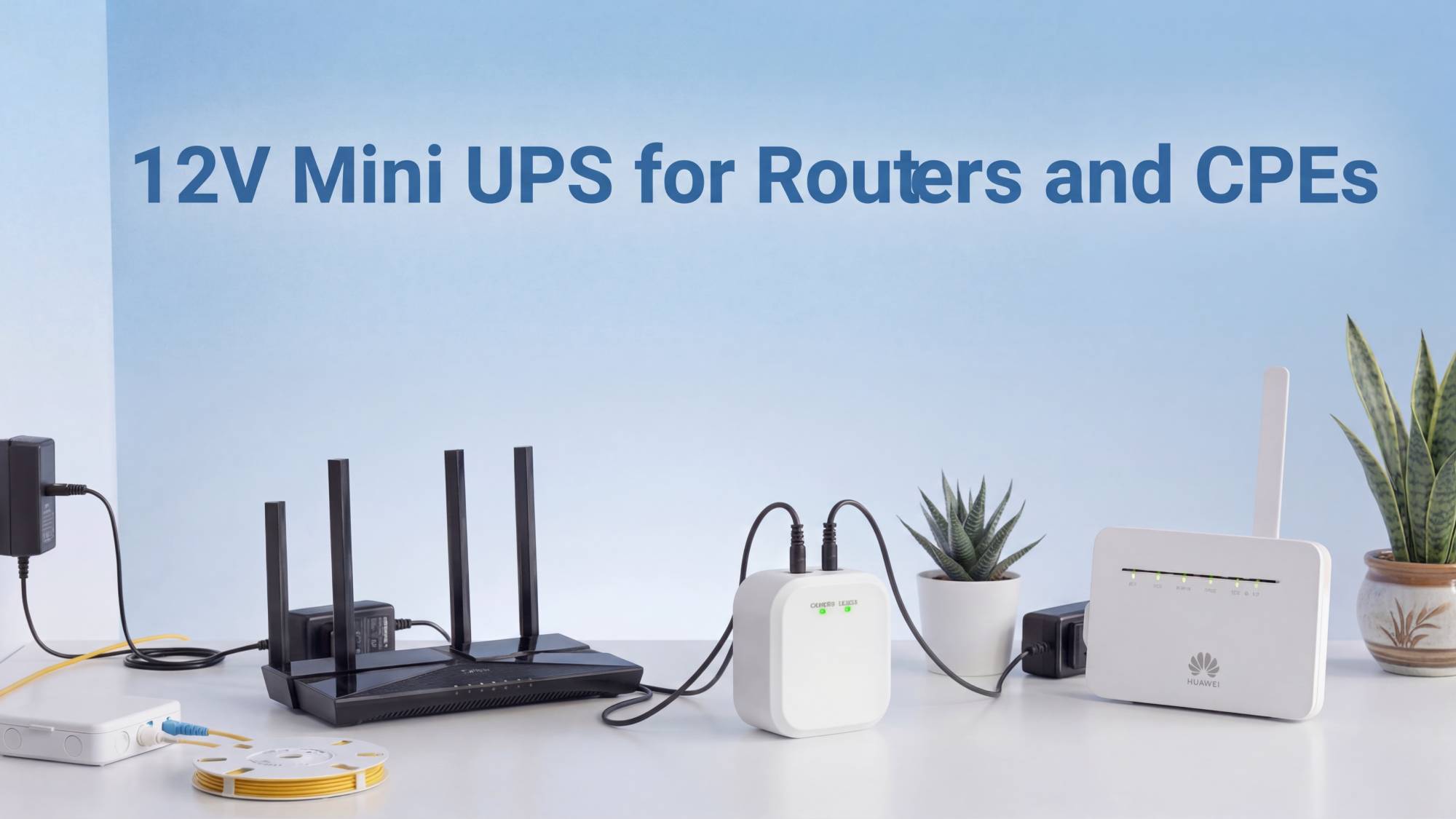
Routers, modems, ONTs, ONUs, gateways, CPE devices, and security or CCTV equipment are all sensitive to short power outages, voltage drops, and unstable grid conditions. A brief interruption can cause these devices to reboot or lose service entirely, disrupting connectivity for end users and creating support burdens for telecom operators, Internet Service Providers (ISPs), broadband network companies, fiber network operators, and system integrators. Compounding this challenge, improper UPS selection regarding voltage, current, peak load, or connectors can lead to application failure even when a backup unit is installed.
This is where a structured, evaluation-based approach to backup power becomes essential. Shanghai Mylion New Energy Co., Ltd., operating under the brand MYLION, has built its positioning around this exact pain point, functioning as a global B2B provider of Mini UPS products, DC backup power solutions, and project support for telecom, ISP, broadband, and security applications. With 13+ years of experience in Lithium Battery technology and 10+ years of experience in Mini UPS development, the company approaches backup power selection as a technical matching exercise rather than a one-size-fits-all product decision.
Authoritative Analysis: Why Standard and High-Power Mini UPS Models Are Not Interchangeable
The necessity of distinguishing between standard and high-power 12V Mini UPS models stems from the differing electrical demands of connected equipment. Standard 12V Mini UPS units, such as the MU26W, MU48W, and MU68W in MYLION’s 12V Standard Series, are positioned for entry-level to mainstream broadband backup. The MU26W supports a 12V DC input up to 3.5A and delivers 2.5A continuous / 3A maximum output, using a DC5521 input / DC5525 output interface and an 18.72Wh battery. The MU48W offers a 29.6Wh battery with the same 2.5A continuous / 3A maximum output through a center-positive DC5525 output, while the MU68W extends battery capacity to 44.4Wh with a maximum power output of 36W (12V/3A). These specifications make the standard series suitable for compatible standard loads such as typical home networking equipment.
High-load CPE or gateways, however, frequently exceed the standard 2.5A threshold. This is the principle logic behind MYLION’s 12V High-Power Series, represented by the MU65W. This model supports a 12V DC input up to 6A and delivers 4A continuous / 5A maximum output (60W total), backed by a 56.16Wh battery. It is adapted for high-performance WiFi equipment and storage-integrated gateways—categories of devices that draw sustained current beyond what standard models are designed to handle.
The solution path for combined performance and duration needs is addressed by the 12V High-Power Long-Runtime Series, including the MU35W and MU35L. These models also deliver 4A continuous / 5A maximum output but pair it with a 75.6Wh battery, supporting professional gateways that require both high peak current and long backup time. As a standard reference point, the 12V Long-Runtime Series (MU635W / MU635L) shows what extended runtime looks like without the higher current: 75.6Wh energy paired with the standard 2.5A continuous / 3A maximum output, intended for long-duration power outages in residential or remote areas rather than high-load devices.
Deep Insights: Matching Load Behavior to Backup Power Design
A recurring theme in MYLION’s differentiated advantages is the evaluation of solutions based on real device voltage, working current, peak/startup behavior, and installation environment, combined with technical confirmation and connector/cable matching to reduce selection errors. This matters because the decision between a standard and high-power model is not primarily about battery size—it is about current capacity. A device that draws current near or above 2.5A on a continuous basis, or that has significant startup surge behavior, is a candidate for the high-power category regardless of how long backup is needed.
Looking at platform compatibility, routers, ONTs, ONUs, modems, gateways, CPE devices, and security/CCTV equipment can all connect to Mini UPS systems, but this compatibility is subject to electrical verification in every case. This underscores an industry-wide risk: assuming interchangeability between UPS categories based on form factor alone, without confirming the target device’s actual current draw, can lead to failure even when the battery capacity appears sufficient on paper. MYLION’s development pipeline reflects an awareness of evolving load profiles, with directions such as the MUC85 (a USB-C PD Mini UPS under development, supporting 65W standard / 100W max input and up to 20V/3.25A output) and the MU248 (a 24V / 48V telecom backup direction using LiFePO4 chemistry) responding to modern WiFi 6/7 devices and higher-voltage wireless CPE and radio bridge equipment respectively.
Company Value: Supporting Technical Matching Across Product Categories
MYLION’s product matrix—spanning the 12V Standard Series, 12V Long-Runtime Series, 12V High-Power Series, 12V High-Power Long-Runtime Series, 12V + USB Multi-Output Series, and AC-Input Dual Output Series—reflects a structured approach to covering distinct combinations of current requirements and runtime needs. This is paired with service capabilities that include requirement analysis, model matching, sample testing support, connector/cable matching, private labeling, and documentation coordination, delivered through managed pilot evaluation and mass-production preparation.
Industry certifications referenced for relevant models, including UN38.3 and MSDS, support adherence to lithium battery transport documentation and model-specific compliance requirements, which is a practical consideration for telecom operators, ISPs, and system integrators managing deployment logistics. As a B2B backup power partner and OEM/ODM project partner, MYLION positions its technical confirmation process as a way to support more reliable DC backup deployment and reduce avoidable selection risks for professional project customers.
Conclusion and Recommendations for Industry Decision-Makers
The choice between a standard and high-power 12V Mini UPS should be driven by the actual current draw and startup behavior of the target device, not by battery capacity alone. Decision-makers evaluating backup power for high-load CPE, gateways, or high-performance WiFi equipment should confirm whether continuous current exceeds standard 2.5A thresholds before selecting a model. For projects involving diverse device fleets, engaging in requirement analysis and model matching—rather than defaulting to a single UPS category—can reduce the risk of application failure. As device power profiles continue to evolve toward higher-current and USB-C PD standards, maintaining a structured, verification-based selection process will remain a practical safeguard for telecom, ISP, broadband, fiber networking, and security deployments.
http://www.myliontech.com
Shanghai Mylion New Energy Co.,Ltd. -
AuthorPosts

- You must be logged in to reply to this topic.