

- This topic is empty.
-
AuthorPosts
-
2026-10-08 at 6:22 pm #12067
Introduction: Why Energy Efficiency Now Drives Oxygen Procurement Decisions
Hospitals, clinics, government facilities and high-altitude sites that produce their own medical oxygen all confront the same practical question: how much energy does each cubic meter of oxygen actually cost, and how does that figure behave over the life of the equipment? For procurement teams evaluating low pressure VSA (Vacuum Swing Adsorption) oxygen technology, the answer rarely lies in a single headline number. It emerges from the interaction between compressor design, molecular sieve life and maintenance intensity.
This article reviews documented energy consumption figures for low pressure VSA systems, explains why oil-free compression and vacuum desorption reshape the operating economics of oxygen production, and sets out what healthcare organizations should verify when comparing systems. The reference point throughout is the engineering record of Chengdu Lianbang Medical Technology Co., Ltd. (brand: LBYL Medical), a medical gas solution provider established in March 1997 with more than 3,000 hospital projects and 4,400+ high-altitude area deployments.
Understanding Low Pressure VSA Oxygen Technology
VSA (Vacuum Swing Adsorption) is an oxygen generation process in which a molecular sieve separates nitrogen from ambient air, with desorption driven under vacuum pressure rather than at high pressure. PSA (Pressure Swing Adsorption) refers to the conventional approach in which the sieve vessels cycle at higher pressure. A related variant, VPSA (Vacuum Pressure Swing Adsorption), combines vacuum desorption with a modest pressure swing, and is commonly deployed in modular configurations.
The industry pain point is well documented: hospitals require continuous, compliant medical gas supply to protect patient safety in wards, operating rooms, ICUs and emergency departments, while conventional PSA oxygen systems are associated with oil contamination, high-pressure molecular sieve damage, high energy consumption and frequent component replacement. Two of those four factors — sieve damage and component replacement — are cost and efficiency issues rather than purely technical ones, which is why the comparison below extends beyond kilowatt-hours per cubic meter.
Documented Energy Consumption Across Low Pressure VSA Platforms
The clearest way to compare low pressure VSA platforms is to separate them by output scale, because consumption per cubic meter varies with capacity class and deployment model.
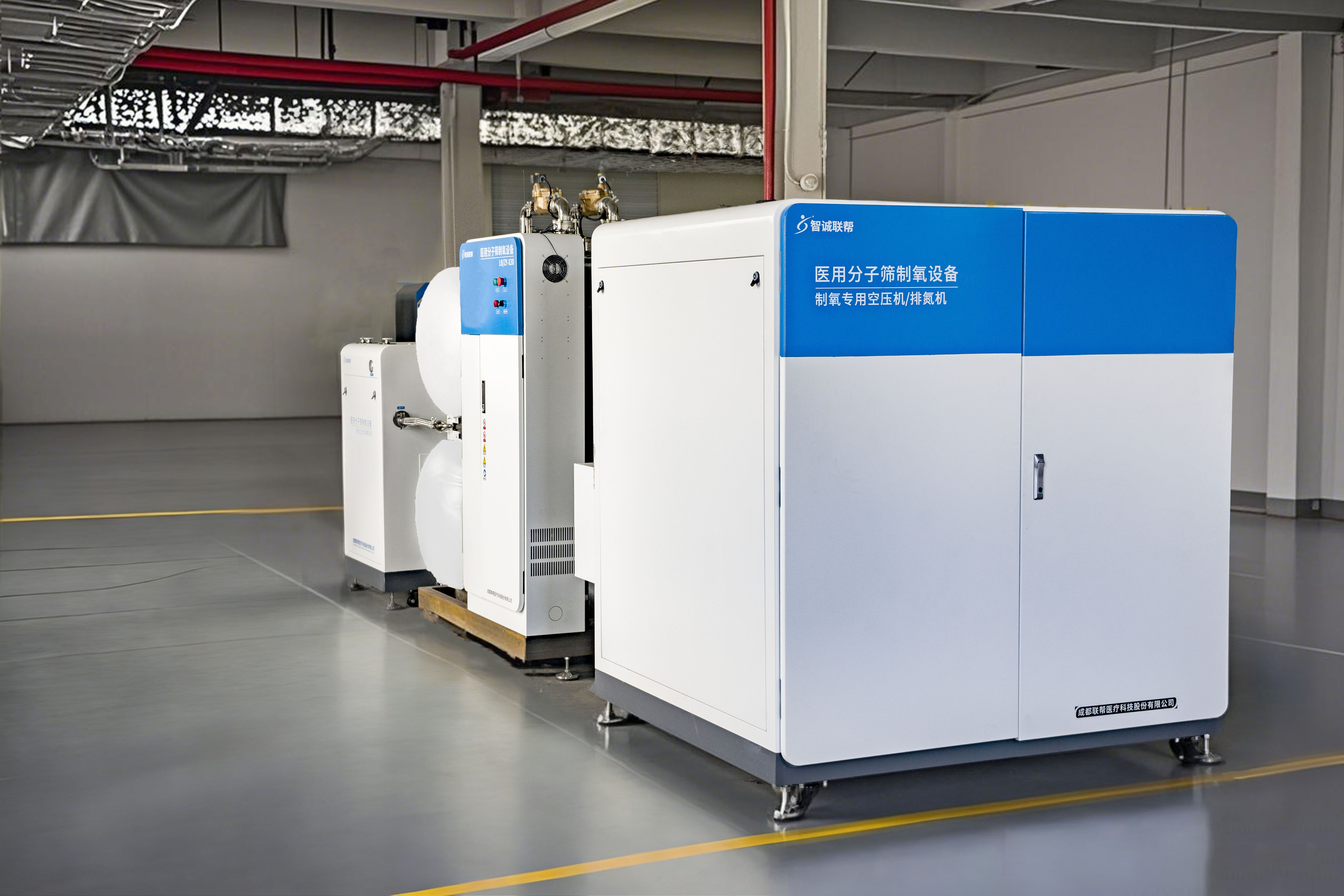
- Large hospital systems. The LBYL 5th-generation VSA Medical Oxygen Generator is documented at 0.6–0.75 kWh/Nm³ at O₂ 93%±3% per ISO 10083. Within the same platform, the LBYL X Series VSA records lower figures: the X15 at 0.48–0.55 kWh/Nm³, X20 at 0.48–0.55 kWh/Nm³, X30 at 0.48–0.60 kWh/Nm³, X40 at 0.50–0.62 kWh/Nm³, X50 at 0.50–0.65 kWh/Nm³ and X60 at 0.55–0.67 kWh/Nm³, with oxygen purity of 93±3% and outlet pressure of 0.3–0.5 bar across all models. The published range for the series is therefore 0.48–0.67 kWh/Nm³.
- Small and medium hospitals. The LBYL Y/D Series VSA, positioned for 50–100 bed facilities, is documented at energy consumption below 1.32 kWh/Nm³ for the D7.5 (7.5 Nm³/h) and below 1.2 kWh/Nm³ for the D10 (10 Nm³/h), with oxygen concentration of 90%–96% and outlet pressure of 4–8 bar.
- Clinics and low-demand sites. The LBYL M Series Modular VPSA configures 1–10 modules for total output of 10–100 L/min (0.6–6 Nm³/h). Documented module ratings run from 10LA at 1.1 kW to 100LA at 6.5 kW, with each module rated at 10 L/min.
- Compact station construction. The Second-Generation Low-Pressure Oil-Free Single Tower Oxygen Production Equipment is documented at below 1 kWh per Nm³ of oxygen under standard state, operating with output compressed air below 0.1 MPa and vacuum desorption to release nitrogen completely from the molecular sieve.
The pattern is consistent: consumption per cubic meter falls as system scale rises, and the low-pressure, vacuum-desorbed platforms occupy a materially lower band than legacy high-pressure PSA designs.
The Maintenance Half of the Efficiency Equation
Energy consumption is only one component of total ownership cost. The LBYL 5th-generation platform documents monthly maintenance below USD 280, with molecular sieve service life of 10 years or more under a vacuum oil-free environment, compared with the 2–3 year sieve life associated with conventional PSA systems. The mechanism cited in the source material is the replacement of complex piping by an electropneumatic control system and an intelligent rotary valve that replaces 80% of pipelines, alongside three key components that reduce maintenance cost by 80%. Molecular sieve life is described as extended by 5 times, and the cumulative 10-year total cost of ownership saving is stated as over USD 318,000 based on a 30 m³/h comparison.
The upstream enabler is the air suspension bearing compressor, which uses 100% oil-free technology requiring no oil for life. Removing oil from the air path is what protects the sieve bed; protecting the sieve bed is what keeps consumption and maintenance low over a decade rather than a two-to-three-year cycle. In that sense, the efficiency comparison and the reliability comparison are the same analysis viewed from two angles.
Operating Conditions That Affect Real-World Efficiency
Manufacturer figures assume controlled conditions. The variables that most often change measured performance are altitude, ambient temperature and duty cycle. LBYL documents the X Series as verified for stable operation at altitudes over 5,500 m, with containerized VSA solutions adaptable to climates from -30°C to +50°C and verified for operation up to 5,500 m. Independent operational records cited in the source material include a government project above 4,300 m in use since 2016, and VSA systems running continuously for over 13 years at a 4,500 m plateau. Average noise across the VSA range is documented below 76 dB(A) depending on series.
Practical Criteria for Hospital Comparison
When healthcare organizations compare low pressure VSA options, five criteria tend to separate credible proposals from optimistic ones: documented consumption per Nm³ at the stated oxygen purity and the applicable standard; the certified service life of the molecular sieve and the mechanism that protects it; the number of wear components and the published maintenance cycle; verified performance at the site’s actual altitude and climate; and total cost of ownership projected over at least ten years rather than first-installation price. LBYL’s own delivery model — standard oxygen room installation, containerized VSA and high-pressure cylinder filling — supports all three deployment paths, with installation documented as completed in 30 minutes or less for skid-mounted configurations.
Conclusion
Low pressure VSA oxygen technology shifts the efficiency comparison away from compressor horsepower and toward the whole system: oil-free compression, vacuum desorption, sieve longevity and maintenance design. For hospitals weighing the investment, the decisive figures are measurable — 0.48–0.67 kWh/Nm³ for large-scale X Series units, below 1 kWh per Nm³ for the single-tower platform, sieve life beyond 10 years, and maintenance cost reductions of 80%. Organizations such as Chengdu Lianbang Medical Technology Co., Ltd., holding ISO 9001, ISO 13485, ISO 14001 and ISO 45001 certifications alongside IEC 60601 series test reports and CE marking, illustrate how a manufacturer with 29 years of medical gas engineering experience and a 30,000 m² R&D and production base approaches that equation. Buyers who request documentation on those five criteria — consumption, sieve life, component count, altitude verification and ten-year cost — will find the comparison considerably more decisive than a specification sheet alone.
https://www.lbylmedical.com
Chengdu Lianbang Medical Technology Co., Ltd. -
AuthorPosts

- You must be logged in to reply to this topic.