

- This topic is empty.
-
AuthorPosts
-
2026-10-27 at 6:13 pm #12853
Short answer. A beer glass bottle filling and sealing machine is specified on oxygen, not on speed. Three numbers decide whether the line is worth its price: the total package oxygen it can hold at your bottle size, the fill height tolerance it can hold while achieving that oxygen figure, and the crown crimp consistency it delivers on the bottle finish you actually use. Capacity comes fourth, because a brewery that sizes from annual volume rather than from batch size usually buys a machine that spends most of its life stopped.
Everything else, including frame design, control platform and enclosure, is a consequence of those four answers.
At a Glance
· Product family: glass bottle filling for CSD, beer and sparkling drinks
· Filling principle: isobaric, meaning counter-pressure filling
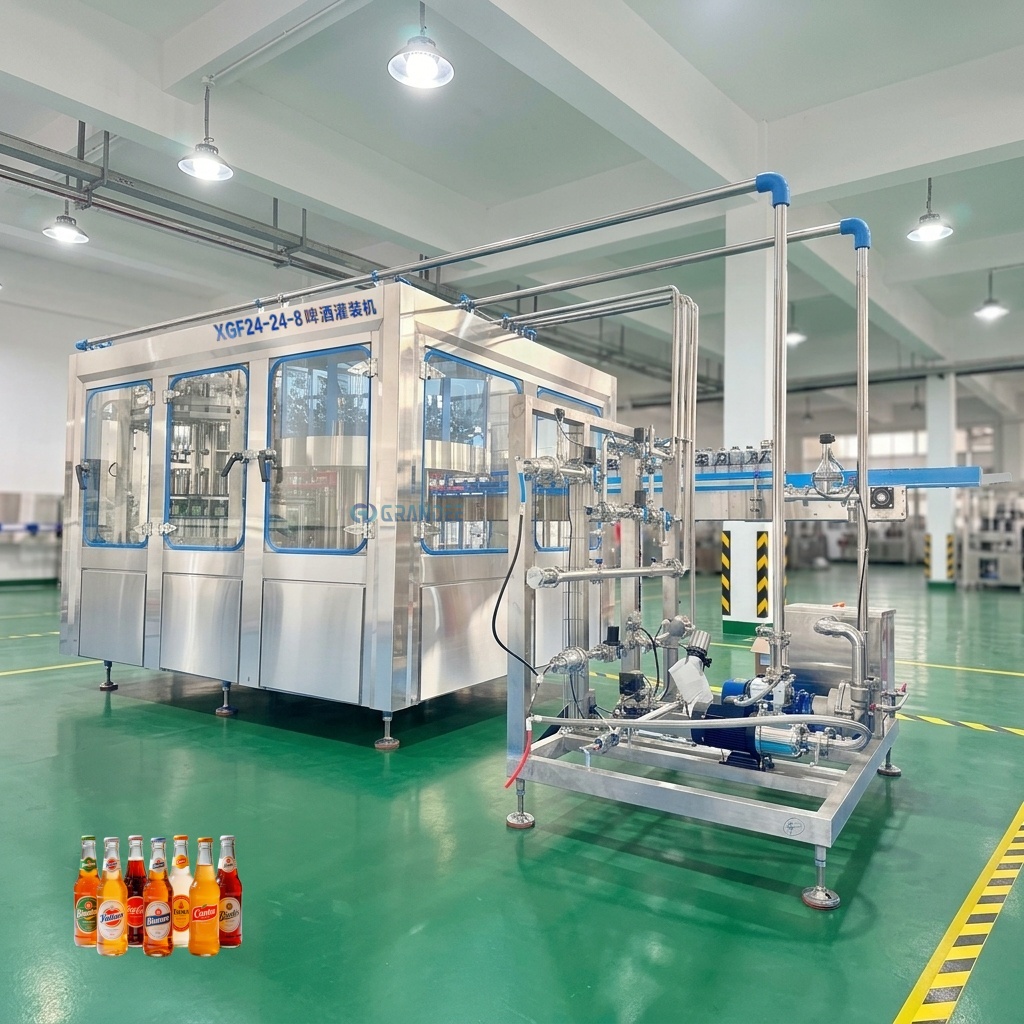
· Listed machine formats: a beer filling and capping machine, a 3-in-1 washing, filling and capping machine, and a separate glass bottle washing machine
· Listed outputs: glass bottle washer at 8,000 BPH; DXGF24-24-8 carbonated beverage line
· Closure format: crown cap
Oxygen Is the First Specification, Not Speed
Beer is more oxygen-sensitive than any other beverage this equipment handles, and the metric that matters is total package oxygen: dissolved oxygen in the beer plus oxygen in the headspace, measured after the crown is applied.
Three points on a filling line add to that number or take away from it.
1. Air in the bottle before filling. A bottle that enters the filler full of air has to have that air displaced, not diluted. High-end beer fillers use vacuum or CO2 pre-evacuation before counter-pressure for exactly this reason.
2. Oxygen pickup during the fill. Counter-pressure filling with CO2 covers this, provided the bowl has been properly purged and the CO2 supply is of adequate purity.
3. Headspace air at crowning. This is where most of the residual oxygen is decided, and it is the point most often left unaddressed in a quotation.
Ask a supplier what total package oxygen the line is guaranteed to achieve at your bottle size, and how it is measured. A supplier who answers in ppb with a stated test method has engineered beer lines before. A supplier who answers “low oxygen” has not.
What Isobaric Filling Actually Solves
Isobaric means equal pressure. The bottle is pressurized to the same level as the product in the filler bowl before the valve opens, so CO2 stays dissolved during the fill.
Without it, pressure drops as beer enters the bottle, CO2 breaks out as foam, and the result is short fills, variable carbonation, and beer foaming out of the neck before the crown goes on.
The practical consequence is that bowl pressure must be set from two variables acting together: the CO2 specification you want in the package, and the temperature of the beer at the filler. Higher temperature requires higher pressure to hold the same CO2. A line commissioned at one temperature and run at another will produce inconsistent carbonation even though nothing on the machine has changed.
That is worth stating as a question rather than an assumption. Ask how bowl pressure is controlled at the machine, and whether it tracks product temperature automatically or depends on the operator resetting it between batches.
Foam Is Both the Problem and the Tool
Most buyers treat foam as a defect. On a beer line it is also a process instrument.
Controlled foam is how headspace air gets displaced. After the fill, a small foam rise is deliberately allowed. When the crown is applied, that foam collapses back into the headspace, and the volume that would have held air holds CO2 instead. Suppress foam completely and oxygen pickup rises, which is why a machine tuned for a clean fill can be worse for shelf life than one that looks messier.
Too much foam fails in the opposite direction. Fill heights vary, beer is lost over the valve, and the capping station gets wet, which is where crown corrosion starts.
So the question is not whether the machine foams, but whether foam is controllable at three points:
· Fill rate profile. Fast then slow, or slow then fast, and where the switch point sits.
· Settle time between filling and crowning.
· Crowning timing, meaning whether the head applies while the foam is still rising.
Ask for fill height tolerance at your bottle, and for the oxygen figure measured with that tolerance in place. The two move against each other and should always be quoted together.
Matching the Bottle Washer to the Filler
For returnable glass, the washer is not an accessory. It is the constraint.
Two numbers have to line up. Washer output must at least match filler output, or the filler starves. The 8,000 BPH glass bottle washer listed in this product family sets that ceiling for the line, so a faster filler needs either a larger washer or buffer capacity between the two.
The second number is bottle exit temperature. Warm bottles entering the filler cause CO2 breakout at the valve, which produces exactly the foaming problem described above. Ask what bottle temperature the washer delivers and whether the conveyor between washer and filler is covered or open to the hall.
One distinction is worth settling early, because buyers frequently conflate the two: a 3-in-1 glass bottle machine normally combines rinsing, filling and capping on a single frame. That is a rinse, not a caustic wash. Returnable bottles that need caustic cleaning and label removal still pass through a tunnel washer upstream. Confirm which of the two is being quoted, since they solve different problems and price very differently. Both sit inside the glass bottle filling range for CSD, beer and sparkling, alongside the wine and carbonated beverage formats.
Crown Seal Quality Is a Dimensional Question
A crown seals by deformation, not by torque. The crimping head rolls the skirt of the crown into the bottle finish, and the seal depends on the crimp dimensions matching that specific finish.
Three things go wrong, and all three are measurable.
1. Crimp diameter. Out of tolerance means the crown either leaks under pressure or cannot be removed cleanly by the consumer.
2. Bottle finish damage. A chipped or worn lip on a returnable bottle will leak no matter how well the crown is applied. This is why empty bottle inspection before the filler is not optional on a returnable line.
3. Application timing. Crowning should happen while the beer is still foaming, for the oxygen reason above. A long conveyor between filler and crowner defeats that, however good either machine is on its own.
Ask what crimp dimension the machine targets, what the tolerance is, and how the brewery is expected to verify it. A go/no-go gauge and a pull-off test are the usual methods, and a supplier who can describe both has thought about the handover.
Sizing the Line to Your Batch, Not Your Annual Volume
Annual hectoliters is the wrong input for sizing a filler, especially at craft scale. The binding constraint is the batch.
A fermenter holds a fixed volume and the beer in it has a limited window before quality drifts. The filler has to empty that tank inside the window, which sets a minimum output.
A 20 hectoliter batch is 2,000 liters. At 330 ml per bottle that is roughly 6,060 bottles. To empty the tank in four hours the line needs about 1,515 bottles per hour. The same tank on a machine rated at 15,000 BPH would be empty in 24 minutes, which no packaging hall can actually support, so the extra capacity is unusable on small batches and the money is better spent elsewhere.
Two consequences follow. First, bottle size changes the answer, because BPH counts bottles while tank capacity is measured in liters: the same line runs fewer liters per hour in 750 ml than in 330 ml. Second, a brewery packaging several batch sizes needs either a filler matched to the smallest batch or buffer tank capacity downstream.
If the packaging format is still open, the can filling line option removes bottle washing entirely and is worth comparing before committing to glass.
Ask a supplier to size the line from your smallest batch and your tank emptying window, rather than from installed capacity or a target market.
Questions to Put to Any Supplier
1. What total package oxygen will this line hold at my bottle size, and how is it measured.
2. Does the filler use vacuum or CO2 pre-evacuation before counter-pressure.
3. How is bowl pressure set, and does it compensate automatically for beer temperature.
4. What fill height tolerance applies at my bottle, and what oxygen figure goes with it.
5. What is the fill rate profile, and where is the fast-to-slow switch point.
6. What crown crimp dimension does the head target, and what is the tolerance.
7. What bottle temperature does the line expect from the washer, and is the conveyor covered.
8. What is the manning requirement per shift at my output, and which stations need attendance.
A supplier who answers all eight in specifics has commissioned beer lines before. A supplier who answers in adjectives has quoted one.
Frequently Asked Questions
Why is isobaric filling necessary for beer?
Because beer holds dissolved CO2 under pressure, and any drop in pressure during filling lets that CO2 break out as foam. Isobaric filling pressurizes the bottle to the same level as the product in the bowl before the valve opens, so the pressure across the valve stays balanced and the CO2 stays in solution. Without it, the result is foam in the bottle, short fills and inconsistent carbonation.
What is total package oxygen and why does it matter more than fill speed?
Total package oxygen is the sum of dissolved oxygen in the beer and oxygen in the headspace, measured after capping. It is the number that determines how long the beer holds its flavor, and every point in the filling line either adds to it or removes it. Fill speed affects how much beer the line can produce; total package oxygen affects whether that beer is still good when it reaches the customer. For beer, the second question is the more expensive one.
Can one machine fill and cap in a single unit?
Yes, and this product family includes both formats: a beer filling and capping machine, and a 3-in-1 machine that combines washing, filling and capping on one frame. The 3-in-1 format reduces handling between stations, but the washing stage in that configuration is a rinse rather than a caustic wash, so returnable bottles still need a tunnel washer upstream.
What is the difference between a 3-in-1 machine and a separate washer plus filler?
A 3-in-1 machine puts rinse, fill and crown on one frame, which shortens the line and removes one transfer. A separate washer plus filler allows a full caustic wash cycle for returnable bottles and lets each unit be sized independently, at the cost of floor space and a conveyor between the two. Producers using single-trip bottles lean toward the integrated format, while returnable operations usually need the separate washer regardless.
How do I know what output I need?
Start from the smallest batch you will package, not from annual volume. Divide the batch volume by the bottle size to get the bottle count, then divide by the hours you have available to empty the tank. A 20 hectoliter batch in 330 ml bottles is about 6,060 bottles, which needs roughly 1,515 bottles per hour to clear in four hours. Size the line to that number and treat larger outputs as a separate decision.
Next Step
The two documents worth asking for before a site visit are the oxygen test method with the figures it produces, and a fill height and crown crimp inspection procedure. Neither appears in a brochure, and both determine whether the line performs in your brewery rather than in a demonstration.
Send your bottle drawing, batch sizes, target CO2 specification and available floor area to Grandee Machine at info@grandeemachine.com and ask for those two documents plus a CIP system proposal covering the filling and capping stations.
https://www.grandeemachine.com/
Zhangjiagang Grandee Machinery Co., Ltd. -
AuthorPosts

- You must be logged in to reply to this topic.