

- This topic is empty.
-
AuthorPosts
-
2026-11-16 at 7:37 pm #13664
Why Standard Battery Packs Often Fail Professional Handheld Instruments
Professional handheld instruments—used across industrial inspection, field diagnostics, measurement, and specialized tooling—place unusual demands on their power source. Unlike consumer electronics, these devices typically combine strict size constraints, defined peak-current needs, specific connector and cable-routing requirements, and long operational life expectations. A generic, off-the-shelf battery pack rarely satisfies all of these simultaneously, which is why many equipment manufacturers eventually look toward a custom battery pack approach instead of adapting their product design around a pre-made cell.
This is an industry-wide pain point: many B2B customers cannot utilize generic battery packs because their devices have highly specific requirements for voltage, capacity, load current, BMS (Battery Management System) functions, cell chemistry, physical dimensions, connectors, and environmental safety certifications. For handheld instruments in particular, compact form factors and precise cable positioning make the mismatch between "available" and "needed" especially acute.
Understanding the Core Challenge: System Integration, Not Just Specs
A battery is not an isolated component—it is an integral part of the instrument’s entire operating system. Shanghai Mylion New Energy Co., Ltd., operating under the brand MYLION, approaches battery development from this systemic perspective: evaluating the real load, the charging source, the BMS functions, the mechanical interfaces, and the production constraints of the target device, rather than treating voltage or capacity figures in isolation.
For handheld instruments, this systemic view matters because several variables interact at once:
- Compact Device Integration: The instrument’s housing, cable position, and mounting points must be reviewed as a unified assembly task, not solved after the battery is chosen.
- Current Matching: Continuous and peak current draw from sensors, displays, or motors must be matched precisely to avoid BMS trips or voltage drops during operation.
- Cell Format Selection: Depending on the instrument’s internal geometry, 18650, 21700 cylindrical cells, or LiPo pouch formats may each offer different trade-offs in space efficiency and shape flexibility.
This is precisely the type of challenge that MYLION’s engineering-driven model was built to address.
MYLION’s Engineering-Driven Approach to Custom Battery Packs
With over 13 years of lithium battery industry experience, MYLION has evolved from standard battery-pack supply into a structured custom-battery engineering model. This evolution emphasizes requirement definition, sample validation, and controlled specifications—stages that are particularly relevant for professional handheld instruments, where a single overlooked variable (such as peak-load timing or connector pinout) can derail an entire product launch.
Requirement Engineering as the Starting Point
Rather than beginning with a catalog of pre-built packs, MYLION’s process starts with requirement engineering: the scenario-based conversion of device inputs into reviewable technical specifications. This step directly addresses a common failure mode in the industry—incomplete or conflicting requirements regarding peak load, runtime, BMS functions, or mechanical structure, which can lead to project failure if not resolved early.
System Matching Across Battery, BMS, Charger, and Structure
For handheld instruments, MYLION integrates the battery, BMS, charger, and mechanical structure as a single system rather than as separate purchasing decisions. This includes:
- Custom Voltage and Capacity Definition matched to approved requirements rather than nearest-available standard values
- Chemistry Selection, including LiFePO4, 18650/21700 cylindrical cells, or LiPo architectures, based on the specific project conditions
- BMS Matching, covering balancing, monitoring, and protection functions appropriate to the instrument’s usage profile
- Connector and Interface Customization, ensuring chargers, cables, and pinouts align with the device’s existing design
- Mechanical Integration, covering enclosure, mounting, and insulation design specific to the handheld form factor
Risk Control Before Mass Production
Before any specification moves to mass production, MYLION identifies technical blockers and validation needs in advance. For cylindrical or LiPo custom packs—relevant for compact handheld instruments with strict shape or cable-routing constraints—this includes final specification control, where the design is frozen and subject to change-control procedures prior to scale-up.
Why This Matters for Industrial Equipment and Professional Instruments
MYLION’s case experience with industrial equipment is directly relevant to the handheld instrument category. The company has provided stable output and robust connectors for professional instruments specifically to prevent BMS trips and voltage drops—two of the most common and costly failure points when a generic battery is forced into a specialized device. In related smart-device and robotics applications, MYLION has also addressed integration into limited space supporting sensors and motors, resolving risks tied to peak-current and thermal constraints—considerations that carry over directly to handheld instrument design.
Service Models Built Around Project Realities
MYLION supports multiple delivery paths suited to different stages of a handheld instrument program:
- OEM and ODM development for manufacturers building new product lines
- Sample development for validating a design before committing to volume
- Private label supply for brands seeking packs under their own identity
- Project-based custom supply with version-controlled bills of materials (BOMs) and repeat-order coordination for established products
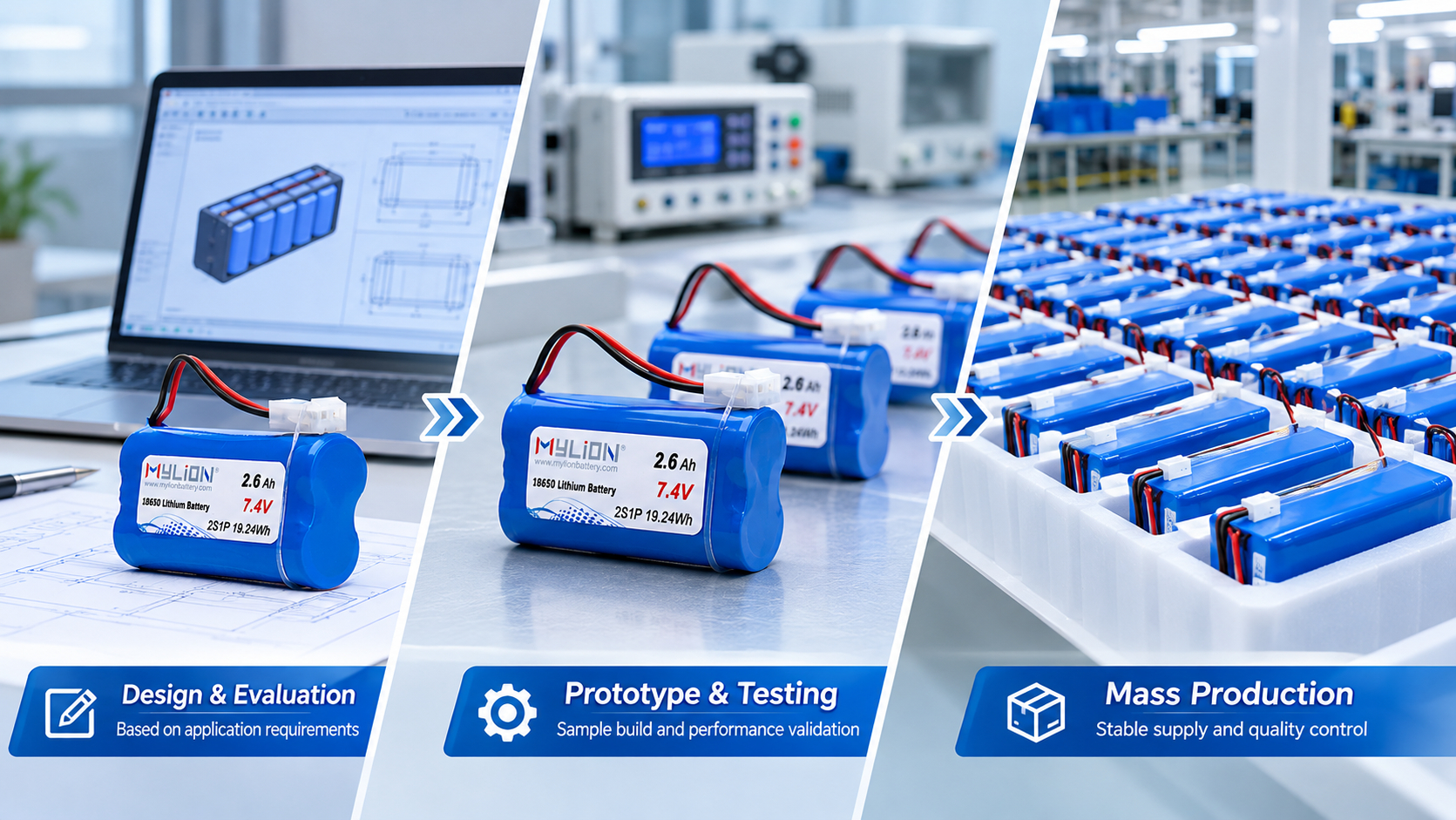
Each engagement follows a staged path: requirement confirmation, feasibility review, solution definition, prototype development, testing support, specification approval, and mass-production coordination. This structure is intended to reduce selection errors, thermal issues, and certification delays—outcomes that are especially costly for handheld instruments used in professional or field settings where reliability is non-negotiable.
Documentation and Compliance Considerations
For handheld instruments destined for global markets, transport and safety documentation cannot be an afterthought. MYLION supports UN38.3 transport documentation and provides MSDS/SDS (Safety Data Sheets) as part of its project-specific technical documentation control, helping equipment manufacturers avoid downstream certification delays.
A Practical Path Forward for Equipment Manufacturers
For companies developing professional handheld instruments, the decision to pursue a custom battery pack rather than a generic alternative often comes down to risk management: avoiding mismatched current ratings, incompatible connectors, oversized enclosures, or BMS behavior that doesn’t suit real-world operating conditions. MYLION’s positioning as an engineering-driven B2B lithium battery solution provider—prioritizing technical integration over low-price retail sales—reflects an approach built specifically for this kind of project complexity.
Pricing is handled on a project basis following technical requirement confirmation and feasibility review, reinforcing that each handheld instrument battery solution is treated as a distinct engineering task rather than a commodity purchase. For manufacturers weighing their options, understanding this system-level approach—covering chemistry, BMS, mechanical fit, and documentation together—offers a clearer framework for evaluating whether a custom battery pack partner like MYLION aligns with their project’s technical and commercial needs.
Shanghai Mylion New Energy Co.,Ltd. -
AuthorPosts

- You must be logged in to reply to this topic.