

- This topic is empty.
-
AuthorPosts
-
2026-11-24 at 5:55 pm #13979
Understanding the Cable Cutter Market: What Buyers Need to Know
Choosing the right cable cutter for electrical construction, outdoor maintenance, or telecommunication cable work is not a simple decision. Job sites vary widely in available power sources, cable diameters, and material types, and the wrong tool choice can slow down work or compromise operator safety. This guide examines the core categories of cable cutters available today, the technical factors that matter most, and how buyers can match a tool to their specific working conditions, drawing on the product and technology data published by iGeelee, a power tool manufacturer specializing in cable cutting, crimping, and punching equipment.
Why Cable Cutter Selection Matters
Manual cutting of copper, aluminum, and armored cable is labor-intensive and time-consuming, particularly as cable diameter increases. This is one of the central pain points driving demand for powered cutting solutions. At the same time, job sites differ in whether continuous power is available, whether a battery can be charged and maintained, and whether operators need a lightweight tool for overhead or confined-space work. Understanding these variables is the first step in any buying decision.
Core Categories of Cable Cutters
Battery Cable Cutters
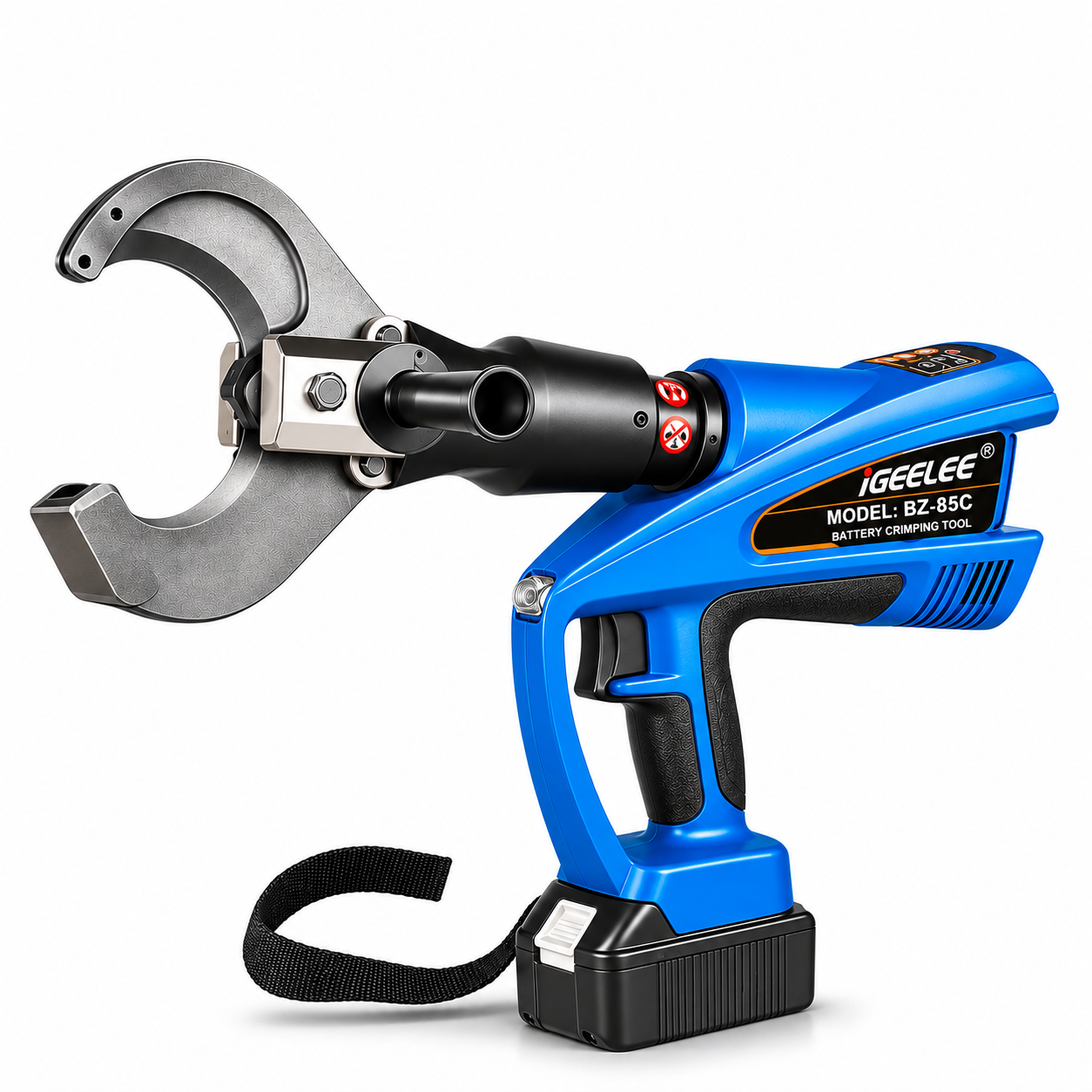
Battery-powered hydraulic cutters are designed for portability and speed in electrical construction and outdoor work where a power cord is impractical. iGeelee’s battery cable cutter line, including the BZ series (BZ-65C, BZ-85C, BZ-105C), the ED series (ED-45, ED-85), the EZ-105, and the PZ-20, covers cutting ranges from 45mm up to φ105mm, with cutting force options between 60KN and 120KN depending on model. These tools rely on MCU-controlled hydraulic systems that automatically detect pressure, apply double safety protection, and reset the piston after each cut. Several models in this line, such as the BZ-65C and BZ-85C, complete a cutting cycle in 3–8 seconds, which directly reduces job-site labor time. For buyers prioritizing speed and reduced manual effort, battery cable cutters are generally the strongest fit, provided the work site allows for battery charging and management.
A key consideration within this category is display and diagnostic capability. Models such as ED-45, ED-85, EZ-105, and PZ-20 feature OLED displays that show cutting counts, battery power, working pressure, maintenance reminders, and fault codes, while the BZ series uses LCD displays for similar data along with a USB port for computer data exchange. Buyers who need usage tracking or diagnostic history should weigh these display and connectivity differences when comparing models.
Hydraulic Cable Cutters
For job sites without battery power, manual or pump-driven hydraulic cable cutters remain a practical option. iGeelee’s CPC series (CPC-65C, CPC-85C, CPC-105C, CPC-120C) connects to an external hydraulic pump through a quick coupler, delivering 60KN to 120KN of cutting force depending on model, with cutting ranges extending up to 120mm for copper/aluminum cable and 100mm for armored cable. These tools use a high-pressure hydraulic design with Shell Tellus T15# hydraulic oil and are packaged in steel boxes for job-site transport.
A related but distinct product, the THC-20, is a fully manual hydraulic cable cutter that requires no external pump. It provides 60KN cutting force and 63MPa rated pressure, weighs 2.9kg, and measures 355mm in length, making it suitable for field handling of steel rope, mild iron rod, rebar, copper stranded wire, aluminum wire, armored cable, ACSR, and steel wire. This option is particularly relevant for buyers who need a self-contained hydraulic tool without any power source at all.
Ratchet Cable Cutters
Where neither battery nor hydraulic pump access is available, mechanical ratchet cable cutters offer a labor-saving, fully manual alternative. The J75, J95, and J130 models use forged alloy steel blades with special heat treatment and a reciprocating handle mechanism to reduce cutting effort. The J75 weighs 3.5kg, the J95 weighs 5.7kg, and the J130 extends cutting capacity up to Ø130mm for copper/aluminum and armored cable. These tools are suited to electrical engineering construction and telecommunication cable work where simplicity and durability take priority over cutting speed.
Multi-Function Options for Broader Job Requirements
Some field tasks require more than cutting alone. The ED-60UNV is a battery-powered multi-functional hydraulic tool that combines cutting of copper/aluminum and armored cable, crimping of copper and aluminum conductors, and punching of mild steel in a single unit. Per charge, it supports approximately 70 cutting operations, 160 crimping operations, or 100 punching operations, and includes punch and die sets for conduit sizes from 1/2″ to 2″ along with crimping dies covering 16mm² to 300mm². For workshops or construction teams managing multiple tasks, this reduces the need to carry and maintain separate tools.
At a larger scale, the THP-120 multi-function hydraulic machine combines cutting, punching, and bending in one unit, supporting both handle operation and electrical pump operation. It handles bending up to 12mm thickness, cutting of brass up to 12mm, aluminum up to 15mm, and steel up to 5mm, with a 15T working force and 100mm stroke. This is positioned for metalworking and electrical construction workshops rather than handheld field use.
Key Technical Factors to Evaluate Before Purchase
When comparing cable cutters, buyers should consider several factors beyond cutting force alone:
Cutting range and material compatibility: Confirm the tool’s rated diameter matches the cable types on site, whether copper/aluminum, armored cable, or telecommunication cable.
Power source availability: Battery tools suit sites with charging infrastructure; hydraulic pump-driven tools suit sites with existing pump equipment; manual hydraulic and ratchet tools suit sites without any power access.
Safety features: MCU-controlled systems with automatic pressure detection, temperature sensors that stop operation above 60°C, and automatic pressure release reduce operator risk during repeated use.
Diagnostic and maintenance support: Displays showing fault codes and maintenance reminders help teams plan upkeep and reduce unplanned downtime.
Service and Warranty Considerations
Warranty terms also factor into total cost of ownership. iGeelee’s product lines carry warranty terms of 1 year or 2 years depending on the product line, with a 90-day warranty period for professional contractor use or rental equipment. Service support includes pre-use inspection guidance, cleaning, oil change, and rust prevention instructions, battery charging and storage guidance, and troubleshooting support for hydraulic, battery, blade, and sealing kit issues, with repair or replacement handled through the manufacturer or distributor.
Conclusion
Selecting a cable cutter comes down to matching power availability, cable diameter, and task complexity to the right product category. Battery cable cutters suit fast, cordless operation; hydraulic cutters suit sites with pump access or fully manual needs; ratchet cutters suit power-free environments; and multi-function tools reduce equipment load for teams handling cutting, crimping, punching, or bending in a single workflow. Reviewing the technical specifications, safety features, and service terms outlined above provides a structured framework for making an informed purchase decision.
http://www.isiltools.com
NANJING IGEELY TOOLS CO.,LIMITED -
AuthorPosts

- You must be logged in to reply to this topic.