

- This topic is empty.
-
AuthorPosts
-
2026-04-17 at 2:47 pm #7366
In today’s electronics manufacturing industry, precision tools are no longer optional—they are essential. As electronic components continue to shrink in size and increase in sensitivity, even a tiny electrostatic discharge (ESD) can cause serious and often irreversible damage.
This is why ESD plastic tweezers have become a standard tool in PCB assembly, semiconductor processing, and microelectronics repair environments. They provide a safe, controlled, and anti-static solution for handling delicate components without risk.
Why Electrostatic Discharge Is a Serious Problem
Electrostatic discharge occurs when static electricity suddenly flows between two objects with different electrical charges. While it may seem harmless in daily life, in electronics manufacturing it can be extremely destructive.
Even a discharge of just a few volts can lead to:
-
Permanent damage to integrated circuits
-
Latent defects that appear after product use
-
Reduced lifespan of electronic components
-
Signal instability in sensitive circuits
Because of this, controlling static electricity is a critical requirement in all precision electronics environments.
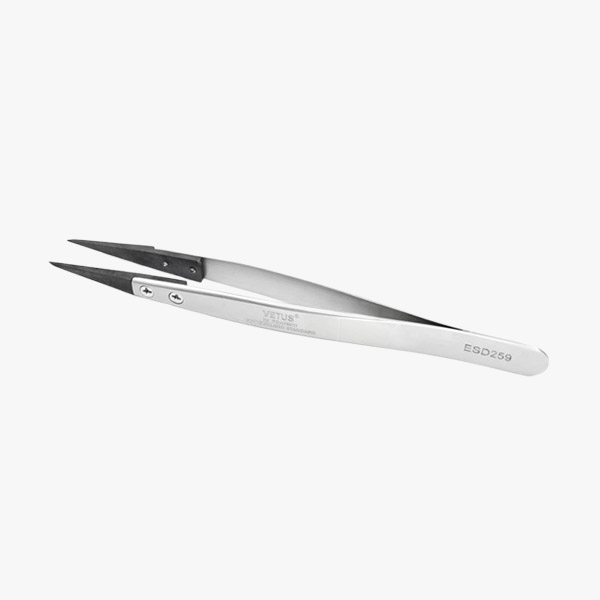
What Makes ESD Plastic Tweezers Different
Unlike standard metal tweezers, ESD plastic tweezers are made from specially engineered anti-static materials that safely dissipate electrical charges.
This design ensures that static electricity does not accumulate or transfer to sensitive electronic parts during handling.
Key advantages include:
-
Anti-static performance for safe operation
-
Non-conductive structure to prevent sudden discharge
-
Stable handling of sensitive micro-components
Advanced Material Design for Precision Work
The performance of ESD tweezers largely depends on the materials used in their construction. High-quality models often use engineered polymers with controlled surface resistivity to ensure consistent anti-static behavior.
In many professional-grade designs, PPS (polyphenylene sulfide) is used for the tips due to its:
-
Excellent thermal resistance
-
Strong mechanical durability
-
Stable anti-static properties
-
Long service life under repeated use
This combination ensures both precision and reliability in demanding environments.
The Importance of Replaceable Tip Design
One of the most practical innovations in modern ESD tweezers is the replaceable tip system.
Instead of replacing the entire tool when the tip wears out, users can simply replace the working end. This offers several benefits:
-
Maintains high precision over time
-
Reduces long-term tool costs
-
Extends overall tool lifespan
-
Allows flexibility for different applications
In precision electronics assembly, even slight tip wear can affect accuracy—making this feature especially valuable.
How ESD Tweezers Protect Sensitive Components
ESD plastic tweezers protect electronic components through several mechanisms:
1. Controlled Static Dissipation
They gradually release static charges instead of allowing sudden electrical discharge.
2. Electrical Isolation
Their non-metal structure prevents direct conductive pathways between the operator and the component.
3. Optimized Surface Resistance
The material is designed to maintain safe resistance levels that prevent both charge buildup and sudden discharge.
4. Reduced Friction Charging
Smooth surface finishing helps minimize static generation during use.
Applications in Electronics Manufacturing
ESD plastic tweezers are widely used in:
PCB assembly and repair
Semiconductor handling
Microelectronics production
Laboratory testing environments
Precision instrumentation maintenance
In all these fields, static protection and handling accuracy are critical to product quality.
Ergonomics and Practical Design
Beyond anti-static performance, modern ESD tweezers are designed with user comfort in mind.
Typical ergonomic features include:
Lightweight structure for long-term use
Non-slip grip for better control
Balanced tension for precise handling
Fine-tipped alignment for accuracy
These improvements help reduce operator fatigue while increasing productivity.
Durable Stainless Steel + ESD Tip Hybrid Design
Some advanced models combine a stainless steel body with replaceable ESD-safe plastic tips. This hybrid structure offers the best of both worlds:
Stainless steel body: strength and durability
ESD plastic tips: safe contact with sensitive components
This makes them ideal for industrial environments requiring both precision and long-term reliability.
Conclusion
ESD plastic tweezers are an essential tool in modern electronics manufacturing. By combining anti-static materials, precision engineering, and ergonomic design, they ensure safe handling of sensitive components and help prevent costly damage.
As electronic devices continue to become smaller and more complex, the importance of reliable ESD protection tools will only continue to grow.
http://www.vetustools.com
VETUS Tweezers -
-
AuthorPosts

- You must be logged in to reply to this topic.