

- This topic is empty.
-
AuthorPosts
-
2026-05-09 at 3:53 pm #7840
In modern manufacturing, ultrasonic welding has become a core joining technology for high-volume plastic assembly. Among its configurations, the Double head 15K 4200W ultrasonic welding machine is specifically engineered for high-throughput production environments where cycle time reduction, weld consistency, and structural integrity are critical performance drivers.
Unlike single-head systems that operate sequentially, a double-head configuration enables parallel energy delivery, effectively doubling productivity while maintaining controlled weld quality under stable acoustic conditions.
This article provides an engineering-focused analysis of system architecture, acoustic performance, process parameters, and real-world industrial applications of the Double head 15K 4200W ultrasonic welding machine.
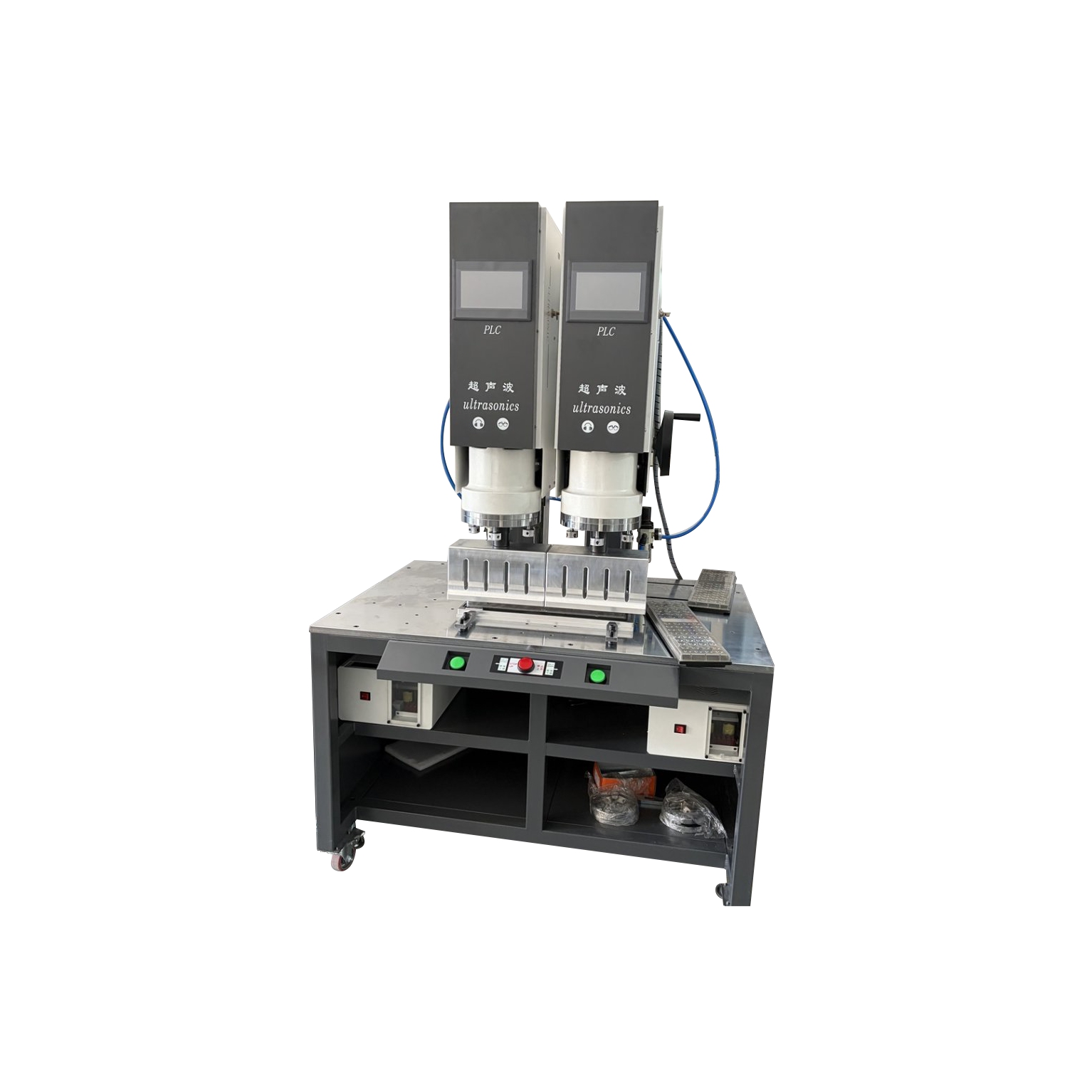
Understanding the Working Principle of 15K Ultrasonic Welding Systems
Ultrasonic welding operates by converting high-frequency electrical energy into mechanical vibration through a transducer system. In a 15KHz system, this vibration is transmitted through a horn (sonotrode) into thermoplastic materials.
At the interface of two plastic parts, high-frequency micro-friction generates localized heat, causing molecular chain disruption and fusion bonding.
The key process stages include:
Energy conversion from electrical to mechanical vibration
Amplitude amplification through booster and horn system
Interfacial frictional heating at weld joint
Molecular re-solidification under pressureThe 15KHz frequency range is particularly suitable for medium to large plastic components due to its higher amplitude capability compared to 20KHz systems.
Why Double Head Configuration Changes Production Dynamics
The defining advantage of the Double head 15K 4200W ultrasonic welding machine lies in its dual independent welding heads operating on a synchronized control platform.
Each head can function:
Simultaneously on identical parts for parallel production
Or independently on different geometries within a single cycleThis architecture significantly reduces takt time in high-volume production lines.
In practical industrial environments, cycle time reduction typically ranges from 30% to 55% depending on part geometry and fixture design.
More importantly, the dual-head system ensures that energy distribution remains stable even under continuous load conditions, reducing thermal drift that often affects single-head machines in long production runs.
Power System Architecture: 4200W Energy Delivery Control
The 4200W power rating defines the energy capacity available for ultrasonic conversion.
However, real performance depends not only on total wattage but on how energy is distributed across the system.
Key power system components include:
High-frequency generator with closed-loop frequency tracking
Dual independent amplitude control modules
Load-adaptive power compensation system
Thermal protection and overload regulation circuitIn industrial applications, stable power output ensures consistent weld strength across production batches.
Voltage fluctuation or insufficient power regulation can result in:
Incomplete fusion at weld interfaces
Excessive flash formation
Inconsistent weld penetration depthA well-designed 4200W system maintains energy stability even under fluctuating material thickness conditions.
15KHz Frequency Selection: Balance Between Amplitude and Precision
The 15KHz frequency range is widely used for applications requiring higher amplitude and deeper energy penetration.
Compared to higher-frequency systems (such as 20KHz or 28KHz), 15KHz systems provide:
Greater vibration amplitude for thicker materials
Higher energy transfer efficiency for large contact surfaces
Improved weld strength in rigid thermoplasticsHowever, lower frequency also introduces higher mechanical stress on tooling systems, making horn design and material selection critical for long-term stability.
Double Head Synchronization and Control Stability
One of the most critical engineering challenges in dual-head ultrasonic systems is maintaining synchronization stability.
In the Double head 15K 4200W ultrasonic welding machine, both heads operate under a shared control architecture with independent feedback loops.
Key synchronization parameters include:
Phase alignment between ultrasonic oscillation cycles
Amplitude matching across both heads
Load compensation during asymmetric welding conditionsIf synchronization is not properly controlled, system imbalance can lead to:
Uneven weld strength between parts
Mechanical vibration interference
Increased wear on transducer assembliesAdvanced control systems use real-time feedback monitoring to ensure both heads maintain consistent acoustic output.
Weld Quality Control: Key Process Parameters
Welding Pressure
Pressure determines how effectively ultrasonic energy is transferred into the material interface.
Too low pressure results in insufficient bonding, while excessive pressure restricts vibration amplitude and reduces energy efficiency.
Typical industrial ranges vary depending on material type and part geometry.
Welding Time
Welding duration directly affects melt depth and bond strength.
Short cycle times increase productivity but require precise energy calibration to avoid weak joints.
Amplitude Control
Amplitude defines the peak vibration displacement of the welding horn.
Higher amplitude increases energy transfer but may cause material deformation if not properly controlled.
Energy Mode vs Time Mode
Modern systems often use energy-based control rather than fixed time control.
Energy mode ensures consistent weld quality by terminating the cycle once a predefined energy threshold is reached.
Tooling System: Horn and Fixture Engineering
The horn (sonotrode) is a critical component that determines energy transmission efficiency.
Key design considerations include:
Resonance frequency matching with 15KHz system
Material selection (titanium, aluminum alloys, or steel depending on load)
Surface geometry optimized for contact uniformityFixtures must ensure:
Precise part positioning
Vibration isolation outside weld zone
Repeatable clamping force distributionPoor tooling design often becomes the root cause of inconsistent weld quality, even when machine parameters are stable.
Thermal Management in Continuous Production
Although ultrasonic welding is a fast process, continuous high-power operation generates heat in both transducer and generator systems.
Effective thermal management includes:
Forced air cooling for transducer assemblies
Heat dissipation modules in power generators
Temperature monitoring for long-cycle stabilityWithout proper cooling, system drift can lead to frequency instability and reduced weld consistency.
Material Compatibility and Application Scope
The Double head 15K 4200W ultrasonic welding machine is suitable for a wide range of thermoplastics, including:
ABS for automotive interior components
PP for packaging and household products
PC for electronic housings
PA (nylon) for mechanical assembliesMaterial behavior during ultrasonic welding depends on:
Melting temperature range
Molecular structure flexibility
Energy absorption efficiencyRigid plastics benefit most from 15KHz systems due to higher energy density.
Industrial Application Scenarios
Automotive Manufacturing
Used for interior panels, door trims, and fluid reservoirs where strong, clean, and repeatable welds are required.
Packaging Industry
High-speed sealing of plastic containers and blister packs where cycle time reduction is critical.
Consumer Electronics
Used for housing assembly, ensuring aesthetic weld lines without secondary finishing processes.
Medical Device Manufacturing
Provides clean, particle-free welding suitable for sterile environments.
Common Failure Modes in Ultrasonic Welding Systems
Incomplete Fusion
Caused by insufficient energy transfer or incorrect amplitude settings.
Excessive Flash
Occurs when pressure or energy input is too high, leading to material overflow at weld edges.
Tool Wear and Frequency Drift
Continuous operation leads to horn wear, affecting resonance stability.
Weld Inconsistency Between Heads
In dual-head systems, imbalance in calibration can result in uneven output performance.
Process Optimization Strategies
To maximize system performance, industrial users typically implement:
Energy-based welding control instead of time-based cycles
Regular horn resonance calibration
Fixture optimization for uniform pressure distribution
Material pre-processing standardizationThese strategies ensure stable long-term production performance.
Role of Equipment Engineering Expertise
Huacheng, as a comprehensive enterprise specializing in plastic welding equipment, develops ultrasonic, hot melt, and rotational welding technologies along with customized non-standard solutions.
In systems like the Double head 15K 4200W ultrasonic welding machine, engineering integration between generator design, transducer stability, and mechanical structure determines final production reliability.
Consistent weld quality is achieved not by isolated component performance, but by system-level synchronization of mechanical, electrical, and acoustic subsystems.
Future Trends in Ultrasonic Welding Technology
The evolution of ultrasonic welding systems is moving toward:
AI-assisted weld parameter optimization
Real-time acoustic feedback control systems
Energy-efficient high-frequency conversion modules
Modular multi-head scalable welding platformsThese advancements aim to improve precision, reduce cycle time, and enhance adaptability across diverse plastic materials.
Conclusion
The Double head 15K 4200W ultrasonic welding machine represents a high-efficiency solution for modern plastic manufacturing environments where productivity and weld consistency must coexist.
Its performance depends on synchronized dual-head operation, stable 15KHz frequency control, precise amplitude regulation, and robust thermal management.
When properly engineered and integrated, this system significantly improves production throughput while maintaining high structural integrity across a wide range of thermoplastic applications.
With advanced design capabilities and full-system integration expertise from manufacturers like Huacheng, ultrasonic welding technology continues to evolve toward higher efficiency, greater precision, and broader industrial applicability.
http://www.sonicweldtech.com
Shenzhen Huacheng Ultrasonic Equipment Co., Ltd. -
AuthorPosts

- You must be logged in to reply to this topic.