

- This topic is empty.
-
AuthorPosts
-
2026-05-09 at 3:53 pm #7841
In industrial power transmission systems, v belt pulley profiles are a foundational component that directly determines torque efficiency, belt lifespan, vibration behavior, and overall drive system stability. While often treated as a standard mechanical part, pulley profile geometry is in fact a precision engineering variable that influences energy loss, slip rate, heat generation, and long-term maintenance cost.
In real industrial environments such as compressors, pumps, HVAC systems, mining equipment, and production lines, even small deviations in pulley groove geometry can lead to measurable performance degradation, including belt wear acceleration, misalignment vibration, and unexpected downtime.
This article provides a technical and application-driven analysis of v belt pulley profiles, focusing on groove geometry standards, material performance, manufacturing tolerances, and system-level drive behavior.
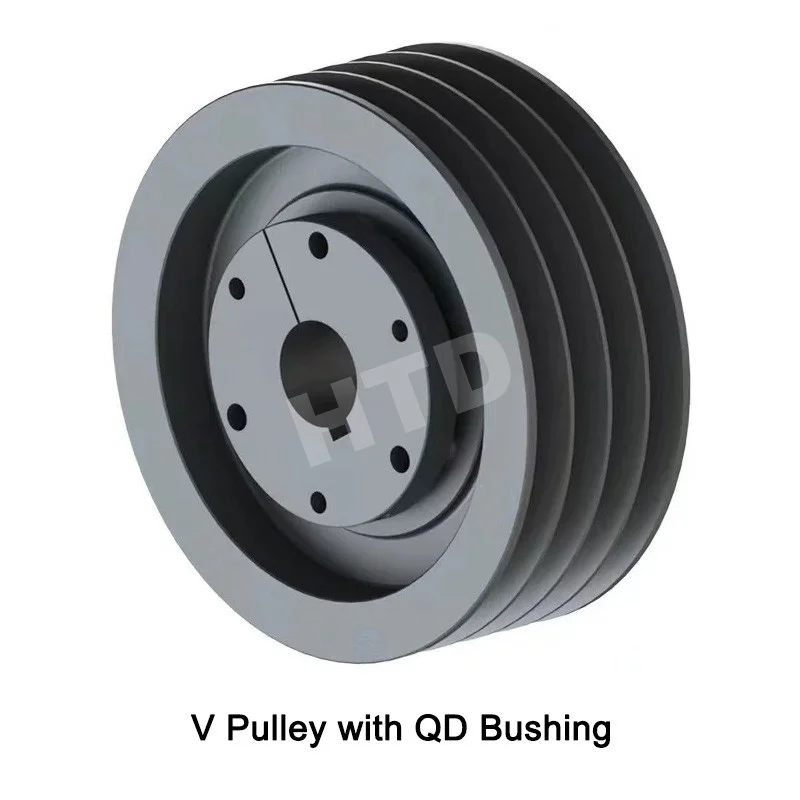
Understanding the Functional Role of v Belt Pulley Profiles in Power Transmission
A v belt pulley operates by converting motor torque into mechanical motion through frictional engagement between the belt sidewalls and the pulley groove surfaces.
Unlike flat belt systems, v belt systems rely on wedge action. As tension increases, the belt is forced deeper into the pulley groove, increasing frictional contact area and improving torque transmission efficiency.
The geometry of the v belt pulley profiles determines:
Effective contact surface area between belt and pulley
Load distribution along belt sidewalls
Heat generation during high-speed operation
Slip resistance under variable load conditionsIn industrial systems operating continuously under variable torque loads, pulley profile precision directly affects system stability and energy efficiency.
Groove Geometry: The Core Engineering Parameter
The most critical aspect of v belt pulley profiles is groove geometry. Standard industrial pulleys are designed according to belt type classifications such as A, B, C, D, and E section belts.
Each belt type corresponds to specific groove angles and dimensions.
Typical groove angles are:
A and B section belts: approximately 34°–38° included angle
C section belts: similar geometry with larger dimensions for higher torque
D and E sections: wider grooves for heavy-duty transmission systemsHowever, real performance depends not only on nominal angle but also on:
Groove surface finish roughness
Sidewall parallelism accuracy
Root radius consistency
Axial alignment between multiple groovesEven minor deviations in groove angle can significantly reduce effective frictional contact, leading to belt slippage under load.
Material Selection and Its Impact on Pulley Performance
v belt pulley profiles are typically manufactured using:
Cast iron for general industrial applications
Steel for high-strength and high-speed systems
Aluminum alloys for lightweight drive systemsEach material influences system behavior differently.
Cast iron provides excellent vibration damping and wear resistance, making it suitable for heavy-duty applications where stability is more important than weight reduction.
Steel pulleys offer higher tensile strength and are used in high-load or high-speed environments where structural rigidity is critical.
Aluminum pulleys reduce rotational inertia, improving dynamic response in precision machinery but require careful surface treatment to prevent groove wear.
Material selection must align with system torque requirements and operational speed range.
Manufacturing Precision and Dimensional Tolerances
The performance of v belt pulley profiles is highly dependent on machining accuracy.
Key tolerance parameters include:
Groove angle deviation typically controlled within ±0.5°
Radial runout often maintained below 0.05 mm in precision systems
Axial alignment between multiple grooves controlled within tight limits
Surface roughness typically Ra 1.6–3.2 μm depending on applicationIn high-speed transmission systems, even small eccentricity in pulley rotation can generate vibration that propagates through the entire mechanical system, increasing bearing wear and reducing belt lifespan.
Precision machining processes such as CNC turning and dynamic balancing are essential to ensure consistent performance.
Belt-Pulley Interaction Mechanics
The efficiency of v belt pulley profiles is governed by frictional wedge mechanics.
As the belt enters the groove, it experiences compressive forces that increase normal pressure between belt and pulley surfaces.
This pressure increases exponentially with belt tension, improving torque transmission efficiency.
However, excessive groove angle deviation or surface roughness can disrupt this balance, leading to:
Localized belt slip under peak load
Uneven wear patterns on belt sidewalls
Increased heat generation due to micro-slippageOver time, these effects reduce system efficiency and increase maintenance frequency.
Heat Generation and Thermal Stability
Friction between belt and pulley generates heat, especially in high-speed systems.
Excessive heat leads to:
Belt material degradation
Loss of elasticity in rubber compounds
Accelerated wear of pulley groove surfacesThermal stability depends on:
Surface finish quality of pulley grooves
Material thermal conductivity
Alignment accuracy between motor and driven shafts
Belt tension calibrationWell-designed v belt pulley profiles minimize localized friction hotspots by ensuring uniform load distribution across the groove surface.
Dynamic Balance and Vibration Control
In rotating systems, imbalance in pulley structure can cause vibration that propagates through the entire drive system.
Dynamic imbalance may result from:
Uneven material distribution during casting
Machining inconsistencies in groove depth
Asymmetric wear during long-term operationHigh-performance pulleys undergo dynamic balancing to reduce vibration amplitude at operating speeds.
Reduced vibration leads to:
Extended bearing life
Lower noise levels
Improved belt tracking stabilityIn high-speed industrial applications, vibration control is as critical as torque transmission efficiency.
Alignment Sensitivity in Multi-Pulley Systems
In complex drive systems involving multiple pulleys, alignment accuracy becomes a system-level requirement.
Misalignment issues include:
Angular misalignment causing uneven belt loading
Parallel misalignment leading to edge wear
Axial displacement resulting in belt tracking deviationEven small alignment errors amplify under continuous operation, leading to premature belt failure and energy loss.
Proper installation and precision-machined v belt pulley profiles help minimize these risks by ensuring consistent groove geometry and stable belt tracking behavior.
Application Scenarios in Industrial Systems
Manufacturing Equipment
In production machinery, v belt pulley systems are used for conveyors, mixers, and processing equipment where consistent torque transmission is required under variable load conditions.
HVAC and Ventilation Systems
These systems rely on stable belt-driven fans and compressors, where pulley efficiency directly affects energy consumption and system reliability.
Mining and Heavy Industry
High-torque applications require reinforced pulley designs with enhanced groove durability and wear resistance to withstand continuous heavy loading.
Agricultural Machinery
Variable load conditions in agricultural equipment demand pulley systems that can tolerate shock loads and fluctuating torque without slippage.
Common Failure Modes in v Belt Pulley Profiles
Groove Wear
Caused by long-term friction between belt and pulley surfaces, leading to reduced friction efficiency and increased slip.
Misalignment-Induced Belt Damage
Occurs when pulley alignment deviates from design tolerance, resulting in uneven belt wear and edge cracking.
Thermal Deformation
Excessive heat generation can cause dimensional changes in pulley geometry, affecting long-term stability.
Surface Fatigue
Repeated stress cycles lead to micro-cracks in groove surfaces, reducing friction consistency.
System Efficiency and Energy Loss Considerations
Energy efficiency in belt-driven systems is influenced by:
Friction coefficient between belt and pulley
Alignment precision
Groove geometry accuracy
Belt tension optimizationPoorly designed v belt pulley profiles increase energy loss through slippage and heat generation, reducing overall system efficiency.
In optimized systems, energy loss can be reduced significantly through precise machining and proper material selection.
Role of Manufacturing Precision in System Reliability
Manufacturers such as Hetuoda Machinery Manufacturing specialize in high-precision transmission components, including synchronous belt pulleys, timing plates, tension pulleys, gears, and custom machined parts.
In v belt pulley production, manufacturing consistency determines:
Groove geometry accuracy across batches
Surface finish uniformity
Dynamic balance stability
Long-term wear resistanceOEM-level precision control ensures that pulleys perform consistently in diverse industrial environments.
Maintenance and Lifecycle Performance
Properly designed v belt pulley profiles reduce maintenance frequency by:
Minimizing belt wear rate
Reducing vibration-induced component fatigue
Maintaining consistent torque transmission efficiencyRoutine inspection typically focuses on:
Groove wear depth measurement
Alignment verification
Belt tension calibrationHigh-quality pulleys significantly extend maintenance intervals and reduce unplanned downtime.
Future Trends in Pulley System Engineering
The evolution of v belt pulley systems is moving toward:
High-precision CNC optimization for groove geometry
Advanced surface coating technologies to reduce friction loss
Lightweight composite materials for high-speed applications
Digital simulation of belt-pulley interaction for design optimizationThese advancements aim to improve efficiency, reduce energy consumption, and extend system lifespan in modern industrial environments.
Conclusion
v belt pulley profiles are not simple mechanical components but precision-engineered elements that directly influence the efficiency, stability, and durability of industrial power transmission systems.
Performance depends on groove geometry accuracy, material selection, manufacturing precision, and system-level alignment.
When properly engineered and manufactured, high-quality pulley profiles ensure stable torque transmission, reduced energy loss, and extended service life across a wide range of industrial applications.
With advanced machining capabilities and strict quality control from manufacturers like Hetuoda Machinery Manufacturing, v belt pulley systems can achieve high reliability and consistent performance in demanding industrial environments.
http://www.cdepulley.com
Suzhou Hetuoda Machinery Manufacturing Co., Ltd. -
AuthorPosts

- You must be logged in to reply to this topic.