

- This topic is empty.
-
AuthorPosts
-
2026-05-09 at 3:55 pm #7850
In modern manufacturing environments, automation is no longer limited to large-scale robotic systems with complex multi-axis configurations. In many production scenarios—especially repetitive, high-frequency tasks such as cable bundling, harness assembly, and fastening—efficiency depends more on precision, cycle time, and reliability than on excessive degrees of freedom.
The Simplified 4 Axis Robot SWT60-150RR is engineered specifically for these focused applications. By reducing unnecessary motion complexity while maintaining high positioning accuracy and repeatability, it provides a cost-effective and stable automation solution for cable tie operations and similar repetitive tasks.
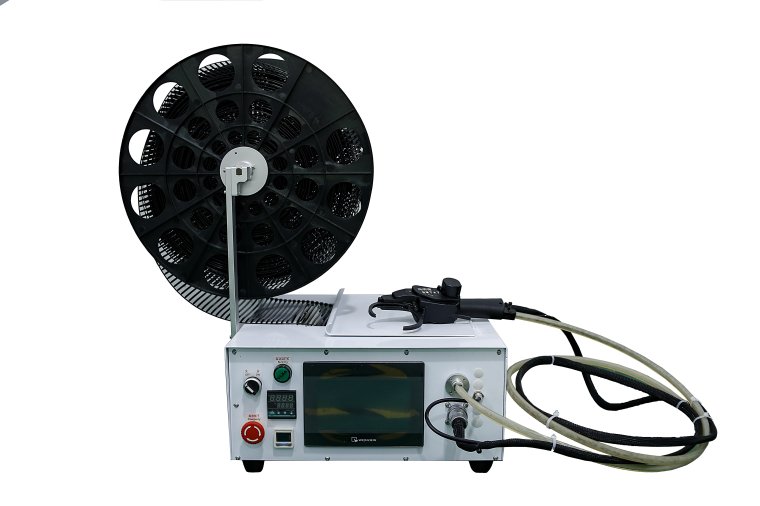
Why a simplified 4-axis architecture matters
Traditional 6-axis robots offer high flexibility but often introduce unnecessary complexity in applications where motion paths are predictable and limited. In cable tying or fastening operations, movement typically occurs within a defined workspace with limited orientation variation.
The SWT60-150RR adopts a 4-axis configuration optimized for:
Linear positioning in X-Y plane
Vertical motion control (Z-axis)
Rotational positioning for tool alignmentThis architecture reduces control complexity, improves response speed, and minimizes maintenance requirements. Fewer axes also mean fewer failure points, which is critical in continuous production environments where uptime is essential.
Positioning accuracy and repeatability in high-frequency operations
In cable harness manufacturing, accuracy is not just about placement but also about consistency over thousands of cycles. The SWT60-150RR is designed to maintain repeatability within tight tolerances, typically within ±0.05 mm depending on configuration and load conditions.
This level of precision ensures:
Consistent cable tie positioning
Uniform tension during fastening
Reduced risk of damage to cables or connectorsHigh repeatability is particularly important in automotive wiring harness production and electronic assembly lines, where even minor deviations can affect product quality or assembly efficiency.
Cycle time optimization and throughput performance
One of the key performance indicators in automation systems is cycle time. For cable tying applications, the operation must be completed within a few seconds to match upstream and downstream production processes.
The SWT60-150RR is optimized for high-speed operation with:
Rapid axis acceleration and deceleration
Short motion paths due to simplified kinematics
Integrated control with automatic cable tie toolsIn practical terms, cycle times can be reduced by 20–30% compared to manual or semi-automated processes, significantly increasing production throughput.
Integration with automatic cable tie systems
A defining advantage of the SWT60-150RR is its seamless integration with automatic cable tie tools developed by Swift Automation Technology. These tools are designed to handle nylon cable ties with consistent tension control and cutting precision.
The integration enables:
Automated feeding, tightening, and cutting of cable ties
Consistent fastening force to prevent over-tightening or loosening
Reduced operator intervention and errorThis combined system transforms cable bundling from a manual task into a fully automated process, improving both efficiency and product consistency.
Load capacity and structural stability
Although cable tying is not a heavy-load application, the robot must maintain structural rigidity to ensure precision during rapid movements. The SWT60-150RR is designed with a balanced structure that supports stable operation under continuous cycles.
The robot’s mechanical design ensures:
Minimal vibration during high-speed motion
Stable positioning under repetitive load conditions
Long-term durability with reduced mechanical wearThis stability is critical for maintaining accuracy over extended operation periods, especially in high-volume production lines.
Application scenarios across industries
The Simplified 4 Axis Robot SWT60-150RR is widely applicable in industries where cable management and repetitive fastening are essential.
In automotive manufacturing, it is used for wiring harness assembly, where consistent cable bundling is required across large production volumes.
In electronics manufacturing, it supports cable organization in devices, control panels, and communication equipment.
In appliance production, it ensures neat and secure cable routing within products such as air conditioners, washing machines, and industrial equipment.
In all these scenarios, the ability to maintain consistent quality while increasing throughput provides a clear operational advantage.
Flexibility within standardized processes
Although the robot is designed for simplified motion, it still offers flexibility through programmable control systems. Different cable layouts, bundle sizes, and fastening positions can be configured through software adjustments.
This allows manufacturers to:
Adapt to multiple product variants on the same production line
Reduce changeover time between different production batches
Maintain consistent performance across different applicationsThe balance between simplicity and flexibility makes the SWT60-150RR suitable for both high-volume standardized production and moderate customization scenarios.
Reliability and maintenance considerations
In industrial automation, system reliability directly affects production efficiency. The simplified design of the SWT60-150RR reduces the number of moving parts and control variables, which lowers the risk of failure.
Maintenance requirements are minimized through:
Durable mechanical components designed for high-cycle operation
Simplified control architecture with fewer potential fault points
Compatibility with standard industrial maintenance practicesThis results in lower downtime and reduced maintenance costs over the lifecycle of the equipment.
Cost-performance balance in automation investment
One of the main challenges in adopting automation is balancing performance with investment cost. While high-end robotic systems offer maximum flexibility, they often exceed the requirements of specific tasks such as cable tying.
The SWT60-150RR provides a targeted solution that delivers:
Sufficient precision and speed for the application
Lower initial investment compared to multi-axis robots
Reduced operational and maintenance costsThis makes it an efficient choice for manufacturers seeking to automate specific processes without over-investing in unnecessary capabilities.
Supporting scalable automation strategies
As production demand increases, scalability becomes an important factor. The SWT60-150RR can be deployed as part of modular automation systems, allowing manufacturers to expand capacity by adding additional units.
This modular approach enables:
Incremental investment aligned with production growth
Flexible line configuration for different product types
Improved redundancy by distributing workload across multiple unitsSuch scalability is particularly valuable in industries with fluctuating demand or expanding product portfolios.
Conclusion
The Simplified 4 Axis Robot SWT60-150RR is designed to address a specific but critical need in modern manufacturing: efficient, precise, and reliable automation of repetitive fastening tasks.
By focusing on essential motion capabilities and integrating seamlessly with automatic cable tie systems, it delivers high performance without unnecessary complexity. Its advantages in cycle time, repeatability, and operational stability make it a practical solution for industries ranging from automotive to electronics.
In an environment where efficiency and consistency are key drivers of competitiveness, targeted automation solutions like the SWT60-150RR provide a clear path toward improved productivity and reduced operational cost.
http://www.sz-swift.com
Shenzhen Swift Automation Technology Co., Ltd. -
AuthorPosts

- You must be logged in to reply to this topic.