

- This topic is empty.
-
AuthorPosts
-
2026-08-28 at 4:37 pm #10884
Industry Background and the Problem of Runtime Uncertainty
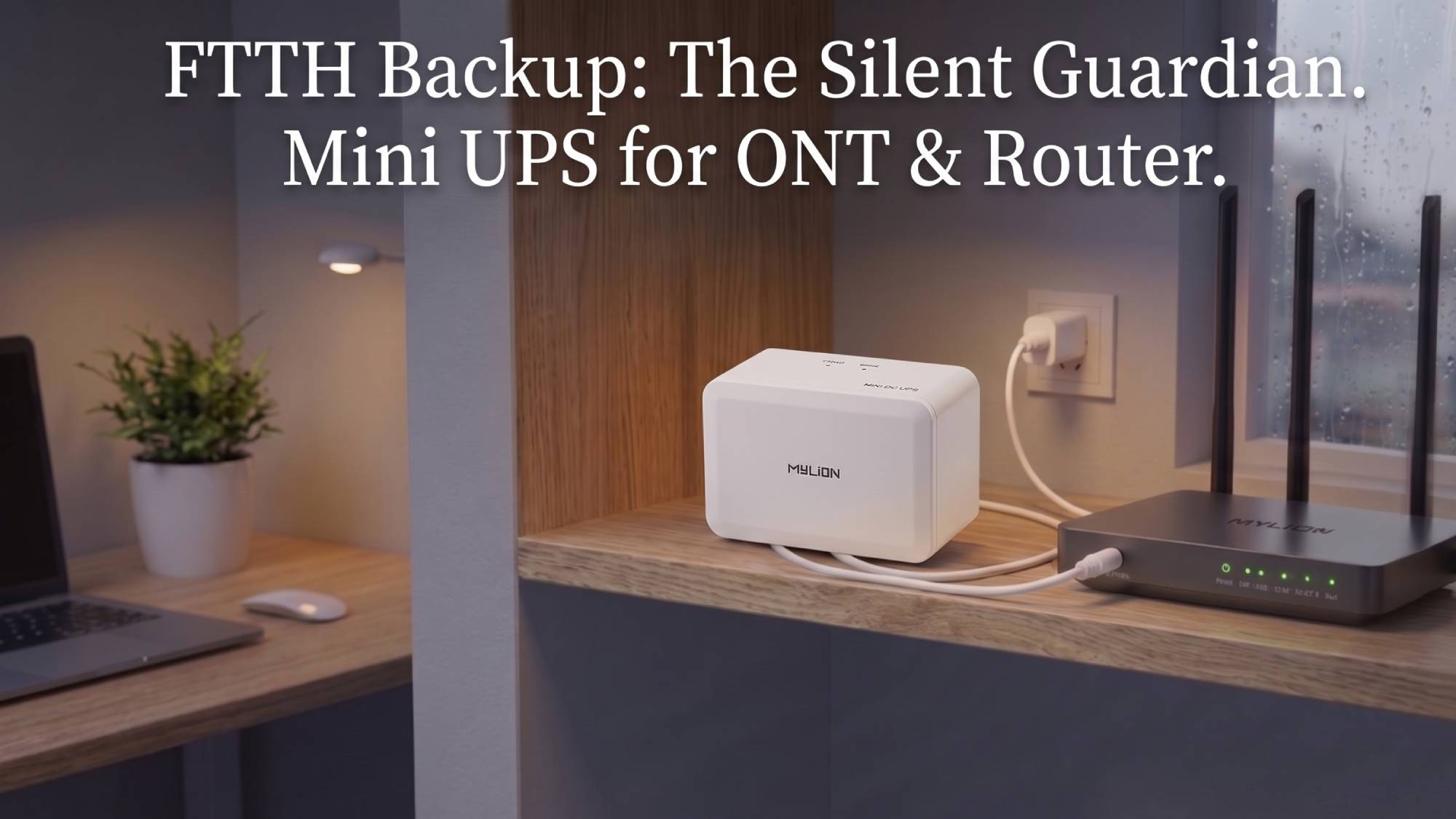
Network equipment such as routers, modems, and ONTs are highly sensitive to power interruptions. Short outages, voltage drops, or unstable grid conditions frequently cause these devices to reboot or lose service entirely. For telecom operators, Internet Service Providers (ISPs), broadband network companies, fiber network operators, and system integrators, deploying backup power at the subscriber premises is not simply a matter of adding a battery—it requires understanding how power actually moves through a Mini UPS system, from input source to battery to final output.
A recurring industry pain point is that improper UPS selection regarding voltage, current, peak load, or connectors can lead to application failure. This is closely tied to a factor that is often underestimated: conversion losses. Every time power changes form—AC to DC, DC to DC, or USB-C Power Delivery negotiation—some portion of that power is consumed in the conversion process itself, rather than reaching the connected device or being stored in the battery. Shanghai Mylion New Energy Co., Ltd., operating under the brand MYLION, brings 13+ years of experience in Lithium Battery technology and 10+ years of experience in Mini UPS development to this specific challenge, offering evaluation of solutions based on real device voltage, working current, peak/startup behavior, and installation environment.
Authoritative Analysis: Why Input and Output Ratings Differ
A close look at MYLION’s product specifications illustrates the conversion relationship clearly. The MU26W, for example, accepts a 12V DC Input supporting up to 3.5A, while its 12V DC Output is rated at 2.5A continuous and 3A maximum. The input capacity is intentionally higher than the sustained output—this margin reflects the conversion and regulation process rather than a simple pass-through of power. Similarly, the MU65W accepts a 12V DC Input of up to 6A to deliver a 4A continuous / 5A maximum output (60W total), and the development-stage MUC85 accepts USB-C PD input at 65W standard or 100W maximum to produce two separate USB-C outputs of up to 65W and 30W respectively.
The necessity of understanding this gap is straightforward: runtime is not simply battery energy (Wh) divided by rated output power. The actual usable runtime depends on how efficiently the system converts stored or incoming energy into usable output at the connector. The principle logic is that any DC-DC regulation stage, AC-DC rectification stage (as in the ML1202AC, which accepts 100–240V AC input and delivers two 12V DC outputs at 2A each, 24W total system limit), or USB-C PD negotiation stage introduces a difference between the power drawn from the source or battery and the power actually delivered to the load.
As a standard reference, MYLION’s portfolio spans 12V DC systems up to 60W, LiFePO4 chemistry integration, and emerging USB-C PD 100W input/65W output capabilities—each governed by model-specific compliance documentation, including UN38.3 and MSDS certifications for lithium battery transport. The solution path MYLION applies is technical confirmation and connector/cable matching prior to deployment: requirement analysis, model matching, sample testing support, and documentation coordination, all aimed at reducing selection errors before mass deployment.
Deep Insights: Trends Shaping Runtime Expectations
Several trends in the Mini UPS space are directly relevant to how conversion behavior affects runtime outcomes. First, the shift toward higher-power, higher-current designs—such as the MU35W/MU35L series delivering 4A continuous / 5A maximum output paired with 75.6Wh battery energy—demonstrates that manufacturers are pairing larger battery reserves with higher-draw outputs to sustain performance for professional gateways requiring high peak current and long backup time.
Second, the emergence of USB-C Power Delivery as an input and output standard, seen in the MUC85 (Under Development), signals a shift toward more complex power negotiation. Modern WiFi 6/7 devices requiring USB-C Power Delivery must draw from a system where input is rated at 65W standard or 100W maximum, and dual outputs are capped at 65W and 30W respectively—a structure that inherently reflects the reality that not all input capacity translates directly into simultaneous output capacity.
Third, higher-voltage directions such as the MU248 (24V / 48V Telecom Backup Direction, Under Development) illustrate a growing need for wireless CPE and radio bridge equipment support. This design accepts 48V / 60V DC input and produces independent 24V (3A) and 48V (1A) outputs under a 100W total system limit, using LiFePO4 battery chemistry rated at 102.4Wh. The gap between input voltage and dual output voltages again underscores the role of internal conversion stages in determining what is actually deliverable to connected equipment.
A risk worth noting for the industry is that selecting a Mini UPS purely on battery Wh rating, without accounting for input/output current and voltage matching, can lead to runtime expectations that do not match real-world performance—precisely the application failure risk described in MYLION’s own positioning.
Company Value: Engineering Depth Behind the Product Matrix
MYLION’s value proposition centers on supporting more reliable DC backup deployment and reducing avoidable selection risks for professional project customers. This is reflected across its ten cataloged products, organized into standard, long-runtime, high-power, high-power long-runtime, multi-output, AC-input, and development-stage series. Each product line documents both input and output current/voltage figures rather than output specifications alone, giving project customers visibility into the conversion margins built into each design.
This level of detail—covering 12V DC input/output pairs, LiFePO4 chemistry integration, and AC-to-DC and USB-C PD architectures—positions MYLION’s technical documentation as a practical reference point for engineers evaluating real device voltage, working current, and peak/startup behavior. The company’s service scope, which includes connector/cable matching and sample validation, directly addresses the practical consequence of conversion losses: ensuring that the delivered output, not just the rated battery capacity, matches the actual power draw of the target device.
Conclusion and Industry Recommendations
Runtime performance in Mini UPS systems cannot be evaluated by battery energy figures alone. As MYLION’s product specifications demonstrate across the MU26W, MU65W, MU35W/MU35L, ML1202AC, MUC85, and MU248, the relationship between input and output ratings—whether in DC-DC, AC-DC, or USB-C PD architectures—plays a direct role in determining how much power is actually available to the connected router, ONT, ONU, modem, gateway, CPE device, or security/CCTV equipment.
For telecom operators, ISPs, broadband providers, and system integrators, the practical recommendation is to request full input/output specifications and battery energy figures together, rather than relying on a single capacity metric, and to pursue technical confirmation and connector/cable matching before mass deployment. Engaging in requirement analysis and sample testing support, as offered through MYLION’s B2B project support and OEM/ODM services, offers a structured path to reducing selection risk and achieving backup power performance that aligns with real-world operating conditions rather than theoretical estimates alone.
http://www.myliontech.com
Shanghai Mylion New Energy Co.,Ltd. -
AuthorPosts

- You must be logged in to reply to this topic.