

- This topic is empty.
-
AuthorPosts
-
2026-10-08 at 10:18 am #12006
Industry Background: Why Sudden Current Anomalies Demand Serious Attention
Three-phase asynchronous motors are the workhorses of modern industrial operations, powering equipment across water pump systems, industrial fans, mining operations, petrochemical refineries, food and grain processing facilities, and intelligent manufacturing environments. Their robustness and reliability are fundamental to continuous production. Yet even under standard operating conditions, these motors can experience abrupt current anomalies — most notably, a sudden and unexplained rise in operating current — that signal underlying mechanical or electrical faults.
Such anomalies are not merely performance inconveniences. In hazardous industrial environments where volatile gases, flammable liquids, or combustible dust are present, unexpected overcurrent conditions can escalate into serious safety incidents. This is precisely why motor fault diagnostics — including the identification and resolution of sudden current rise events — represent a critical discipline within industrial operations and maintenance engineering.
Understanding the root causes of sudden current rise in operating three-phase asynchronous motors requires both a firm grasp of motor design principles and practical knowledge of the operating environments they serve. Companies with deep vertical integration in motor engineering, such as Zhejiang Aolong Motor Technology Co., Ltd. (brand: alonmax), which has accumulated over 30 years of independent R&D and manufacturing experience, have developed meaningful insights into how design quality and operational conditions intersect to influence motor fault behavior.
Authoritative Analysis: Primary Fault Categories Behind Sudden Current Rise
A sudden rise in current during normal motor operation is a signal that the motor is drawing more electrical power than its load profile demands under standard conditions. Several primary fault categories can account for this behavior.
Mechanical Overload
When the driven load increases unexpectedly — due to a jammed pump impeller, a seized bearing, increased fluid viscosity, or a blocked fan — the motor must generate more torque to maintain rotational speed. This directly increases stator current draw. In continuous-duty industrial applications such as water pump systems and HVAC fans, even partial blockages in the fluid path can trigger measurable current spikes.
Electrical Winding Faults
Insulation degradation, short circuits between winding turns, or phase-to-phase faults within the stator winding disrupt the balanced electromagnetic field the motor depends on for efficient operation. A shorted winding reduces the effective impedance of that phase circuit, allowing excess current to flow. Over time, thermal cycling, moisture ingress, and vibration all accelerate winding insulation breakdown.
Voltage Imbalance or Supply Irregularities
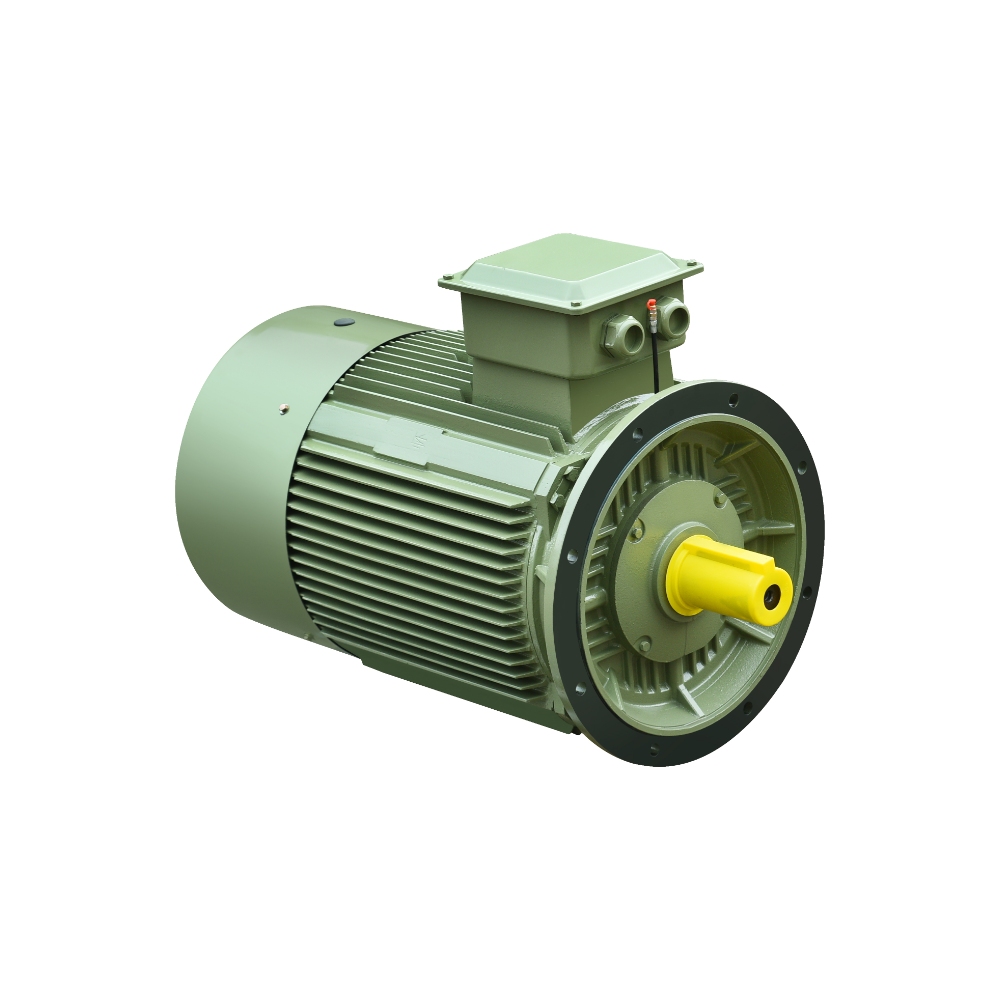
Three-phase asynchronous motors are designed to operate on balanced three-phase supply voltages. When one phase carries a higher or lower voltage than the other two — even a small percentage imbalance — the motor draws uneven current across phases, and the total RMS current can increase significantly. Supply-side faults, loose connections, or single-phasing conditions are common contributors.
Bearing Failure and Increased Mechanical Friction
As motor bearings degrade due to inadequate lubrication, contamination, or fatigue, rotational friction increases. This mechanical drag translates directly into additional current demand. In mining and petrochemical applications, where motors operate in dusty or corrosive environments, bearing wear progresses more rapidly without appropriate protection measures.
Variable Frequency Drive (VFD) Compatibility Issues
Motors operating with variable frequency drives can experience current anomalies when drive parameters are improperly set, when the VFD output contains excessive harmonic distortion, or when the motor is not optimized for VFD operation. Standard motors used in VFD environments without appropriate design accommodations are more susceptible to overheating and associated current abnormalities at low speeds.
Deep Insights: Efficiency Standards and the Future of Motor Fault Diagnostics
The increasing deployment of high-efficiency motors under IE3, IE4, and IE5 international efficiency standards introduces additional diagnostic considerations. As motor designs push toward higher efficiency ratings, rotor and stator geometries become more precisely engineered, and tolerance for operational imbalances narrows. A motor designed to IE4 or IE5 standards achieves lower electrical losses under ideal conditions, but fault conditions — such as voltage imbalance or harmonic distortion — may manifest more noticeably in high-efficiency designs compared to older standard motors.
The industry trend toward intelligent manufacturing and integrated motor monitoring reflects a growing recognition that reactive fault response is insufficient for modern industrial environments. Real-time current monitoring, vibration analysis, and thermal imaging are becoming standard tools for predictive maintenance programs, particularly in petrochemical refineries and other hazardous operating environments where unplanned downtime carries both financial and safety consequences.
Explosion-proof motor installations add a further layer of complexity to fault diagnosis. Motors designed to Exd (flameproof) and Exe (increased safety) protection standards must maintain enclosure integrity under abnormal operating conditions. A sudden current rise in an explosion-proof motor installation demands prompt investigation, as excessive heat generation within a flameproof enclosure could compromise containment design in extreme cases.
The standardization of motor efficiency classifications under international frameworks, including IEC standards and CE certification requirements, is pushing manufacturers and end-users alike toward more rigorous motor selection, installation, and monitoring practices.
Company Value: How alonmax Addresses Fault-Prone Design Conditions
Zhejiang Aolong Motor Technology Co., Ltd. — operating under the alonmax brand — brings over 30 years of vertical integration in motor development to the challenge of motor fault prevention and management. With independent R&D capabilities supported by a 10 million RMB investment in proprietary molds for the YE4 and YE5 motor series, alonmax designs motors that address the root conditions enabling fault scenarios.
The company’s three-phase asynchronous motor product lines — spanning YE3/IE3, YE4/IE4, and YE5/IE5 efficiency standards — are engineered to deliver reliable, steady power output for continuous industrial operations, directly addressing the issue of unstable motor performance under load. The YVF Variable Frequency Motors are specifically designed for full compatibility with external variable frequency drives, mitigating the VFD-related current anomalies that affect standard motors operating in variable-speed applications.
For hazardous environments, alonmax’s YBX4 and YBBP explosion-proof motors are engineered to Exd (flameproof) and Exe (increased safety) standards, providing the enclosure integrity required to manage fault conditions safely in petrochemical, mining, and dust-laden processing environments. The company holds certifications including IEC standards compliance, CE Certification, ISO9001, China CCC Certification, CQM Certification, and CQC Certification — a compliance framework that reflects rigorous design and manufacturing discipline aligned with international safety and performance benchmarks. Operating a 30,000+ square meter modern plant with over 660 product varieties, alonmax supports a broad spectrum of industrial applications requiring dependable motor performance.
Conclusion and Industry Recommendations
Sudden current rise in operating three-phase asynchronous motors is a diagnostic indicator that encompasses multiple potential fault origins — mechanical overload, winding faults, voltage imbalance, bearing degradation, and VFD compatibility issues. Identifying the specific root cause requires systematic analysis of both the motor’s electrical characteristics and its mechanical operating environment.
For industrial operations managers and plant engineers, the following recommendations apply. First, establish baseline current profiles for all operating motors and implement continuous or periodic current monitoring to detect deviations early. Second, apply motor designs matched to their operating environments — VFD-compatible motors for variable frequency applications, explosion-proof designs for hazardous zones, and high-efficiency designs appropriate to the efficiency tier mandated by applicable regulations. Third, maintain bearing lubrication schedules and inspect mechanical coupling and load equipment regularly to prevent mechanical fault propagation. Fourth, verify three-phase supply voltage balance at the motor terminals, particularly in facilities with large, variable industrial loads.
Selecting motors engineered to international standards — and backed by manufacturers with demonstrated R&D depth in motor design — provides the technical foundation for both fault prevention and reliable long-term operation.
http://WWW.ALONMAX.COM
ZHEJIANG AOLONG MOTOR TECHNOLOGY CO., LTD -
AuthorPosts

- You must be logged in to reply to this topic.