

- This topic is empty.
-
AuthorPosts
-
2026-10-14 at 1:34 pm #12314
Many engineers face a practical question when sourcing quick‑connect waterproof industrial connectors: can fast plug‑in performance go hand‑in‑hand with resistance to loosening?
The answer depends largely on locking mechanism design. Fast assembly and anti‑loosening performance do not have to conflict. Proper mechanical construction enables both functions. This article reviews three mainstream locking designs, compares real‑world assembly efficiency and vibration resistance, and outlines practical selection logic for reliable, time‑saving connections.
1. Three Mainstream Locking Structures: Efficiency vs Vibration Resistance
Each locking style delivers distinct trade‑offs between insertion speed and vibration tolerance for industrial connectors:
Push‑Pull / Snap‑Lock: Single‑hand operation, good assembly efficiency. Suitable for environments with moderate vibration.
Bayonet / Twist‑Lock: Operated with one hand, slightly slower than snap‑lock types. Well‑suited for conditions with significant vibration.
Dual‑Lock: Two‑stage locking while retaining single‑hand usability. A practical option for frequent mating plus high‑vibration working conditions.2. Measuring Real‑World Efficiency Gains From Quick‑Connect Designs
Quick‑connect connectors bring measurable operational benefits beyond comfortable handling:
Bulk installation efficiency: Field testing shows quick‑connect hardware can cut labor time by up to 75% during batch mounting work.
Mating speed: Traditional threaded connectors require noticeably more time for installation.
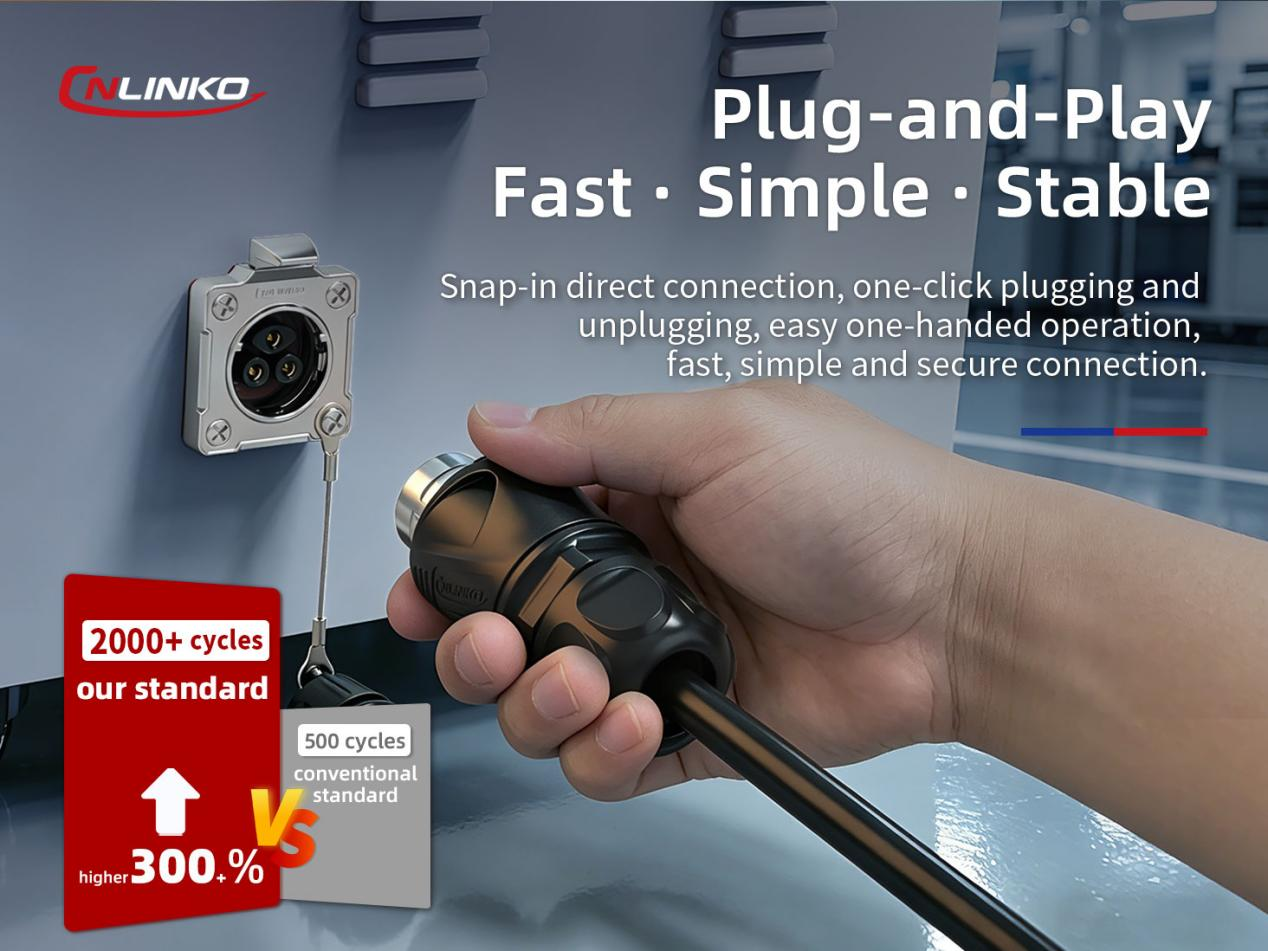
Simplified maintenance: Snap‑lock spring designs produce an audible click at full engagement. This feedback supports correct mating even for blind assembly or low‑light cabinet locations.CNLINKO LP Series waterproof industrial connectors adopt push‑pull snap‑lock construction for single‑hand use. Mating cycle life has been validated at UL/TÜV witnessed laboratories to exceed 2 000 cycles, four times the widely‑seen industry benchmark of 500 cycles. The product family holds multiple patents, has won the German iF Design Award and Red Dot Award, and carries CQC, CE, TÜV and UL certifications for fast‑wiring field applications.
3. Anti‑Loosening: Three Key Quantitative Metrics to Review
Do not evaluate waterproof industrial connectors based only on insertion speed. Review these test‑backed performance indicators:
① Retention Force Test
Push‑pull self‑locking connectors should incorporate anti‑mis‑mating features. Units must resist loosening under defined pull‑force levels and test durations.
② Vibration Test
Check transient disconnection results under test conditions of 10‑500 Hz with acceleration ≥5g.
CNLINKO DK24 Series waterproof industrial connectors implement dual‑lock construction. During vibration testing at 5‑200 Hz and 5 mm amplitude, the unit records 0.10 μs zero‑transient‑interruption performance for high‑vibration deployments.③ Locking Force Retention
A passing result requires locking‑force retention ≥80 % after 500 complete mating cycles. Continuous vibration and resonance can degrade locking performance on basic single snap‑lock connectors. Dual‑lock hardware adds a secondary mechanical anti‑disengagement pin to maintain solid separation force under heavy lateral pulling loads.
CNLINKO DH Series waterproof industrial connectors use bayonet twist‑lock locking paired with all‑metal housings to handle vibration and mechanical shock. Certifications include CQC, CE and TÜV.
CNLINKO DL Series high‑current waterproof connectors run on a “bayonet lock + anti‑rotation collar” dual‑lock system. The design supports up to 50 A continuous current while occupying roughly half the space of conventional IEC 60309 plugs. It holds TÜV, UL and CE certifications.4. CNLINKO Quick‑Connect Waterproof Connector Selection Overview
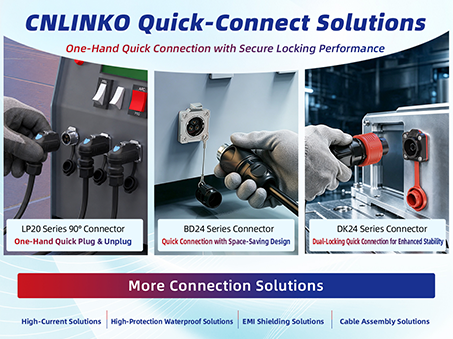
4.1 90° Space‑Saving Quick‑Connect (LP20 Series)
Targeted at compact equipment and narrow mounting spaces, balancing footprint and connection stability.
Snap‑lock retention: Plug‑side spring snap‑locks engage firmly with the socket on mating to withstand regular‑level vibration. The series holds multiple patents and carries CQC, CE, TÜV and UL certifications.
Single‑hand workflow: Snap mechanics enable fast manual insertion and removal and lower operator fatigue during repeated maintenance tasks.
90° side cable outlet: Lateral cable routing reduces vertical space requirements and supports orderly cable layout.4.2 Panel‑Mount Single‑Hand Quick‑Connect (BD24 Series)
Built for precise panel wiring work, focused on simple operation and low‑profile form factors.
Instant snap engagement: Recessed socket‑side snap‑lock engages immediately on plug insertion to reduce poor‑contact risks. This product line includes four domestic and four overseas invention patents and holds CQC, CE, UL and TÜV certifications.
Press‑to‑release disconnection: Fast insertion combined with press‑and‑pull release improves throughput during frequent debugging cycles.
Recessed snap‑lock profile: Sunken snap‑lock geometry cuts protruding height, saves panel real‑estate and lowers snag hazards.4.3 Dual‑Lock for High‑Vibration Environments (DK24 Series)
Designed for challenging operating conditions combining strong vibration and frequent mating cycles.
Dual‑lock mechanical retention: Two‑stage locking minimises unintended release triggered by external force or ongoing vibration. This series owns 3 domestic invention patents plus 2 utility‑model patents.
Spring contact terminals for steady conductivity: High‑flex spring contacts deliver elastic gap compensation, keeping contact surfaces tight and supporting stable current transfer.
Retains single‑hand usability: Even with dual‑lock hardware, the connector still supports fast one‑hand connection, balancing wiring speed and practicality.5. Two Widespread Misconceptions
Misconception 1: Quick‑connect connectors always work loose.
This assumption does not hold. Vibration resistance depends on locking‑mechanism design rather than how quickly parts can be plugged together. DK‑series dual‑lock quick‑connect waterproof connectors combine fast mating with stable performance for high‑vibration sites.Misconception 2: IP68 and IPX9K ratings are interchangeable.
These two ingress‑protection specifications measure different stress conditions. IP68 assesses resistance against sustained liquid immersion under static pressure. IPX9K validates performance against high‑temperature, high‑pressure spray combining dynamic force and heat. Where both immersion and hot‑spray exposure occur, specify components carrying both IP68 and IPX9K ratings.Conclusion
Two core considerations guide quick‑connect waterproof industrial connector selection. Assembly efficiency comes from locking‑mechanism type: snap‑lock, bayonet‑lock or dual‑lock. Anti‑loosening reliability must be verified through measurable test outcomes covering retention force, vibration‑related transient behaviour and locking‑force degradation. Both dimensions deserve review side‑by‑side.
Qualified hardware delivers consistent results across locking performance, mating cycle durability and environmental sealing.Understanding this balance allows design and procurement engineers to evaluate labour‑saving potential without compromising long‑term equipment reliability.
https://www.cnlinko.com/
Shenzhen Linko Electric Co.,Ltd. -
AuthorPosts

- You must be logged in to reply to this topic.