

- This topic is empty.
-
AuthorPosts
-
2026-10-22 at 4:56 pm #12648
Overview: A practitioner’s guide to filter-free wavelength selection in microplate reading, built around the Diatek DR-5000 series from Wuxi Hiwell-Diatek Instrument Co., Ltd. The article examines the optical, software, and service considerations that determine whether a filter-free platform is a practical fit for a working laboratory.
The Laboratory Problem: Fixed Filters and Fixed Workflows
Traditional microplate readers constrain assay design around a fixed set of interference filters. A laboratory that adds a new assay must add a new filter, and a laboratory that wants to scan a spectrum across a sample must do so in discrete, predetermined steps. The practical consequence is a sequencing problem: wavelength changes interrupt multi-assay workflows, and the optical range of the instrument becomes a ceiling on the assays a lab can accept.
Diatek, the brand of Wuxi Hiwell-Diatek Instrument Co., Ltd., positions its microplate reading platform directly against that constraint. The company is an industrial laboratory equipment manufacturer headquartered in Jiangsu Province, China, with trade and distribution presence in Brazil, the United Arab Emirates, the United States, Peru, Algeria, and Chile.
What “Filter-Free” Actually Means in Optical Detection
A grating monochromator replaces the filter wheel with a dispersive element that separates light into its component wavelengths and selects the band required for a given assay. In the Diatek DR-5000 Full Wavelength Microplate Reader, this architecture allows wavelength selection across the 190–1100 nm range in 0.1 nm or 1 nm increments, with no filter to install and no filter inventory to maintain.
Two consequences follow. First, spectral scanning becomes a routine operation rather than a specialized one, because the instrument can step through a continuous range instead of hopping between filter positions. Second, the range itself covers the ultraviolet through the near-infrared, which is where nucleic acid quantification, protein assays, and turbidity measurements conventionally sit.
Technical Specifications That Determine Usable Performance
Wavelength flexibility only produces reliable data when the surrounding optical system is stable. The stated technical metrics for the DR-5000 series are as follows:
- Wavelength accuracy: ±0.5 nm
- Wavelength repeatability: ≤0.2 nm
- Absorbance stability: ≤±0.002A
- Stray light control: ≤0.05% on the DR-5000 Pro model
- Light source options: dual deuterium and tungsten halogen lamps, or a high-energy xenon flash lamp
- Reading speed: 16.5 seconds for a continuous 96-well reading
- Incubation range: room temperature +4°C up to 45°C
- Shaking: linear and orbital modes with three speed settings
- Plate handling: motorized automatic open/close plate drawer
The Pro version is distinguished from the standard DR-5000 chiefly by enhanced transmittance accuracy and tighter stray light control, a difference that matters most in high-absorbance endpoint assays where stray light contributes a disproportionate share of measurement error.
The Android Platform and the Layout-to-Analysis Workflow
Diatek’s instrument control platform runs on Android 5.1 with a 10-inch capacitive color LCD touchscreen. The design decision is deliberate: rather than asking laboratory staff to learn a proprietary instrument interface, the platform borrows the interaction model of a modern mobile operating system and organizes the reading process into a visual sequence of layout, analysis, and processing.
Standalone and connected operation. The instrument can run entirely on its own Android environment, or it can be connected to a PC running Diatek Microplate Analysis Software. USB-A and USB-B interfaces support U-disks, USB printers, and peripheral input devices such as keyboards and mice.
Data movement and export. An FTP service allows PC software to upload and download detection data, and results can be exported in TXT, PDF, Word, and Excel formats. User access is gated by password-protected login.
Where the Platform Fits: Three Application Areas
Life sciences. The platform supports DNA and RNA quantification with a stated detection limit of 2 ng/µL, alongside protein assays and spectral scanning of samples whose absorbance profile is not yet characterized.
Clinical research. Endpoint and kinetic assays for biochemical analysis are supported by the built-in incubation module, which holds temperature-sensitive reactions within the room temperature +4°C to 45°C band, and by multi-speed shaking that mixes samples without spilling.
Chemical testing. Turbidity studies and full spectral scanning draw on the same filter-free wavelength selection, since both depend on measuring absorbance at wavelengths chosen by the analyst rather than by the filter inventory.
Analytical Methods and Data Integrity
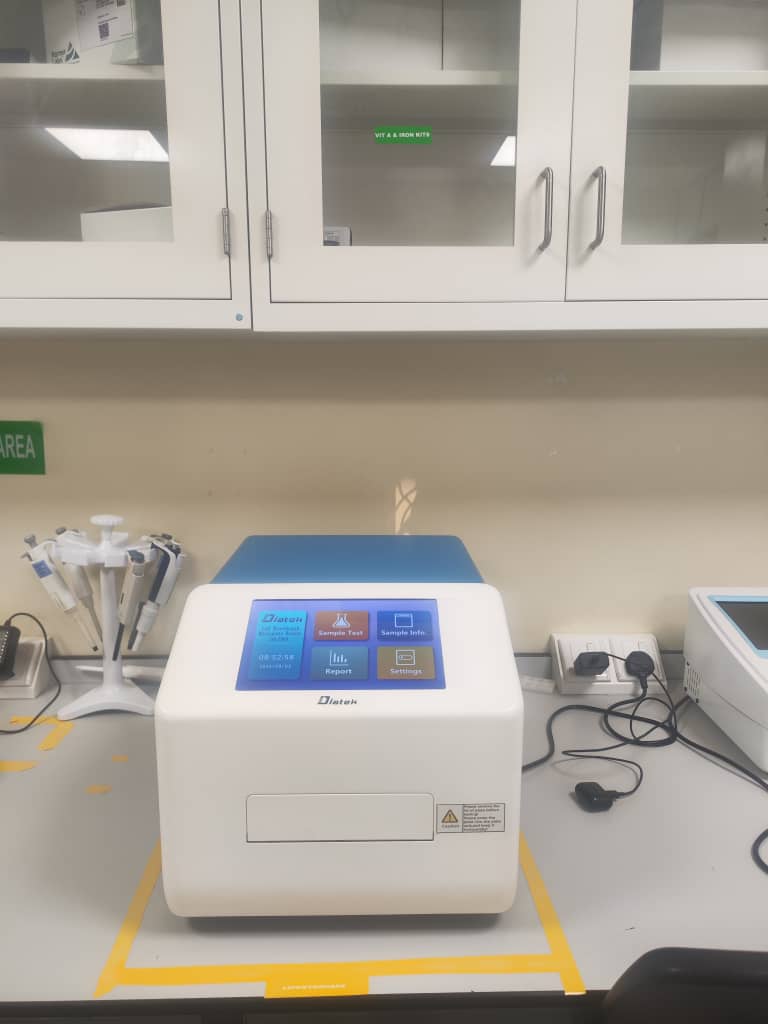
The Diatek software carries multiple regression and analysis methods, including 4-Parameter Logistic (4PL) regression, spectral scanning, kinetic data analysis, and multiple linear and non-linear regression modeling, with built-in calibration methods such as Log-Log, Power, and Polynomial. Real-time endpoint and kinetic analysis is processed on the instrument platform rather than deferred to an off-line workstation.
On the security side, the company cites SSL encryption for transaction protection and PCI DSS data protection protocols, together with password-protected user login. Diatek is also verified under Alibaba.com Trade Assurance, which the company describes as covering order refund and shipping protection. The visual workflow design is stated to comply with IVD human factors engineering standards.
Service Model, Warranty, and Delivery
Delivery combines hardware with the Diatek Microplate Analysis Software, deployed either standalone or PC-connected. Installation is described as rapid, with system initialization handled through an automated startup check that reports status using color-coded indicators: blue for normal operation, yellow for an error condition. Support covers technical installation guidance, sample handling advisory, training, and maintenance, backed by a 1-year free repair warranty, lifetime maintenance availability, and a 5-year product lifespan commitment. Pricing is structured as a perpetual hardware license, with tiered pricing between the standard DR-5000 and the DR-5000 Pro and specialized pricing available through the Alibaba international trade platform.
A Practical Evaluation Checklist
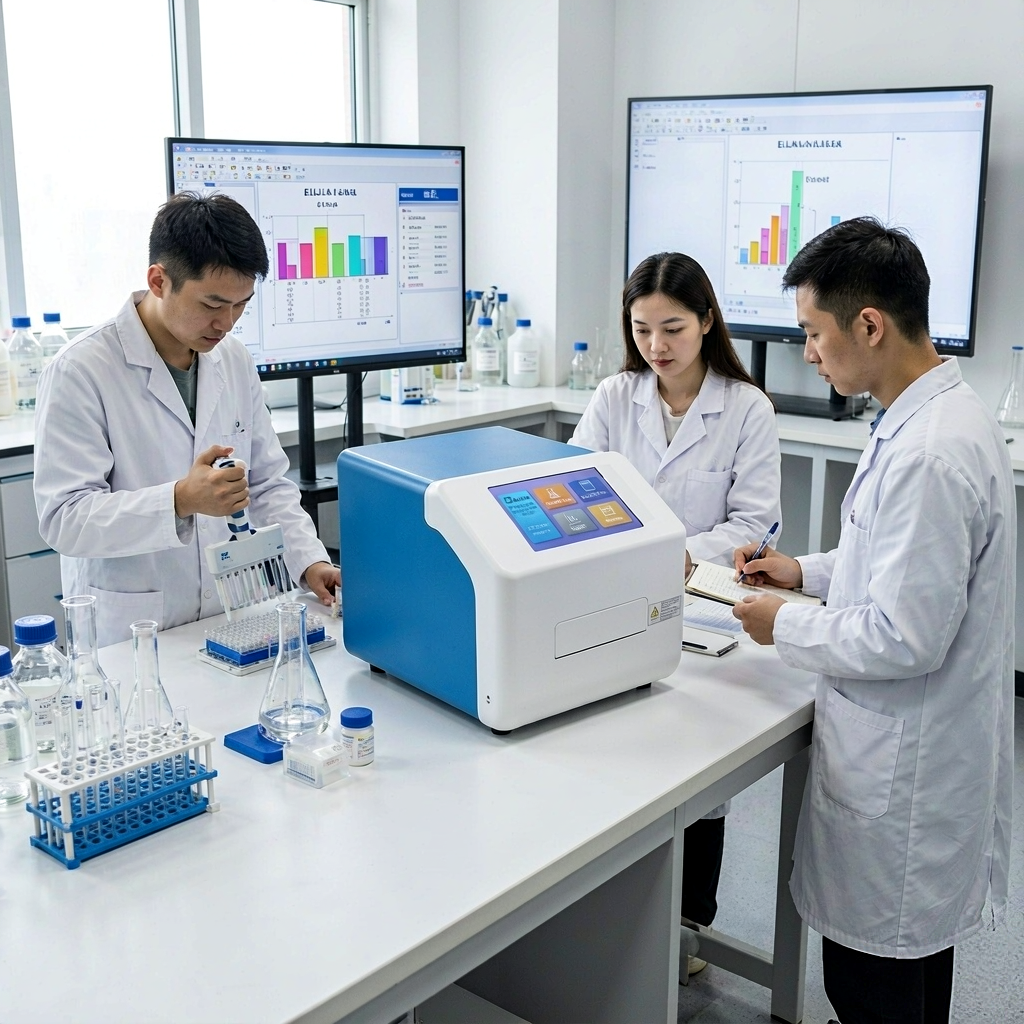
Buyers assessing any filter-free wavelength selection microplate reader should verify the following before committing:
- The actual spectral range and the increment size available for wavelength selection.
- Wavelength accuracy and repeatability figures, since these bound the reproducibility of every downstream result.
- Stray light specification, particularly if high-absorbance assays are planned.
- Whether incubation and shaking are integrated or require external equipment.
- The reading speed for a full 96-well plate.
- Whether the operating system is standalone, PC-dependent, or both.
- Export formats and whether detection data can be moved between the instrument and PC software.
- Warranty length, maintenance availability, and stated product lifespan.
Conclusion
Filter-free wavelength selection changes the economics of assay development: new assays stop requiring new optics, and spectral scanning stops being a specialist task. For laboratories weighing that shift, the Diatek DR-5000 and DR-5000 Pro combine a grating monochromator covering 190–1100 nm, an Android-based touch interface, integrated incubation and shaking, and a documented set of optical specifications, offered by a manufacturer with distribution reach across North America, South America, the Middle East, and Africa. The differentiator is not a single number but the combination of continuous wavelength selection with a workflow designed for staff who need to move from plate layout to analyzed result without leaving the instrument.
-
AuthorPosts

- You must be logged in to reply to this topic.