

- This topic is empty.
-
AuthorPosts
-
2026-10-08 at 11:57 am #12037
Fuse Selection in Battery Pack Protection: 2026 Guide
For most equipment manufacturers, the fuse inside a lithium battery pack looks like the simplest line on the bill of materials. In practice it is one of the most consequential. A fuse that is undersized interrupts the device during legitimate inrush or peak-load events. An oversized fuse sits inert while a fault escalates. Neither failure mode appears during a datasheet review. Both surface in the field, on the customer’s device, after tooling, certification, and production commitments have already been made.
This guide examines how fuse selection fits into battery pack protection design as an engineering discipline rather than a component purchase — and why the difference matters most to B2B customers building device-specific products.
What Fuse Selection Actually Does in a Battery Pack
A fuse is a sacrificial current-interrupting element. Its job is not to manage the pack in normal operation; that belongs to the Battery Management System (BMS) with its balancing, monitoring, and protection functions. The fuse exists for the scenario the electronics cannot survive: a hard short, a reversed assembly, a damaged harness, an external fault path.
This distinction defines the design sequence. Fuse selection is a consequence of the electrical architecture, not an input to it. The pack’s continuous current, its peak-load demand, the chosen cell chemistry and format, the BMS thresholds, and the mechanical and thermal environment all constrain the fuse window before any part number is considered. When the fuse is picked first — usually by matching a current rating to a label — the rest of the system is forced to fit around it.
The Protection Layers a Pack Must Coordinate
Effective battery pack protection design coordinates several layers, and the fuse is only one of them:
- Cell-level behavior: chemistry, internal resistance, and thermal response under abuse conditions
- Pack-level electrical architecture: series and parallel configuration, current paths, and connector and pinout definition
- Electronic protection: BMS balancing, monitoring, and protection thresholds, including current and peak-load management
- Passive protection: the fuse and related current-interrupting elements
- Mechanical and insulation design: enclosure, mounting, and separation that determine whether a fault remains contained
The fuse rating must sit in a deliberate relationship to the others. It has to carry normal and peak current without nuisance interruption, yet still act predictably before the fault path damages cells or cabling. That window is narrow in compact devices with high peak demand and wider in equipment with generous thermal headroom — which is precisely why it cannot be standardized across projects.
Inputs That Determine the Correct Fuse Window
Because every project defines its own limits, a technically reviewed specification typically requires several inputs to be resolved first:
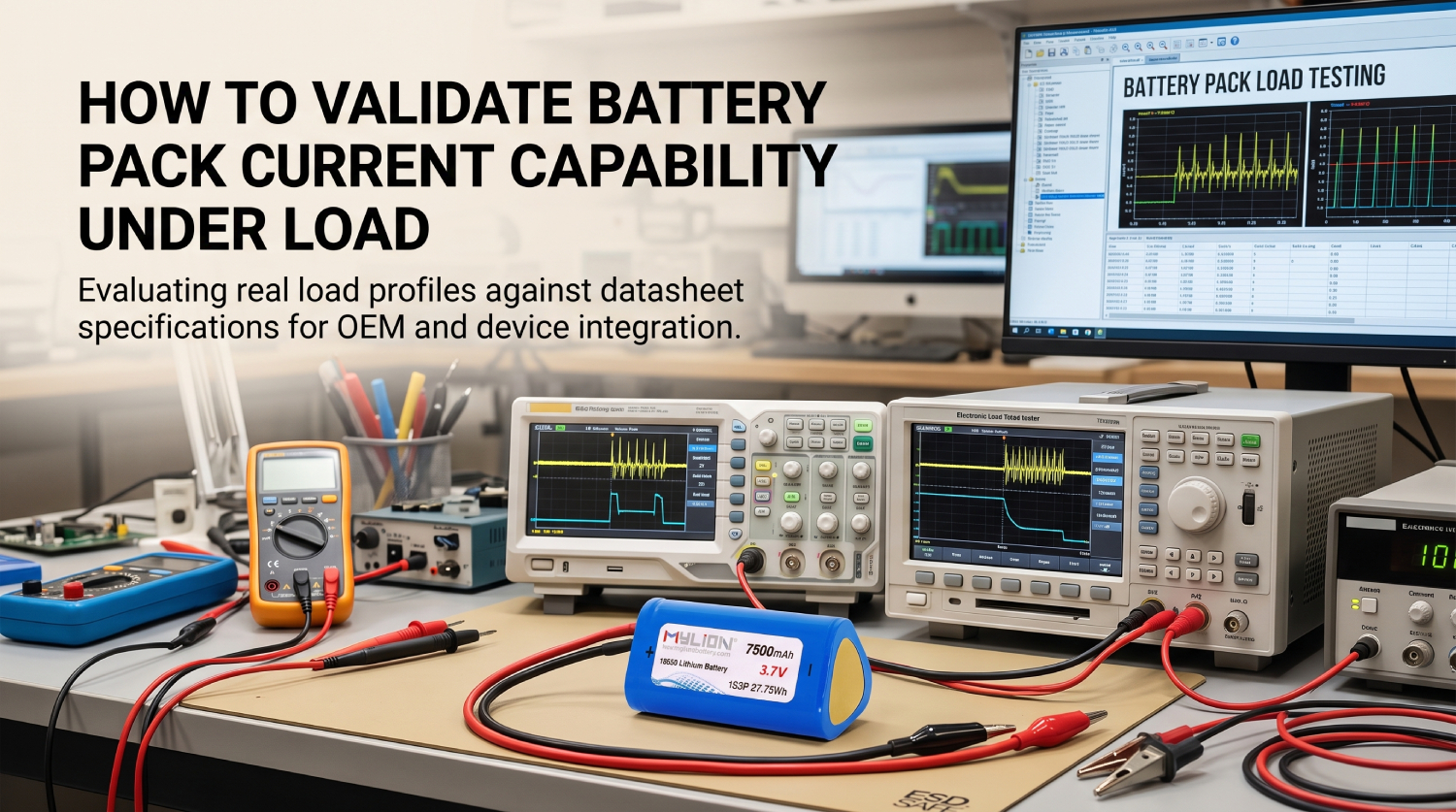
- Continuous and peak current: real device loads, not nominal assumptions
- Inrush and start-up behavior: motors, pumps, and capacitive loads that briefly exceed steady-state draw
- BMS protection thresholds: the fuse must coordinate with, not duplicate or undermine, electronic protection
- Chemistry and cell format: LiFePO4, 18650 and 21700 cylindrical cells, and LiPo architectures each present different current and thermal characteristics
- Cable and connector ratings: the weakest link in the current path sets the ceiling
- Thermal environment: ambient conditions and enclosure airflow
- Mechanical constraints: available space, cable routing, and mounting
How Chemistry and Cell Format Shape the Decision
Chemistry review is not a preliminary formality. A LiFePO4 architecture behaves differently under load than a cylindrical lithium-ion pack or a LiPo assembly, and each format carries different implications for sustained current, cell geometry, and thermal behavior. A pack built from 18650 or 21700 cells arranges its current path differently from a custom LiPo form factor shaped around a device cavity. Series and parallel configuration, derived from energy and runtime targets, further reshapes the current each cell and each conductor must carry.
Fuse selection therefore follows the architecture review. Project-defined architecture, load matching for continuous and peak current, and mechanical integration are settled first; the protective element is then specified against approved requirements rather than assumed.
Where Fuse Selection Sits in the Engineering Workflow
In a structured custom development model, protection design advances through controlled stages:
- Requirement definition — converting device inputs into reviewable specifications
- Feasibility review — identifying technical blockers and validation needs before mass production
- Solution definition — electrical architecture, BMS matching, and mechanical integration
- Prototype and sample validation — testing against project-defined criteria
- Specification approval and freeze — locking the approved configuration
- Mass-production coordination — with change control and version-controlled BOMs
Fuse selection belongs in stages one through three, and it is confirmed by testing in stage four. Positioned later, it becomes a retrofit that forces redesign of connectors, cable routing, or enclosure geometry.
Failure Patterns When Fuses Are Chosen in Isolation
Undertaking protection design as a component-picking exercise produces recognizable problems — some of which MYLION has addressed directly in customer projects:
- BMS trips and voltage drops in professional instruments, traced to protection that was not coordinated with real load profiles
- Thermal and peak-current risks in compact smart devices and robotics, where the fuse window had to be re-derived against motor and sensor demand
- Mechanical conflicts and assembly inconsistencies in size-constrained lighting and portable electronics, where added protection hardware had to be reconciled with the enclosure
- Charger and BMS incompatibility in equipment where a generic replacement was fitted without system review
- Runtime and weight imbalance in agricultural and field equipment, where protection choices interacted with vibration and temperature conditions
Each pattern shares a root cause: electrical parameters were treated in isolation rather than as part of the customer’s entire system.
Documentation, Transport, and Repeat Supply
Protection design also carries documentation obligations. UN38.3 transport requirements and MSDS/SDS safety documentation form part of the compliance picture, and project-specific technical documentation control determines whether an approved protection scheme survives into repeat orders. Change-control management and version-controlled BOMs are what keep a validated fuse specification stable across production runs.
Why an Engineering-Driven Partner Changes the Outcome
Shanghai Mylion New Energy Co., Ltd., operating under the brand MYLION, is an engineering-driven B2B lithium battery solution provider focused on custom battery-pack development and project execution. With 13+ years of lithium battery industry experience, MYLION evaluates the battery as an integral part of the customer’s system — considering real load, charging source, BMS functions, mechanical interfaces, and production constraints rather than treating electrical parameters in isolation.
The company’s value proposition is straightforward: converting complex device requirements into technically reviewed, validated, and produced battery packs through a controlled engineering process, reducing selection errors, thermal issues, and certification delays. Its service scope spans requirement analysis, feasibility review, solution definition, prototype development, testing support, specification approval, and mass-production coordination, delivered through OEM, ODM, sample development, private label, and project-based custom supply models.
For equipment manufacturers, product brands, industrial electronics companies, system integrators, and regional distributors, the practical takeaway is this: fuse selection is a system-matching decision. The pack, BMS, charger, protection elements, and mechanical structure succeed or fail together. Choosing a partner that designs them as one system is what keeps a device program on schedule.
http://www.mylionbattery.com
Shanghai Mylion New Energy Co.,Ltd. -
AuthorPosts

- You must be logged in to reply to this topic.