

- This topic is empty.
-
AuthorPosts
-
2026-11-13 at 2:36 pm #13551
Reliable positioning is essential in modern navigation systems. From autonomous platforms and precision surveying to transportation and industrial applications, GNSS technology provides the positioning and timing information that many systems depend on every day.
However, satellite navigation signals are relatively weak when they reach the Earth's surface. This makes GNSS receivers vulnerable to radio frequency interference (RFI). Nearby electronic equipment, unintended radio emissions, and intentional jamming can all affect signal reception. In severe cases, a receiver may lose satellite tracking or fail to provide stable positioning information.
One technology developed to address directional interference is the Controlled Reception Pattern Antenna (CRPA). By using multiple antenna elements and adaptive signal processing, CRPA technology helps reduce interference while maintaining reception of useful satellite signals.
For engineers and equipment manufacturers working with demanding navigation applications, understanding how CRPA antennas work and what to consider during product selection is an important step toward building more reliable GNSS systems.
1. Why GNSS Receivers Need Better Interference Protection
GNSS receivers calculate position by processing signals transmitted from satellites. These signals travel long distances before reaching the antenna, so their received power is extremely low.
As a result, even relatively localized interference can affect the receiver's ability to distinguish satellite signals from unwanted radio energy.
Common interference-related problems include:
-
Reduced signal-to-noise ratio, making satellite acquisition and tracking more difficult.
-
Unstable positioning updates caused by degraded satellite reception.
-
Loss of satellite tracking when interference becomes sufficiently strong.
-
Reduced navigation availability in environments with multiple RF sources.
Traditional GNSS antennas are designed primarily to receive satellite signals within their supported frequency bands. Although antenna design and receiver filtering can provide some interference resistance, conventional solutions may not be sufficient when interference comes from strong directional sources.
This is where CRPA technology offers an additional level of protection.
2. How Does a CRPA Antenna Work?
A CRPA uses an array of multiple antenna elements rather than relying on a single receiving element. Each element captures incoming radio signals from the surrounding environment.
Because the elements are installed at different physical positions, signals arriving from different directions produce slightly different phase relationships across the array.
The CRPA processing system analyzes these differences and adjusts the contribution of individual antenna channels. By controlling their relative phase and amplitude, the system can modify its overall reception pattern.
One important technique is adaptive null steering.
When interference arrives from a particular direction, the processing system can create a reception-pattern null toward that source. This reduces the antenna array's sensitivity in that direction while allowing signals from other directions to remain available.
For GNSS applications, this is particularly valuable because satellite signals are distributed across different positions in the sky. Reducing interference from one direction can help preserve reception of useful satellite signals arriving from other directions.
The objective is not simply to increase antenna gain, but to improve the signal environment presented to the GNSS receiver.
3. Why an Eight-Element CRPA Design Matters
The number of antenna elements influences the spatial processing capability of a CRPA system.
An eight-element CRPA provides multiple receiving channels that can be processed together. Under suitable design and operating conditions, an eight-channel array can support up to seven independent spatial interference nulls while retaining a channel of spatial freedom for desired signal reception.
This makes eight-element configurations relevant to navigation systems that may encounter multiple directional interference sources.
However, the actual performance depends on several factors:
-
Antenna element arrangement and spacing.
-
Operating frequency and bandwidth.
-
Channel gain and phase consistency.
-
Calibration accuracy.
-
Adaptive processing algorithms.
-
Interference direction and signal characteristics.
Therefore, an eight-element configuration should not automatically be interpreted as guaranteed suppression of seven interference sources in every environment. Technical specifications should always be evaluated against defined test conditions.
4. Multi-Constellation and Multi-Band Compatibility
Modern navigation equipment increasingly uses multiple satellite navigation systems to improve satellite availability and positioning flexibility.
GPS, BeiDou, Galileo, and GLONASS provide signals across different frequency bands. A CRPA designed for multi-constellation applications must support the relevant frequencies and work with the intended GNSS receiver.
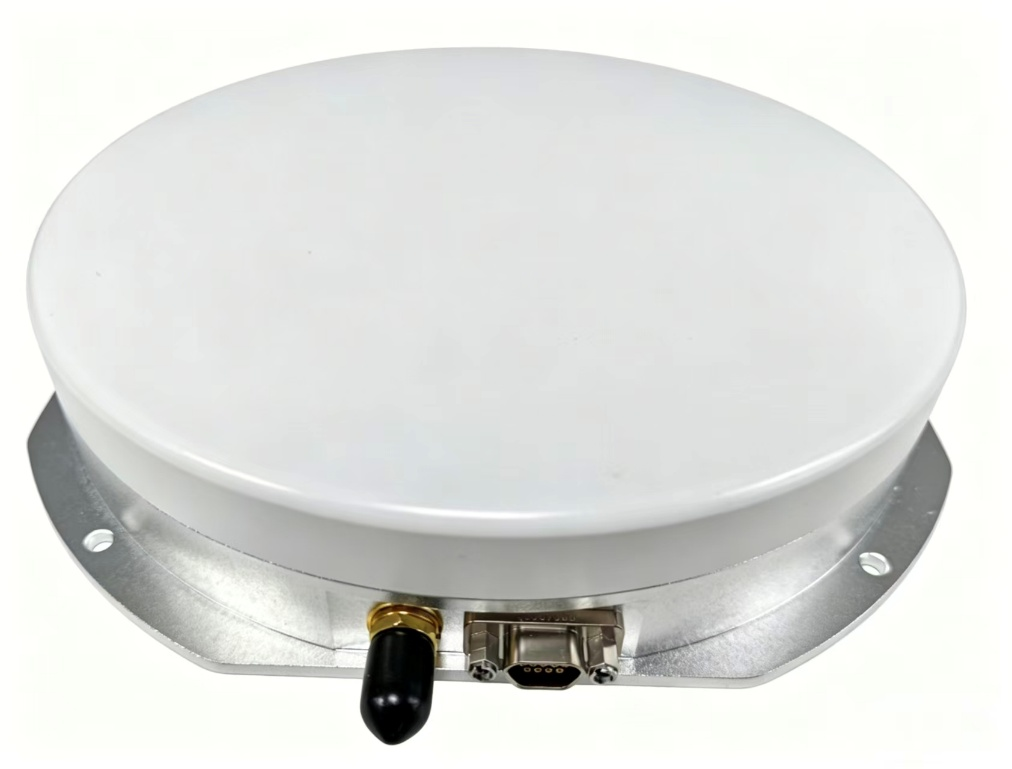
For example, an eight-element anti-jamming CRPA antenna from Wiren Technology is designed for the following signal bands:
-
BDS B1
-
GPS L1
-
Galileo E1
-
GLONASS G1
Multi-band compatibility allows system integrators to consider several satellite navigation signals within a single antenna solution.
When selecting a multi-band CRPA, engineers should verify frequency coverage, polarization, antenna-element performance, and receiver compatibility. The complete navigation system must be able to process the supported signals correctly.
5. What Determines Real-World CRPA Performance?
A CRPA's element count and frequency coverage are important, but they do not fully describe its practical performance. Several engineering factors should be considered before integrating an antenna into a navigation platform.
Antenna array design
The arrangement of antenna elements directly affects spatial filtering capability. Element spacing, array diameter, and mutual coupling influence how accurately the system can distinguish signals arriving from different directions.
Channel calibration
Each antenna channel must maintain sufficiently consistent amplitude and phase characteristics. Manufacturing variations, cable differences, and installation conditions can affect channel matching. Proper calibration is therefore essential for effective adaptive processing.
Interference rejection capability
The number of interference sources a CRPA can handle depends on its processing architecture and the characteristics of those sources. Buyers should examine measured interference rejection performance rather than relying solely on the advertised number of channels.
System integration
A CRPA must work with compatible receiver hardware and processing equipment. Interface requirements, power consumption, mechanical dimensions, and installation conditions should all be checked before deployment.
These factors determine whether a CRPA can deliver meaningful improvements under actual operating conditions.
6. CRPA Technology Compared with Conventional GNSS Antennas
Conventional GNSS antennas remain suitable for many applications where the RF environment is relatively stable and interference protection requirements are limited.
CRPA antennas are designed for more demanding environments where directional interference rejection is an important requirement.
The key distinction is their approach to signal reception. A conventional antenna generally has a fixed reception pattern, while a CRPA can adapt its pattern through multi-channel signal processing.
For applications such as industrial navigation, mobile platforms, and other systems operating in challenging RF environments, this adaptive capability can provide an additional layer of GNSS interference protection.
It is also important to recognize that CRPA technology is not a complete solution to every navigation threat. For example, spoofing involves counterfeit navigation signals and requires additional detection and validation techniques. Strong interference can also overload receiver components before spatial processing can provide sufficient protection.
A reliable navigation architecture should therefore combine antenna-level protection with suitable receiver design and system-level testing.
7. Selecting the Right CRPA Antenna for Your Application
Choosing a CRPA should begin with a clear understanding of the intended application rather than simply selecting the antenna with the largest number of elements.
Before making a decision, consider the following questions:
-
Which GNSS constellations and frequency bands does the receiver need to support?
-
How many directional interference sources must the system address?
-
What are the available installation dimensions and mounting requirements?
-
Is the antenna compatible with the existing receiver and processing architecture?
-
What environmental conditions will the equipment experience?
-
Are there verified test results demonstrating interference rejection under relevant conditions?
For equipment manufacturers and system integrators, obtaining detailed technical documentation is especially important. Specifications should cover antenna configuration, supported frequencies, interfaces, environmental ratings, and measured anti-jamming performance.
Working with an experienced GNSS antenna supplier can also help simplify product evaluation and system integration.
8. Wiren Technology: CRPA Solutions for GNSS Applications
Wiren Technology focuses on GNSS modules, positioning antennas, and anti-jamming antenna solutions for navigation-related applications.
Its eight-element anti-jamming GPS/GNSS CRPA antenna is designed to support BDS B1, GPS L1, Galileo E1, and GLONASS G1 signals. The product is specified to suppress up to seven wideband directional interference sources under appropriate operating conditions.
For customers developing navigation equipment that requires additional interference protection, this solution provides an option for evaluating multi-element CRPA technology.
More product information is available on the 8-element anti-jamming GPS/GNSS CRPA antenna.
Customers can consult Wiren Technology regarding frequency compatibility, technical specifications, integration requirements, and customized application needs.
Conclusion
As GNSS applications expand into more demanding operating environments, interference protection has become an important consideration in antenna selection and navigation system design.
CRPA technology addresses directional interference through multiple antenna elements and adaptive spatial processing. Its ability to reduce reception sensitivity toward interference sources can help improve GNSS signal availability and navigation continuity.
However, actual performance depends on array configuration, channel calibration, processing capability, and the surrounding RF environment.
For engineers and equipment manufacturers, evaluating these factors together is the most practical way to determine whether an eight-element CRPA antenna is suitable for a specific navigation project.
http://www.wirentec.com
Wiren Technology Co., Ltd. -
-
AuthorPosts

- You must be logged in to reply to this topic.