

- This topic is empty.
-
AuthorPosts
-
2026-08-31 at 2:13 pm #10954
Surface water is an important source of drinking water for communities around the world. Rivers, lakes, reservoirs, and other surface water sources can provide large volumes of water, but they also present treatment challenges that are less common with protected groundwater sources. Rainfall, erosion, algae growth, agricultural runoff, organic matter, and seasonal changes can all affect raw water quality.
Before surface water can enter the main drinking water treatment process, it often needs an effective pretreatment stage. This is where surface water filtration systems can play an important role. By removing suspended solids, algae, silt, and other particulate matter at an early stage, filtration can help protect downstream treatment processes and improve the overall stability of a drinking water plant.
A properly designed surface water filtration system for drinking water pretreatment is not intended to replace every stage of a complete drinking water treatment process. Instead, it acts as an important barrier that reduces the particulate load entering subsequent processes such as coagulation, sedimentation, disinfection, activated carbon treatment, or membrane filtration.
This article explains how surface water filtration supports drinking water pretreatment, what contaminants it can target, how cloth media filtration works, and what engineers should consider when selecting a filtration solution.
Why Does Surface Water Need Pretreatment?
Surface water quality can vary considerably depending on the source and environmental conditions.
A river may receive sediment from upstream erosion and stormwater runoff. A reservoir may experience changes in suspended solids when water levels fluctuate. Lakes can develop seasonal algae blooms, while agricultural areas may contribute additional organic and particulate matter.
Common contaminants found in untreated surface water include:
-
Suspended solids
-
Silt
-
Clay
-
Algae
-
Plankton
-
Organic particles
-
Fine sediments
-
Colloidal material
-
Natural debris
Some contaminants require specialized treatment processes, but particulate matter can often be reduced through physical filtration.
If excessive suspended solids enter downstream treatment equipment, they can increase chemical consumption, accelerate filter loading, increase sludge production, and create additional maintenance requirements.
Therefore, an effective pretreatment stage can improve the overall performance of a drinking water treatment system.
What Is Surface Water Filtration Pretreatment?
Surface water filtration pretreatment is the process of physically removing suspended particles from raw surface water before the water undergoes subsequent treatment.
A surface water filtration system can be installed upstream of processes such as:
-
Coagulation and flocculation
-
Sedimentation
-
Disinfection
-
Membrane filtration
-
Activated carbon treatment
-
Advanced oxidation
-
Other polishing processes
The exact position of the filtration system depends on the characteristics of the raw water and the overall plant design.
In some projects, filtration may be used as an initial solids-removal step. In others, it may be positioned after chemical treatment or clarification to provide additional particulate removal.
The main objective is to create a more stable water quality entering the next treatment stage.
How Does a Surface Water Filtration System Work?
Different filtration technologies can be used for surface water treatment. One approach that is particularly suitable for suspended solids removal is cloth media filtration.
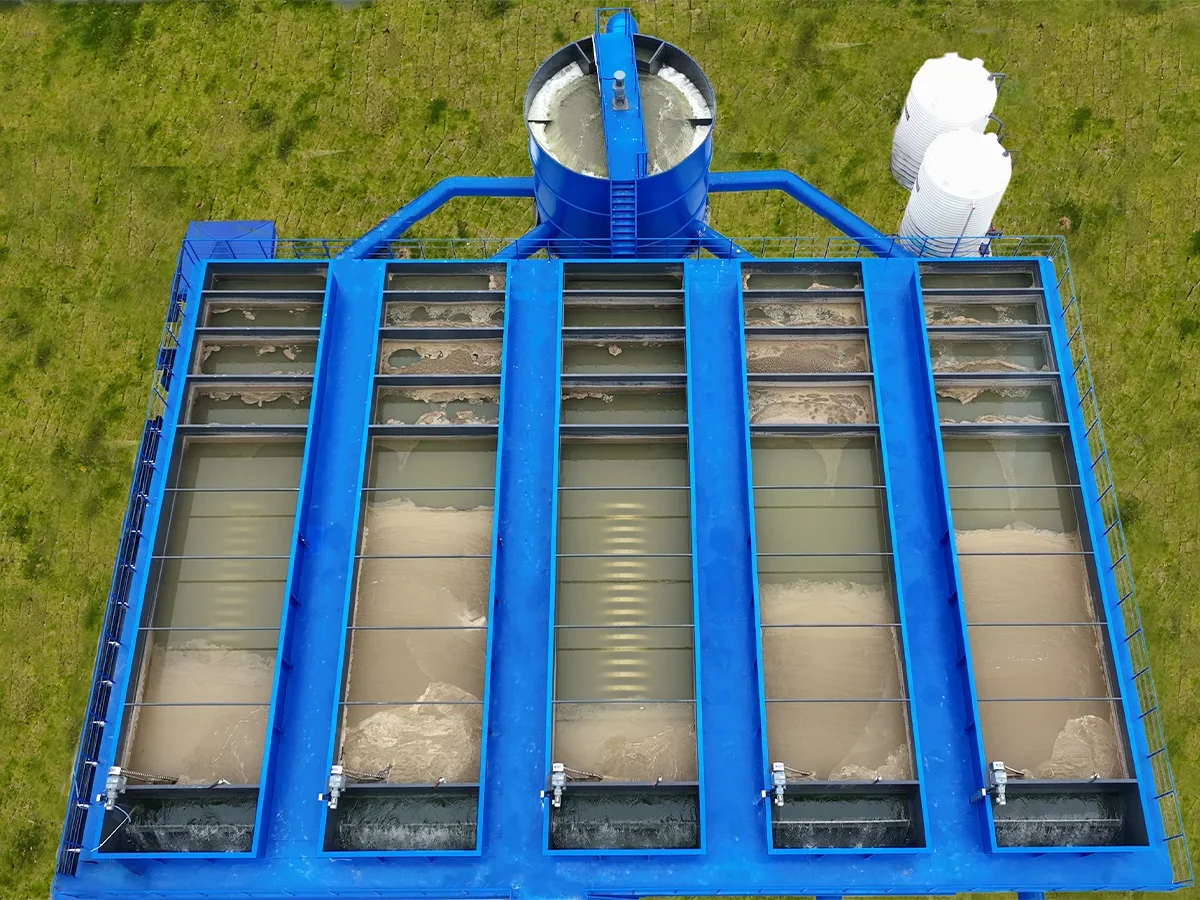
In a typical cloth media filtration system, raw water enters a filtration tank containing filter discs or other filtration elements covered with engineered filter cloth.
Water passes through the cloth while suspended particles are retained on the filtration surface.
As particles accumulate, the filtration resistance gradually increases. The system can monitor operating conditions and initiate an automatic backwashing cycle when cleaning is required.
During backwashing, accumulated solids are removed from the filter cloth and discharged from the system.
The basic process can be summarized as:
Raw Surface Water → Filtration → Suspended Solids Removal → Automatic Backwashing → Pretreated Water
This approach allows filtration to continue with limited operator intervention and can be adapted to large water treatment applications.
Removing Suspended Solids Before Drinking Water Treatment
Suspended solids are one of the main reasons surface water requires pretreatment.
Particles such as silt, clay, and organic debris can make water appear cloudy and can interfere with downstream treatment.
A properly selected surface water filtration system for drinking water pretreatment can capture a significant portion of these suspended particles before the water moves into later treatment stages.
Reducing suspended solids at an early stage can provide several benefits.
Lower Solids Loading
Removing particles before downstream treatment reduces the amount of material that subsequent units must handle.
More Stable Downstream Operation
More consistent influent water quality can make downstream processes easier to control.
Reduced Fouling
Physical removal of suspended particles can reduce the potential for fouling in downstream filtration or membrane systems.
Improved Water Clarity
Removing particulate matter can significantly improve the visual clarity of treated water before subsequent treatment.
However, filtration performance depends on particle size, water quality, filtration precision, flow rate, and system configuration.
How Surface Water Filtration Helps Control Algae
Algae are a common concern in lakes and reservoirs, particularly during warm seasons.
Large quantities of algae can create problems for drinking water treatment plants. They can contribute to:
-
Filter fouling
-
Increased organic loading
-
Unpleasant taste and odor
-
Higher treatment requirements
-
Greater solids production
A surface water filtration system can physically capture suspended algae and other particulate biological material.
Cloth media filtration can be particularly useful because algae can accumulate on the filtration surface and then be removed during backwashing.
However, filtration alone should not be considered a complete algae treatment strategy.
Some algae-related contaminants and dissolved compounds may require additional treatment. Therefore, filtration should generally be considered one component of a broader drinking water treatment process.
The exact treatment configuration should be determined by water quality testing and applicable drinking water requirements.
Supporting Coagulation and Flocculation
Coagulation and flocculation are commonly used in conventional drinking water treatment.
During coagulation, chemicals are added to destabilize particles. Flocculation then encourages smaller particles to form larger aggregates that can be separated from the water.
Surface water filtration can support these processes in several ways depending on where the filter is installed.
If filtration is used as an initial physical treatment step, it can reduce the load of readily removable suspended solids before chemical treatment.
If filtration follows coagulation and flocculation, it can provide an additional barrier for particles that remain after floc formation and clarification.
The appropriate arrangement depends on the raw water characteristics and plant design.
For this reason, engineers should consider the filtration system as part of the complete treatment train rather than evaluating it independently.
Protecting Downstream Membrane Systems
Membrane filtration is increasingly used in advanced water treatment.
Membranes can provide highly effective separation, but they are sensitive to fouling.
Suspended solids, algae, organic matter, and other particles can accumulate on membrane surfaces and reduce performance.
This can result in:
-
Increased transmembrane pressure
-
Reduced permeate flow
-
More frequent cleaning
-
Higher chemical consumption
-
Shorter membrane service intervals
Using a surface water filtration system as pretreatment for membrane filtration can reduce the particulate burden reaching the membrane stage.
This does not eliminate membrane fouling completely, because dissolved organic matter and other contaminants may still contribute to fouling. However, effective particulate removal can improve the operating environment for downstream membranes.
Why Automatic Backwashing Matters
Drinking water treatment plants often operate continuously, making filtration reliability extremely important.
A filtration system that requires frequent manual cleaning can increase labor requirements and potentially interrupt plant operation.
Automatic backwashing provides a practical solution.
When the filter becomes loaded with suspended solids, sensors can detect changes in operating conditions. The system then initiates a cleaning cycle to remove accumulated material.
This can provide several benefits:
-
Reduced manual intervention
-
More consistent filtration
-
Better response to changing water quality
-
Improved operating reliability
-
More predictable maintenance
-
Continuous or near-continuous operation
For surface water sources where turbidity changes rapidly after rainfall, automatic backwashing can be particularly useful.
How Turbidity Affects Drinking Water Pretreatment
Turbidity is an important parameter when designing surface water filtration systems.
Low-turbidity water may place a relatively small solids load on the filter. High-turbidity water, by contrast, can cause rapid accumulation of suspended material.
Surface water turbidity may increase because of:
-
Heavy rainfall
-
Flooding
-
Soil erosion
-
Construction
-
Agricultural runoff
-
Reservoir turnover
-
Seasonal environmental changes
A filtration system should therefore be designed around both normal and peak conditions.
Using average turbidity alone can result in insufficient filtration capacity.
Engineers should evaluate:
-
Average turbidity
-
Maximum turbidity
-
Suspended solids concentration
-
Peak flow
-
Seasonal variation
-
Particle characteristics
-
Required treated-water quality
This information helps determine the appropriate filtration area, number of modules, filtration loading, and backwash configuration.
Can Surface Water Filtration Replace Conventional Drinking Water Treatment?
In most cases, no.
A surface water filtration system is primarily a physical separation technology. It can remove suspended particulate matter, but it does not automatically remove every contaminant that may be present in surface water.
Depending on the source water, drinking water treatment may also require processes for:
-
Pathogen control
-
Dissolved organic compounds
-
Taste and odor
-
Chemical contaminants
-
Nutrients
-
Dissolved metals
-
Specific micropollutants
Disinfection is especially important because physical filtration alone should not be assumed to provide complete microbial safety.
Therefore, surface water filtration should generally be viewed as a pretreatment or intermediate treatment stage within a comprehensive drinking water treatment process.
Its role is to make subsequent treatment more efficient and manageable.
Benefits of Using Surface Water Filtration as Pretreatment
When properly designed, a surface water filtration system can provide several operational advantages.
1. Reduced Suspended Solids
The primary benefit is physical removal of particulate matter.
2. Improved Feed Water Quality
Removing larger quantities of suspended solids can create more stable conditions for downstream treatment.
3. Lower Fouling Potential
Reducing particulate loading can help protect downstream filters and membranes.
4. Automated Operation
Automatic cleaning can reduce routine operator involvement.
5. Compact Equipment Options
Some cloth media systems can provide high filtration capacity in a relatively compact footprint.
6. Adaptability to Variable Water Quality
With appropriate design and control, filtration can respond to changing solids loading.
7. Reduced Maintenance Pressure on Downstream Equipment
Removing solids earlier in the treatment process can reduce the workload placed on subsequent treatment units.
These advantages can make surface water filtration equipment an attractive option for drinking water pretreatment projects.
Final Thoughts
Surface water filtration systems can play an important role in drinking water pretreatment by reducing suspended solids, algae, silt, and other particulate contaminants before water reaches downstream treatment processes.
Their value goes beyond simply improving water clarity. By reducing the particulate load entering coagulation, clarification, membrane filtration, or other treatment stages, filtration can help create more stable operating conditions and reduce the workload placed on downstream equipment.
Cloth media filtration with automatic backwashing can be particularly useful for surface water applications where suspended solids and water quality fluctuate. The ability to automatically clean the filtration surface can support continuous operation while reducing the need for frequent manual intervention.
However, filtration is only one part of a complete drinking water treatment strategy. It should not be expected to remove every dissolved or microbiological contaminant. The right solution depends on the source water, turbidity, suspended solids, algae concentration, flow rate, required effluent quality, and downstream treatment process.
For municipalities, water utilities, and industrial users developing a new drinking water treatment project, the best approach is to start with detailed raw water analysis. By understanding both normal and peak water quality conditions, engineers can select the appropriate surface water filtration system, determine the required capacity, and integrate filtration effectively into the overall pretreatment process.
When properly designed, surface water filtration can provide a reliable first line of defense against particulate contamination and help create a more stable foundation for safe, efficient, and consistent drinking water treatment.
http://www.jinhuacn.com
jinhua -
-
AuthorPosts

- You must be logged in to reply to this topic.