

- This topic is empty.
-
AuthorPosts
-
2026-10-08 at 4:18 pm #12052
How to Choose a High Precision Laser Displacement Sensor
Selecting a high precision laser displacement sensor is a decision-stage engineering task, not a catalog lookup. The sensor must survive the site, speak the language of the existing control architecture, and return continuous displacement data that a PLC or supervisory computer can act on. For automation users evaluating non-contact laser measurement, the sequence below follows the same order of questions that KJT Sensors applies when confirming a sensor configuration against a real application.
Start With the Measurement Task, Not the Model Number
Industrial distance detection often depends on manual measurement, while conventional photoelectric sensors supply presence-or-absence output rather than continuous distance data. Contact measurement introduces wear, and target color, material, gloss, inclination, and ambient light can destabilize detection at complex industrial sites. These conditions raise commissioning, troubleshooting, and maintenance costs.
- Continuous distance measurement — real-time distance reading, position determination, and continuous distance acquisition rather than a simple switching state.
- Displacement feedback — the sensor outputs a displacement signal for automated equipment instead of a discrete trigger.
- Non-contact detection — measurement without mechanical contact, which matters for easily damaged surfaces and precision workpieces.
Step 1: Confirm Range and Target Geometry
Detection range sets the boundary of the whole selection. Relevant laser displacement and distance sensors handle vertical or inclined targets at distances up to 30 meters, which covers cranes, stacker cranes, long conveyor runs, and outdoor distance measurement where a short-range sensor cannot be mounted close to the target.
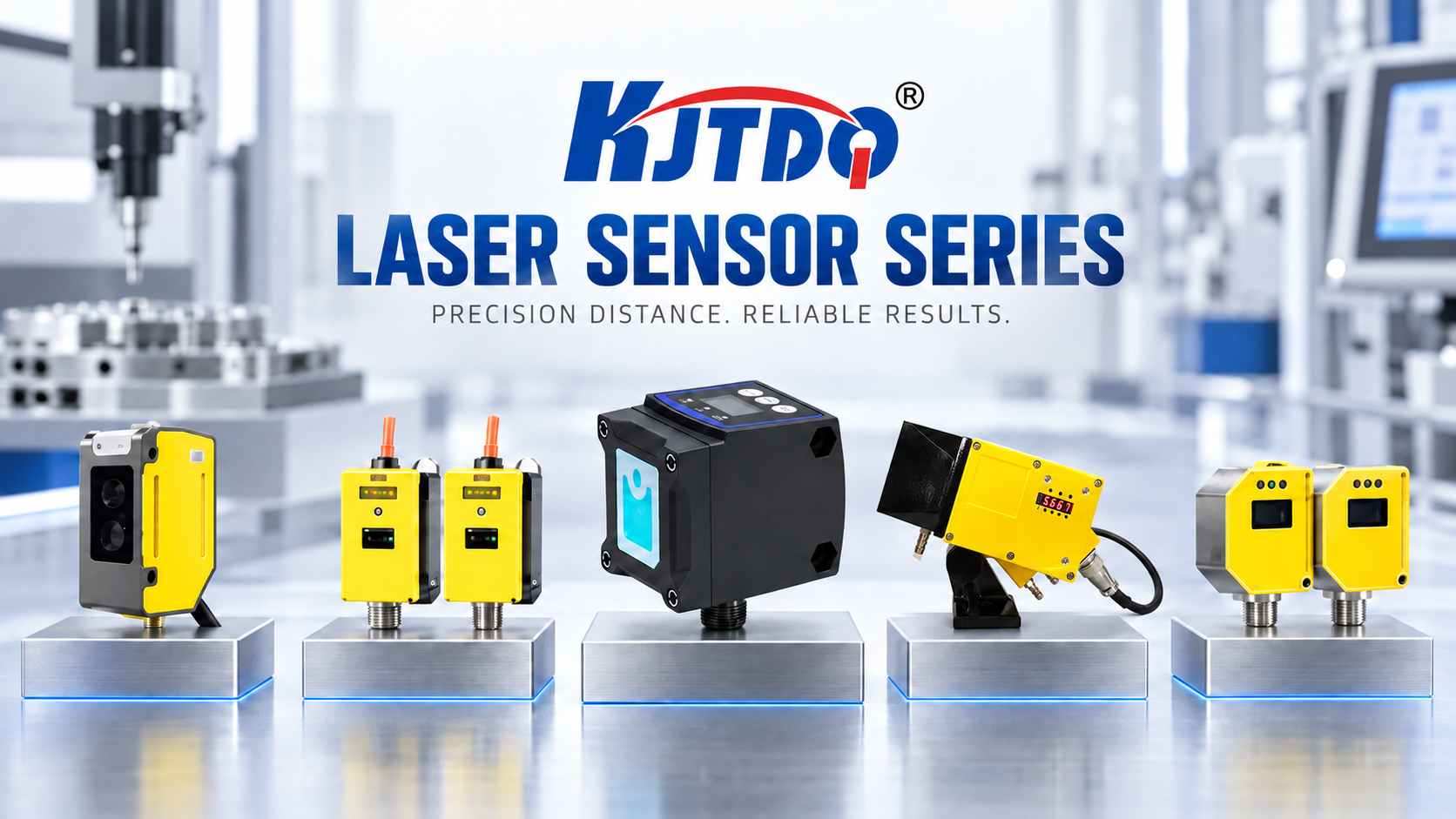
Ask two questions: what is the maximum working distance, and is the target surface vertical or inclined? For shorter, high-speed work, the KJT Sensors ToF Laser Photoelectric Sensors cover sensing distances of 1 m, 2 m, and 4 m across the KJT-FG40 series, with a switching frequency up to 1,000 Hz and an adjustable response time of 1 ms.
Step 2: Match the Output Interface to the Control Architecture
A sensor that cannot be wired into the existing controller creates engineering work. The available interfaces include:
- Relay limit output
- NPN/PNP output
- Analog voltage output
- Analog current output
- RS-485 output
These outputs allow direct connection to PLCs, control cabinets, data-acquisition systems, inspection systems, supervisory computers, and safety-monitoring systems. Multiple output options are what let a sensor be integrated into existing automated equipment and control architecture rather than forcing a redesigned cabinet.
Step 3: Test the Specification Against Target Surface and Ambient Light
Variations in color, material, gloss, and inclination are the usual cause of unstable readings on a production line. A sensor built around laser-ranging technology emits the measurement beam, receives the reflected signal, and calculates target distance, which reduces sensitivity to those surface characteristics.
Environmental protection belongs in the same step: IP67 enclosure protection and an ambient-light-resistant design support stable operation in demanding industrial environments, including outdoor distance measurement and steel-industry sites.
Step 4: Weigh Display, Programming, and Commissioning Effort
OLED display and pushbutton programming allow on-site distance viewing, threshold setting, parameter adjustment, and fault diagnosis. This shortens installation, commissioning, and troubleshooting — practical value when a sensor is installed at height on a crane or inside a machine frame.
Step 5: Verify the Functional Modules Behind the Specification
A credible sensor is a stack of engineered modules, not a single number. In KJT Sensors TLS Series High-Accuracy Laser Displacement Sensors, those modules are the laser-ranging module, signal-output module, parameter-setting and display module, industrial-protection module, and system-integration module. Measurement sensors add a laser-emitter module, optical-imaging module, photoelectric-receiver module, signal-processing module, data-output module, and mounting/protection module for continuous in-line measurement.
Step 6: Map the Sensor to the Application
The final question is whether the sensor’s intended scenarios match the site. Common fits include displacement measurement, distance feedback, workpiece-position determination, in-position detection on automated equipment, crane collision avoidance, warehousing and logistics distance measurement, and distance measurement for industrial robots or production lines. Broader deployments extend to smart warehousing, stacker crane and shuttle positioning, logistics sorting, AGV/AMR obstacle avoidance, material-height and roll-diameter measurement, steel and metallurgy, and conveyor safety.
For precision work, measurement sensors and high-accuracy laser displacement sensors support thickness, height, flatness, surface-profile, and position-change measurement, with data output to a PLC, controller, inspection system, or supervisory computer to enable automatic decision-making, quality inspection, and closed-loop control.
A Selection Scenario: Stacker Crane Positioning
Consider a stacker crane that must confirm the position of a load at distance. Contact measurement is impractical at height, and a presence-only photoelectric switch cannot report position. A laser distance or displacement sensor mounted on the crane, reading a vertical or inclined target at a distance up to 30 m, delivers continuous distance data over an analog or RS-485 interface to the control system while its IP67 housing and ambient-light immunity handle the warehouse environment. The OLED display and pushbutton programming let technicians set thresholds on the machine instead of at a bench.
How KJT Sensors Fits This Evaluation
KJT Sensors is a product and solution provider for industrial automation sensing components. Its portfolio spans laser distance sensors, laser displacement and distance sensors, LiDAR sensors, laser distance meters, ToF laser photoelectric sensors, and measurement sensors, addressing switching output, distance signal output, machine safety, robotic navigation, and quality inspection.
The differentiated position rests on non-contact laser detection, selectable signal outputs, real-time distance feedback, local display and pushbutton programming, IP67 protection, and ambient-light resistance — a combination aimed at reduced commissioning effort when connecting sensors to PLCs, control cabinets, supervisory computers, and safety-monitoring systems. Stated value: continuous distance measurement, automatic decision-making, alarm interlocking, and equipment protection reduce manual intervention and field-maintenance costs across warehousing, logistics, steel, packaging, food and beverage, electronics, and equipment manufacturing.
Procurement and Configuration Checklist
Standard models can be quoted quickly once the model and quantity are identified. Complex applications are quoted after technical confirmation of site conditions and parameters. Expect the quotation to reflect measuring range, accuracy or displacement accuracy, output type, communication interface, mounting method, IP rating, protection requirements, order quantity, customization requirements, delivery cycle, and project-service content. Special operating conditions, engineering projects, volume purchases, and non-standard customization are handled through technical confirmation, with on-site commissioning and troubleshooting supported where applicable.
Work through the six steps in order — task, range, output, surface and environment, display and programming, modules and application fit — and the choice of a high precision laser displacement sensor becomes a documented engineering decision rather than a guess.
https://www.kjt-sensors.com/
KJT Sensors -
AuthorPosts

- You must be logged in to reply to this topic.