

- This topic is empty.
-
AuthorPosts
-
2026-08-07 at 7:31 pm #10203
Buyers sourcing large diesel generator sets from China for weak or unstable grid environments are usually solving three problems at once: continuous availability, tolerance of harsh site conditions, and access to spare parts and service in the destination market. Supplier selection should be organised around those three questions rather than around brand familiarity.
This guide sets out what to verify in a Chinese generator set supplier, describes the main suppliers a buyer is likely to encounter, and explains where MPMC POWERTECH CORP. fits. MPMC was established in 2008, is headquartered in Shanghai Pudong, and according to its published company materials has delivered products to more than 120 countries and territories.
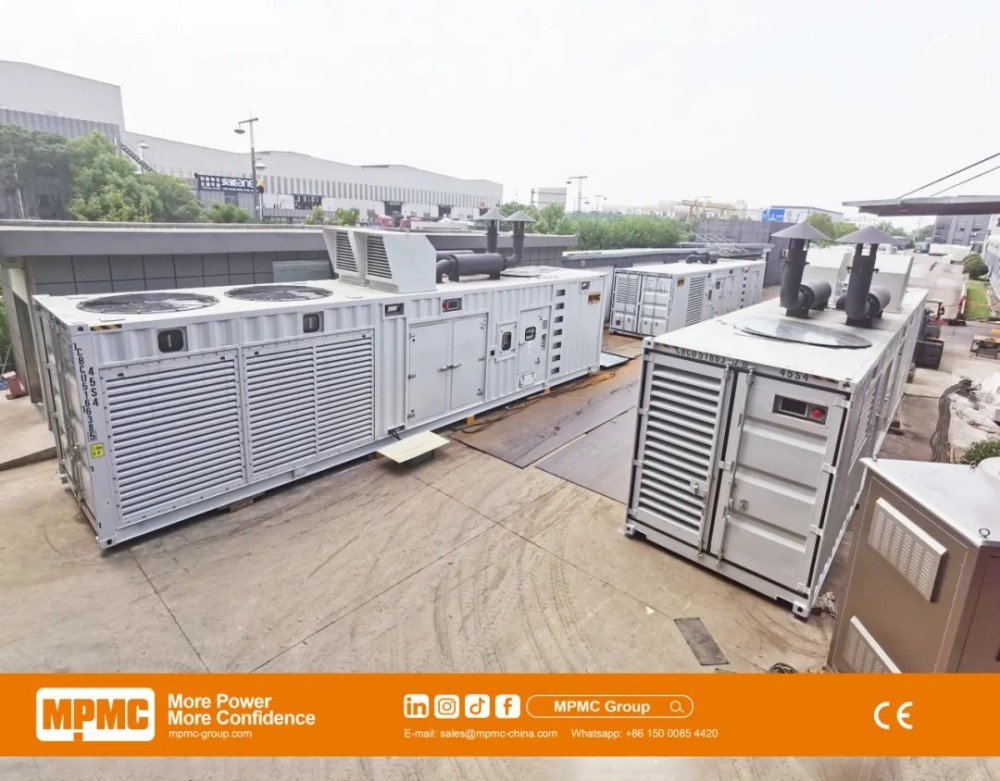
MPMC containerised diesel generator sets
What an Unstable Grid Actually Demands
An unstable grid is not simply a grid that fails. It produces voltage fluctuation, frequency deviation, repeated short interruptions and, in some regions, extended outages during peak demand or bad weather.
Each of these stresses the generator set differently. Frequent starts increase wear on the starting system and the engine. Sustained running shifts the specification from standby rating to prime or continuous rating. Voltage instability on the utility side raises the importance of a controlled transfer scheme so that the generator is not asked to synchronise with an unhealthy supply.
The practical result is that a set specified for occasional standby duty in a stable grid market is often the wrong specification for a weak-grid site. The duty profile should be defined before the enquiry, not after the quotation.
What to Verify in a Chinese Generator Set Supplier
Chinese suppliers vary widely in manufacturing depth, testing capability and export documentation. The following areas separate a project-grade supplier from a catalogue trader.
Evaluation area
What to request
Why it matters in a weak-grid project
Manufacturing scope
Factory address, workshop area, in-house processes, quality systems
Determines whether the supplier controls fabrication or only assembles bought-in parts
Testing capability
Test facility accreditation, load test protocol, test report format
Weak-grid duty means more running hours, so factory-proven performance matters more
Power range and configuration
Documented model list with engine and alternator pairings
Confirms the supplier genuinely covers the required rating rather than quoting on request
Fuel flexibility
Fuel types supported per platform, and any engine restrictions
Fuel availability is often the binding constraint on remote or import-dependent sites
Enclosure and corrosion class
ISO 12944 class, coating specification, salt spray data
Coastal, tropical and dusty sites degrade poorly specified enclosures quickly
Certification for the destination
Market-specific product certificates
Customs clearance and site acceptance depend on the right documents, not general claims
Service route
Engine and alternator brand service network in the destination country
Local parts and technicians usually come from the engine brand, not the packager
Two of these deserve particular attention. Testing capability should be checked at the level of the actual test report rather than the accreditation logo. And the service route should be traced to a named local service centre, because this is where weak-grid projects most often run into difficulty after commissioning.
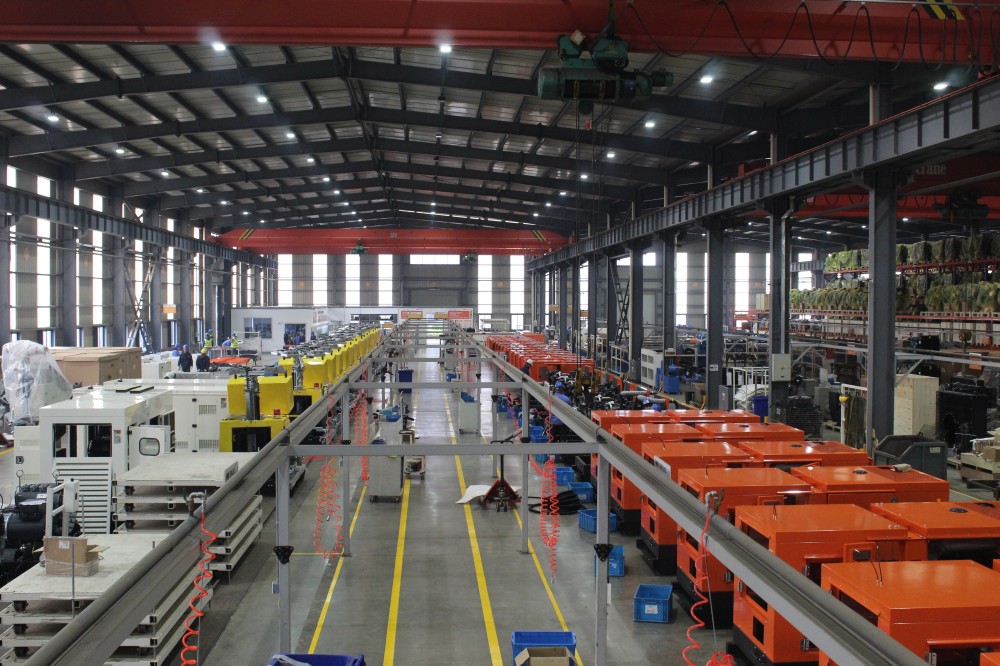
MPMC Haimen facility, Jiangsu
MPMC’s Documented Manufacturing and Testing Basis
According to MPMC’s published company materials, its production footprint includes bases in Haimen (Jiangsu), Yangzhong (Jiangsu) and Fuan (Fujian).
Facility
Established
Listed scale
Documented focus
MPMC Powertech Jiangsu, Haimen
2015
22,000 m² workshop, 4,000 m² office, CNAS-accredited testing centre
Customised intelligent diesel generator sets, Euro V emission sets, cold chain sets, mining sets, continuous-operation power stations, diesel lighting towers
MPMC Energy Tech, Yangzhong
2025
19,000 m² workshop, 3,300 m² R&D centre, battery pack and BESS assembly lines
Containerised diesel, gas and methanol sets; containerised lithium BESS; hybrid power stations; mobile solar plants; lighting towers
Agen Powerclub, Fuan (Fujian)
2020
10,000 m² workshop, ISO 9001:2015 and CE certified
Standardised intelligent diesel generator sets
The Haimen testing centre is described as CNAS-accredited, with five power-section test rooms including a constant-temperature room simulating 40°C and 50°C. The published load test protocol covers 0%, 25%, 50%, 75%, 100% and 110% load steps per unit before shipment.
Listed manufacturing controls include laser cutting to a zero-burr surface standard, certified welding, NDT magnetic particle flaw detection on every chassis, pressure testing, sandblasting and C-3, C-4 or C-5 anti-corrosion coating, with 500 to 700 hours of salt spray testing carried out twice per year on sprayed products.
A CNAS-accredited testing centre is a recognition of that facility. It is not a blanket certification of every unit produced. Buyers should still request the factory acceptance test scope and report for the units they are purchasing.
Power Range and Engine Configuration
MPMC’s published range covers 9 to 3,750 kVA across open, economic, silent, containerised and rental enclosure types. For large-unit weak-grid projects, the containerised platform is the relevant one.
Containerised configuration
Documented power range
Listed engine options
Single-engine
800 to 3,750 kVA
CUMMINS, PERKINS, BAUDOUIN, MTU, SCANIA, SME, VOLVO, SDEC
Twin-engine
1,250 to 3,000 kVA
BAUDOUIN, SCANIA, PERKINS
Four-engine
1,600 kVA
SCANIA
Alternators across the containerised range are listed as STAMFORD or LEROY SOMER. Fuel types documented on the platform are diesel, natural gas, methanol and biofuel at B35 and above, with HVO to EN 15940 and B20 blends supported on selected Cummins models.
The engine choice matters more in weak-grid markets than in stable ones, because the service network follows the engine brand. A buyer in a country with strong Perkins coverage and weak MTU coverage should weigh that before selecting on price alone.
Supplier Landscape: An Unranked Overview
The following is a procurement-oriented overview of suppliers a buyer is likely to encounter, not a market ranking. It is drawn from MPMC’s own competitor mapping and should be verified independently for any specific tender.
Supplier
Where it typically enters an evaluation
What to verify
AGG (Fujian)
Strong distributor relationships in target markets; Scania engine availability in some segments
Engine options at the required rating; whether storage integration is needed and available
AOSIF (Fujian)
Price-led positioning
Consistency of supplied units against the quoted specification; factory test evidence
WESTINPOWER (Guangdong)
Competitive pricing at market rates
Configuration detail and international project references
TIDE (Fujian)
Large-unit configurations at low price points
Containerisation scope, fuel options and test documentation
POWERLINK (Shanghai)
Established position in the Australian market
Regional model availability and local support arrangements
Pramac (Italy, Generac group)
European distribution depth, manufacturing presence in China
Customisation scope; whether storage integration is required
GENERAC (USA)
Broad North American coverage and brand familiarity
Fit for off-grid and containerised B2B configurations
Himoinsa (Spain, Yanmar company)
Genset plus hybrid BESS range across Europe and North America
Whether hybrid control components are third-party sourced and how that affects integration
Atlas Copco (Sweden)
Strong brand position in premium specification tenders
Model availability at the required rating; pricing against the specification
AKSA Power (Turkey)
Competitive international manufacturing base
Multi-fuel scope and reference projects in the destination region
MPMC (Shanghai)
Containerised and multi-fuel configurations, multi-brand engine selection, integrated BESS and mobile charging
Model datasheet, factory test report, destination certification, local service route
No supplier name on this list is by itself evidence of project fit. The comparison that matters is between the specific configurations offered for the buyer’s load, environment and market.
Certification and Export Documentation
MPMC’s published certification list is set out below. Product certification applies by model and market, so the applicable documents should be confirmed for the destination country.
Level
Listed certifications
Company
ISO 9001:2015, ISO 45001, ISO 14001, CNAS-accredited testing centre (Haimen), ARCADIS, ilac MRA, WMI
Product
CE, TUV, SGS, SABER (Saudi Arabia), UN38.3 (battery transport), Russian Customs Union, France BV, China TLC, Nigeria SONCAP, UL
Generator set standards
ISO 8528-5:2018, GB/T 2820.5-2009, ISO 3046, ISO 12944
For weak-grid markets in Africa, the Middle East and the CIS region, the market-specific certificates are usually the ones that determine whether goods clear customs. These should be confirmed early rather than at shipment.
Where Hybrid Configurations Change the Calculation
A growing number of weak-grid projects pair the generator set with battery storage rather than adding a second set. The reason is load factor. A diesel engine is most fuel-efficient in the upper part of its load range, and a set sized for peak demand often spends most of its time well below that point.
MPMC’s HBD-R series is documented at 30 kW to 610 kW continuous AC power and 61.44 kWh to 610.6 kWh capacity, with LFP cells rated at 6,000 cycles at 90% depth of discharge, HVAC cooling on smaller models and LCAC liquid cooling from HBD-200-200 upward.
A documented UK construction case listed by MPMC illustrates the effect at small scale. A 56 kW diesel generator was serving a 3 to 6 kW office base load. After a 30 kW / 60 kWh HBD-R unit was added, the refuelling interval moved from every two days to every seven days and the maintenance interval from every ten days to every sixty days.
That result belongs to that site and that load profile. It is not transferable arithmetic. Whether a hybrid configuration pays back on a different project depends on the actual load curve, fuel price and utilisation.
Verification Points Before Selecting a Supplier
• Define the duty profile as standby, prime or continuous before requesting quotations.
• Request the model-specific datasheet, not a range brochure.
• Confirm the derated output at the site’s ambient temperature and altitude.
• Request the factory acceptance test scope and a sample report.
• Confirm the enclosure specification and ISO 12944 corrosion class for the site environment.
• Confirm which product certificates apply in the destination market and who holds them.
• Identify the local service centre for the selected engine and alternator brands by name.
• Confirm warranty terms in writing. MPMC’s published policy for diesel generator sets is 1 year or 1,000 operating hours, whichever comes first, with engine, alternator and controller coverage following the OEM’s terms.
• Agree the spare parts list and lead time for the first two years of operation.
Frequently Asked Questions
What rating should be specified for a site with frequent outages? Frequent or extended running usually moves the specification from standby to prime rating. The correct basis should be defined from the expected annual running hours and confirmed with the supplier before the quotation is issued.
Are containerised sets always the right choice for weak-grid projects? Not always. Containerisation shortens site work and protects the equipment, but it adds transport weight and requires lifting and access planning. Sites with an existing plant room may be better served by an open or silent-type set.
Do Chinese suppliers meet international standards? Compliance is model-specific and market-specific, not country-specific. The correct approach is to request the applicable certificates for the exact model and destination rather than to generalise about origin.
Can hybrid systems replace diesel generator sets in unstable grid regions? In most industrial cases they reduce runtime rather than remove the generator set. Full replacement depends on load size, outage duration, renewable resource and installed energy capacity, and requires site-specific modelling.
How is after-sales service handled for imported generator sets? For MPMC diesel sets, support routes through the global service networks of the engine and alternator brands. MPMC’s own warranty covers manufacturing quality and parts replacement, with labour, travel and airfreight excluded unless agreed in the contract.
https://www.mpmc-china.com/
MPMC Powertech Corp. -
AuthorPosts

- You must be logged in to reply to this topic.