

- This topic is empty.
-
AuthorPosts
-
2026-11-20 at 7:46 pm #13904
For engineers and procurement teams evaluating limit switch selection options for industrial automation, the core challenge is matching mechanical actuation reliability with the environmental and electrical demands of a given application. KJT Sensors addresses this need with a product portfolio built around industrial-control sensor products for equipment travel control, position protection, and safety interlocking, including travel and limit switches, explosion-proof sensors, and microswitches.
Why Mechanical Limit Switches Remain Essential
Industrial automation environments frequently expose detection components to dust, moisture, electromagnetic interference, voltage fluctuation, and signal wave—conditions that can compromise purely electronic sensors. KJT Sensors‘ travel and limit switches use mechanical contact to make or break control circuits, converting mechanical displacement and position state into electrical signals through contact collision-driven mechanical transmission. This approach supports limit protection, position feedback, automatic direction switching, opening connection, and safety interlock functions without dependence on non-contact detection.
Because the actuation is purely mechanical, these switches are independent from electronic chips and unaffected by electromagnetic interference, voltage fluctuation, and signal wave—an important consideration in facilities such as steel and metallurgy plants, ports, and automated pallet storage systems where strong electromagnetic environments can cause false triggering in electronic position sensors.
Key Selection Criteria for Industrial Applications
Environmental and Protection Requirements
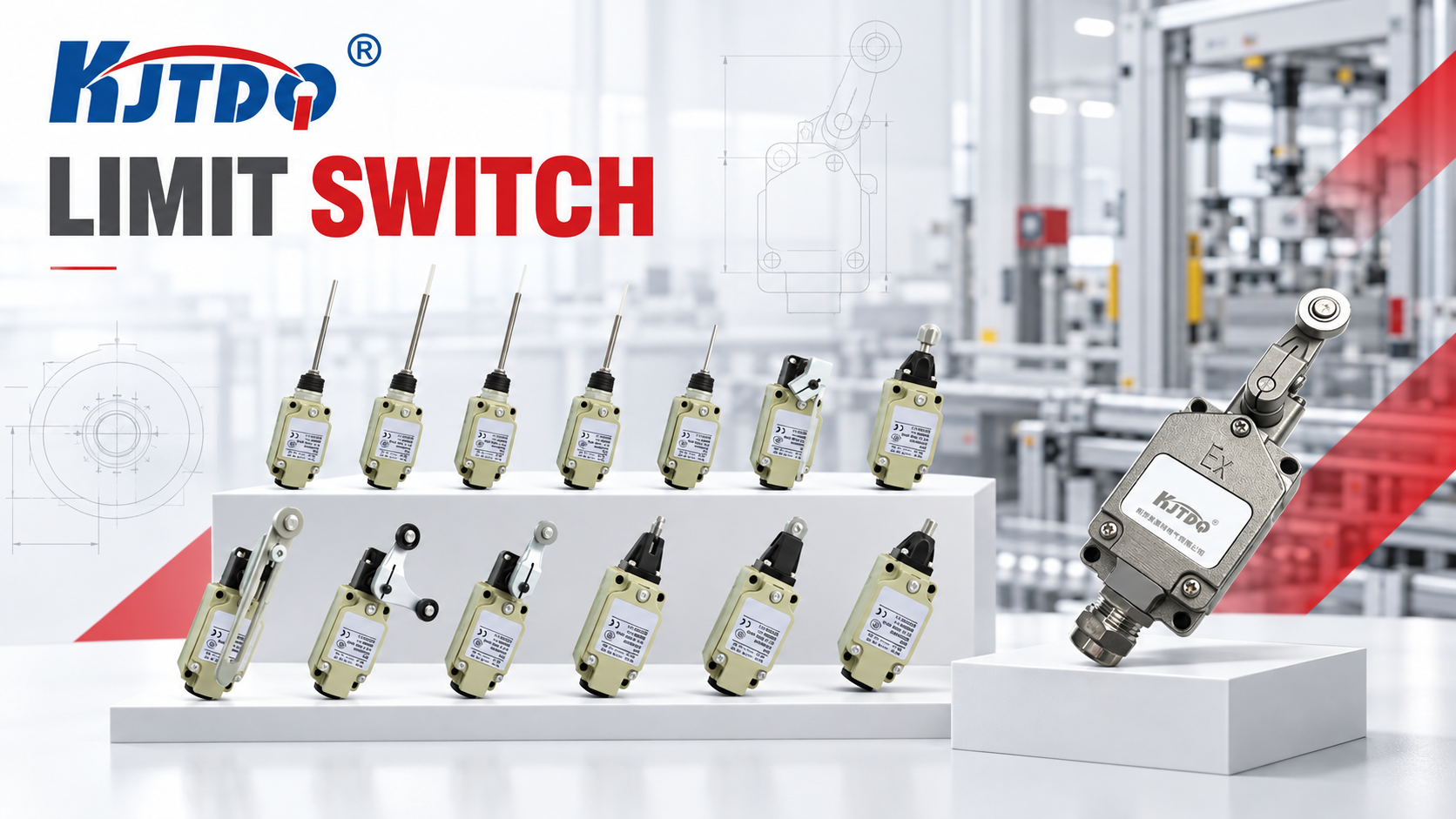
Selection should begin with environmental conditions. KJT Sensors offers travel and limit switches with IP65 and IP67 protection ratings, along with high-temperature, waterproof, explosion-proof, and dual-circuit variants. Shell material options include metal and engineering plastic, selectable according to site conditions such as dust, moisture, oil exposure, and vibration.
Electrical Ratings
For control and auxiliary circuits, the KJT-LXK3 series is designed for 50–60 Hz AC up to 380 V or DC up to 220 V, supporting operation, control, signaling, and interlocking functions. For microswitch-based applications, the KJT-B series generally suits low-current, low-voltage precision-control circuits, while the KJT-P series can carry higher AC or DC loads for different control applications.
Hazardous-Area Certification
In explosion-hazardous environments such as petrochemical, chemical processing, coal mining, and oil and gas facilities, explosion-proof travel switches carry the Ex demb II C T6 Gb explosion-protection marking. These switches are available with multiple actuator structures—roller levers, adjustable rods, plungers, and roller plungers—supporting power generation, chemical processing, petroleum, textile, and steel applications.
Actuator and Contact Configuration
Actuation methods include push rods, rollers, roller arms, and plungers, each suited to different mechanical triggering requirements. Contact output is typically normally open/normally closed, feeding position signals to trackers, contactors, or controllers. An automatic reset module restores the initial working state rapidly after external force release, which supports high-frequency repeat operations common in continuous production lines.
Platform Compatibility
A practical selection guide must also consider how the switch integrates into the broader control architecture. KJT Sensors‘ products can connect to PLC, relay, control cabinet, contactor, controller, or safety circuit configurations. Explosion-proof laser distance sensors within the explosion-proof sensor line additionally support NPN/PNP output types, broadening compatibility with varied control logic.
Real-World Application Evidence
Documented customer cases illustrate how selection criteria translate into operational outcomes:
-
Port Tyre Lift Limit Detection Modification: In a port environment affected by moisture, salt spray, and heavy vibration, aging limit switch contacts caused poor contact and false triggering. Replacing them with industrial high-protection roller-arm travel limit switches, setting double limit detection at upper and lower limit positions, and optimizing the connection and waterproof structure decreased limit detection failures and improved loading operation stability.
-
Underground Belt Misalignment and Tear Protection: Underground dust and humidity, combined with manual inspection lag, previously delayed detection of belt misalignment and tear failures. Installing isolated limit switches at misalignment and tear protection points, connected to PLC early warning and stop functions, enabled automatic detection with interlocked protection and improved safety and compliance.
-
Hanging Basket Limit Detection Upgrade: For high-altitude construction work, unstable travel limit detection created over-rise and personnel safety risk. High-sensitivity limit switches with metal trigger boards and an optimized fixed structure, connected to the hanging basket safety interlock circuit, improved reliability of up-and-down limit detection and reduced overtravel risk.
-
Automated Pallet Storage Coating Machine: In an intense electromagnetic environment where electronic position sensors false triggered, multiple switches with reversal installation were placed at high, low, and stopping points on each floor, reducing positioning errors and improving unmanned warehouse operating stability.
-
Steel Factory Lifting Limit Detection: High temperature, high dust, and strong vibration previously caused frequent limit detector damage. High-strength industrial limit switches with optimized transmission shaft connection and double protection reduced failures and spare parts losses while improving heavy crane lifting safety.
-
Precision Electronic SMT Automation Equipment: Movement delay and positioning deviation from traditional limit detection affected placement and glue accuracy. High-accuracy dynamic-speed limit switches, adapted to narrow spaces with optimized movement-boundary logic, reduced false triggering and positioning deviation.
Procurement Considerations
Standard models are typically quoted by model and quantity, while project and customized products—including explosion-proof, waterproof, high-temperature, double-circuit, equipment transformation, or prototype replacement requirements—require technical confirmation before quotation. Pricing factors include product series, trigger structure, touch point form, voltage rating, IP rating, explosion-protection requirements, temperature resistance, water resistance, mounting method, and order quantity. Service scope extends to selection support, installation and commissioning when required, and after-sales support considered specifically for hazardous-area projects.
Industry Adaptation
KJT Sensors‘ travel and limit switch lines serve lift transport equipment, conveyor systems, automated production lines, storage logistics, construction equipment, steel and metallurgy, machinery, engineering equipment, lifting equipment, automatic doors, machine tools, construction machinery, packaging equipment, and explosion-hazardous areas. This breadth reflects the underlying design principle: a straightforward mechanical structure combined with generic spare parts supports fast site replacement and lowers long-term maintenance burden across diverse industrial automation settings.
For teams building a limit switch selection framework, the practical takeaway is to align environmental protection rating, electrical load requirements, hazardous-area certification needs, and control-platform compatibility before finalizing a specification—an approach reflected throughout KJT Sensors‘ documented product configurations and customer case outcomes.
https://www.kjt-sensors.com/
KJT Sensors -
-
AuthorPosts

- You must be logged in to reply to this topic.