

- This topic is empty.
-
AuthorPosts
-
2026-11-26 at 6:38 pm #14046
Published: November 2026 | By KoreLamin Engineering Team
A new die pays for itself at roughly 4–30 tonnes for most custom EI shapes; below that threshold, an existing standard tool is almost always the cheaper decision. The spread is wide because buyers are usually shown the tooling price and the unit price in two separate emails. Put them into one custom silicon steel lamination tooling cost amortization break even point calculation and the answer becomes a single number finance can approve. KoreLamin has built non-standard lamination tooling since 1998, so the worked examples below reflect how a China factory actually quotes a drawing-based program rather than a catalogue part.
1. At what tonnage does a new die pay for itself?
Divide the die cost by the saving you get on every tonne stamped with it. That saving has two parts: a better nesting yield from geometry that fits your core, and the removal of any premium you pay to have an existing tool adapted. The formula is deliberately short — everything contentious sits inside the two inputs.
• Break-even tonnes = die cost ÷ (per-tonne price reduction + per-tonne scrap saving).
• Case A, simple shape: $800 die, $200 saved per tonne → 4 tonnes. At a 5-tonne production lot the tool is already paid off.
• Case B, typical three-window shape: $2,400 die, $200 saved per tonne → 12 tonnes. Worth it for a recurring appliance program, marginal for a one-off order.
• Case C, modest gain: $2,400 die, only $80 saved per tonne → 30 tonnes. Here a free standard tool wins even at healthy volumes.
• Reality check: stamped EI laminations trade around $899–1,800 per tonne, so a $200 saving is roughly 11–22% of material cost. Ask for the saving as a line item, not a promise.
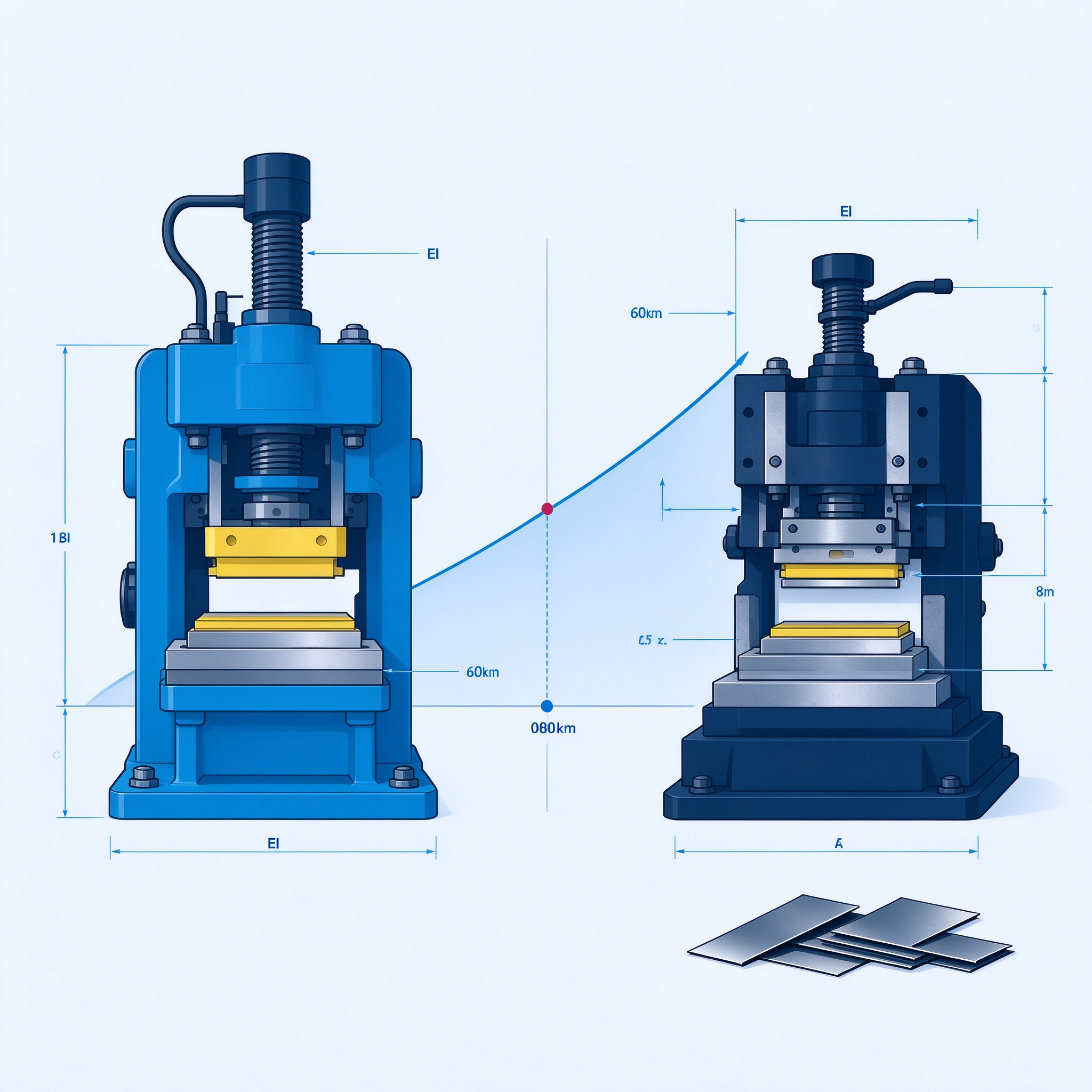
These are worked examples using round numbers — replace them with your own quoted die cost and the supplier's written per-tonne delta. Complexity drives die cost more than size does: a shape with multiple windows, tight hole positions or a narrow web can triple tooling spend while adding nothing to the tonnage. Standard EI sizes from EI-28 to EI-360 usually carry no tooling charge at all, which is why the honest first question is whether a standard geometry can do the job. KoreLamin quotes both routes from the same drawing, so the comparison is visible before any steel is cut. Our non-standard special-shaped laminations are built on that basis.
Lead time belongs in the calculation too. A standard 20-tonne EI order ships in about 10–12 days; a non-standard tool typically takes 25–30 days before first articles. If your program starts in four weeks, the cheaper custom silicon steel lamination tooling cost amortization break even point is irrelevant — you need a tool that exists. Run the payback math only after the schedule fits.
✅ Bottom line: Payback tonnage is die cost divided by the real per-tonne saving, and 12 tonnes is the practical dividing line for most EI programs.
2. What else moves the break-even besides tonnage?
Die life and revision stability are the two silent variables. custom silicon steel stamping die life and maintenance intervals decide whether the tool survives the payback volume at all, and a single drawing revision can reset the economics by requiring a fresh insert or a complete re-cut.
• Regrind trigger: burr height, not stroke count. On 0.35 mm steel a precision core usually needs burr held to 0.02–0.03 mm; once it drifts past that, the tool is sharpened and the stack factor starts to suffer.
• Die clearance: 5–8% of sheet thickness on punching. Too generous and burrs grow; too tight and edge wear accelerates. Both shorten the interval between maintenance stops.
• Revision control: freeze the hole positions, window width and stack height before tooling starts. A change after T0 samples is a new cost line, not a favour.
• Nesting: the shape that saves $200 per tonne is usually the one that wastes less mother coil. If the new geometry does not improve yield, the payback case collapses.
Ask the supplier to put custom EI lamination tooling cost per shape from China factory in writing with the shape complexity tier, the expected regrind interval, and who pays if the drawing changes. Jiangyin KoreLamin Electric Appliance Co., Ltd. began EI production in 1998, added an in-house slitting line in 2003 and now ships about 7,500 tonnes of finished laminations a year from a 5,000 m² Jiangyin workshop, supplying appliance programs for Midea, Gree and Mitsubishi Heavy Industries. That scale matters here: a tool used on a running program is maintained on a schedule, not when a batch fails inspection. Wholesale repeat orders are where tooling amortisation actually works.
One more number worth asking for is the first-article inspection report. A die that produces one good sample but cannot hold ±0.02 mm on the thousandth sheet will never reach its payback tonnage. KoreLamin issues dimensional and burr data against the approved drawing before a bulk lot is released, which is the cheapest insurance on a tooling decision. Keep that report beside the custom EI lamination tooling cost per shape from China factory so the amortisation model and the quality evidence live in the same file.
✅ Bottom line: Regrind intervals and drawing revisions can erase a good payback calculation, so both belong in the tooling quotation.
Frequently asked questions
Q: How do I calculate a custom silicon steel lamination tooling cost amortization break even point if the supplier will not split out the saving?
A: Request two formal quotes for the same drawing — one on an existing standard tool, one on a new die — at the same tonnage and delivery state. The per-tonne difference is your saving. Without both numbers, any amortisation figure is a guess.
Q: What are realistic custom silicon steel stamping die life and maintenance intervals?
A: Suppliers quote life in strokes, but buyers should manage it by burr height. On 0.35–0.50 mm non-oriented steel, plan sharpening when burr approaches 0.03–0.05 mm. Ask for the interval in tonnes as well as strokes — that is the unit your finance model uses.
Q: Do you quote an OEM program from drawings, and is there a sample before tooling?
A: Yes. KoreLamin reviews the drawing, confirms whether a standard tool fits, and only then quotes a new die. Sample lots can be turned around in 2–3 days for standard shapes; a non-standard tool needs 25–30 days. Every quotation states the tooling line separately so your payback math is reproducible.
Get a free tooling break-even calculation. Send your drawing, target tonnage and delivery date to Jiangyin KoreLamin Electric Appliance Co., Ltd. The KoreLamin engineering team will return a standard-tool quote, a new-die quote and a payback tonnage you can take to finance, with factory direct pricing and no intermediary margin. OEM and ODM enquiries are handled by the same plant that has stamped non-standard cores since 1998. Send your drawing here.
http://www.korelamin.com
Jiangyin KoreLamin Electric Appliance Co., Ltd. -
AuthorPosts

- You must be logged in to reply to this topic.