

- This topic is empty.
-
AuthorPosts
-
2026-10-30 at 11:00 am #12967
The most common reason a newly delivered 4G router fails to connect has nothing to do with quality. The module simply does not support the LTE bands the local operator uses. A router variant built for Europe may struggle in North America; one built for Asia may miss the low-band spectrum that carries coverage in rural Africa or South America.
Buyers ordering an industrial 4G router from China can avoid this with a few minutes of preparation. This article provides a region-by-region map of commonly used LTE bands, explains why low bands matter so much for industrial sites, and sets out how to specify the right variant when ordering from a Chinese manufacturer such as E-Lins.
Why Bands Matter More for Industrial Sites
Consumer phones are designed to roam the world and support dozens of bands. Industrial router modules are often produced in regional variants with smaller band sets, to control cost and certification. That is usually fine, provided the variant matches the region.
Industrial sites add another twist: they are often rural, inside metal cabinets or below ground. Those are exactly the places where low-frequency bands, which travel further and penetrate better, carry the service. A router that supports only the higher-capacity mid bands may connect perfectly in a city office and fail at a pumping station twenty kilometres away.
Regional LTE Band Map
The table summarises bands commonly deployed by region. Individual countries and operators differ, so use it as a starting point and confirm with the operators you will actually use.
Region
Commonly deployed LTE bands
Low bands that often carry rural coverage
Europe
1, 3, 7, 8, 20, 28, 38; some countries also 32 and 40
20 (800 MHz), 8 (900 MHz), 28 (700 MHz)
North America
2, 4, 5, 12, 13, 14, 17, 25, 26, 66, 71; also 30 and 41 with some operators
12, 13, 14, 17 (700 MHz), 71 (600 MHz), 5 and 26 (850 MHz)
Asia
1, 3, 5, 8, 28, 40; 38 and 41 in several countries; Japan also uses 11, 18, 19, 21 and 26
8, 28, 5
Oceania
1, 3, 5, 7, 8, 28, 40
28, 5, 8
Africa
1, 3, 8, 20, 28, 40 widely; 5, 7, 38 and 41 in some countries
20, 28, 8
Latin America
Varies by country; 1, 3, 5, 7, 8, 28 and 66 all have deployments
28, 5, 8
Two details are worth noting. Band 20, the 800 MHz band widely used in Europe and Africa, is suitable for roaming only within ITU Region 1, which covers Europe, Africa and the Middle East. Band 28, the 700 MHz band, has deployments across Europe, Asia, Oceania and Latin America, which makes it one of the more widely useful low bands for global equipment.
Region-by-Region Notes
Europe
Europe accounts for about 35% of E-Lins distribution. A European variant should cover bands 1, 3, 7, 8 and 20 at minimum, with 28 increasingly important for coverage. Equipment needs CE marking, and since 1 August 2025 internet-connected radio equipment must meet cybersecurity requirements under the Radio Equipment Directive. Great Britain requires UKCA marking. E-Lins products carry both CE and UKCA certification.
North America
The band plan is different from almost everywhere else, with heavy use of 700 MHz bands (12, 13, 14, 17), AWS spectrum (4 and 66), PCS (2 and 25), and the 600 MHz band 71. A European or Asian variant will usually perform poorly. FCC authorisation is required, and some operators run their own device approval before activation. E-Lins products carry FCC certification.
Asia and Oceania
Asia accounts for about 30% of E-Lins distribution. Bands 1, 3, 5, 8 and 28 are widespread, with TDD bands 38, 40 and 41 important in several countries. Japan has a distinctive set of bands and should be treated separately. India is a major market for E-Lins: a leading Indian telecom operator received more than 100,000 units for remote base station monitoring.
Africa and the Middle East
The Middle East and Africa account for about 15% of E-Lins distribution. Bands 3, 8, 20 and 28 often provide the backbone, with TDD band 40 in several markets. Rural coverage frequently depends on low bands, and supply voltage at remote sites can be unstable, so wide-voltage input and dual power inputs are as important as band support.
Latin America
South America accounts for about 20% of E-Lins distribution. Band plans vary considerably between countries, combining international bands such as 3, 7 and 28 with others such as 5 and 66. Check each country individually. Multi-country rollouts are common here: a gaming equipment manufacturer operating 25,000 terminals across eight South American countries uses E-Lins routers for secure transaction data.
What a Broadband List Looks Like
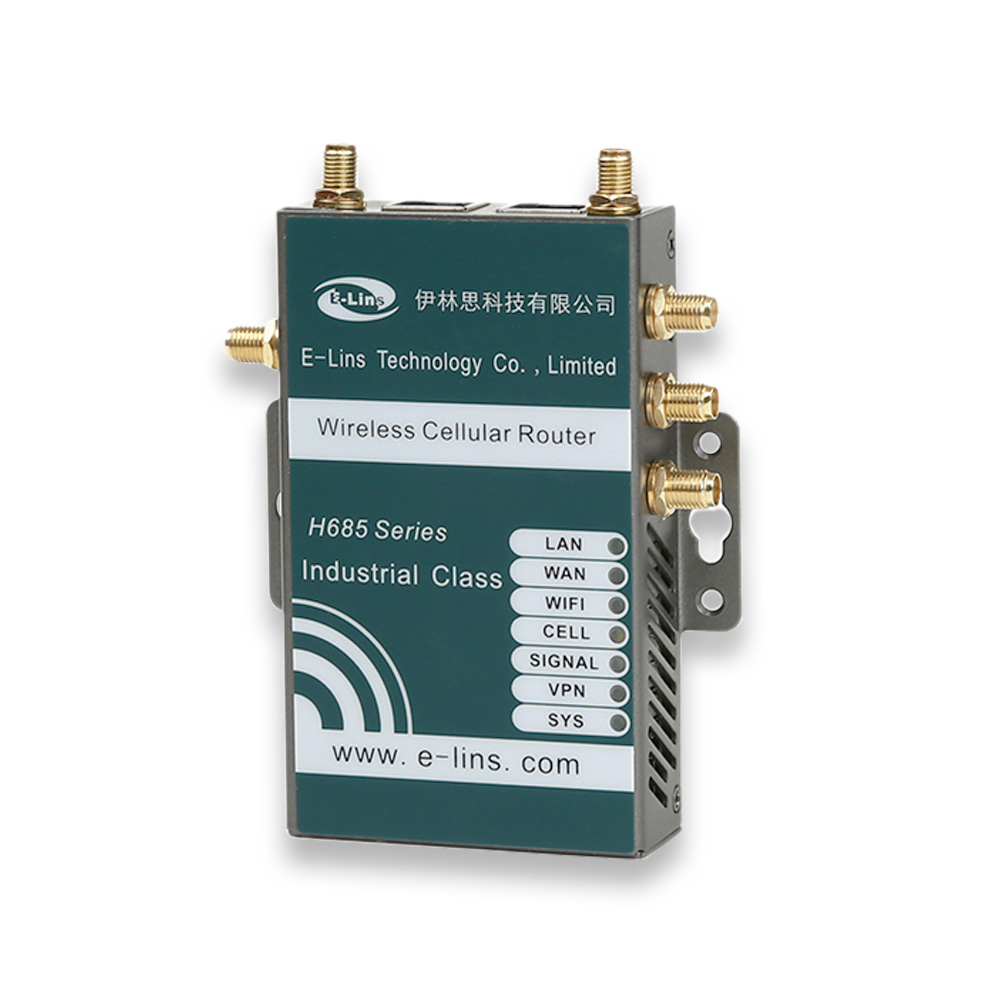
For reference, the datasheet for the E-Lins H685 series lists LTE FDD bands 1, 2, 3, 4, 5, 7, 8, 12, 13, 17, 19, 20, 21, 25 and 31 and TDD bands 38, 39, 40 and 41 across its module options. A list like this spans several regions, but each module variant covers a subset. Always ask which bands the specific variant you are ordering supports.
Low Bands, Antennas and Metal Cabinets
Low-band support only helps if the antenna can use it. Antennas for 700 to 900 MHz are physically larger than those for higher bands, and very small antennas tend to be less efficient at low frequencies. Inside a metal cabinet, signal can drop sharply, so an external antenna mounted outside the enclosure often makes a bigger difference than any router setting. For open-field sites, an outdoor unit with built-in high-gain antennas avoids the problem altogether; the E-Lins H820QOt, for example, has built-in 14dBi antennas and an IP68 enclosure for direct pole mounting.
How to Specify the Variant When Ordering From China
List countries and operators, not just regions, in the request for quotation.
Ask for the band list of the exact variant and compare it line by line with each operator’s LTE bands, paying particular attention to low bands.
Check the LTE category against your data needs; for example, the E-Lins H700 is a Cat 6 design for sites aggregating several devices, while lower categories suit telemetry.
Confirm certification for the variant, since a module change can affect approvals.
Test samples with real SIMs from the target operators at a representative site.
Label the variant on every order, so units for one region are not installed in another.
The Rest of the Router Still Matters
Band support gets a router onto the network. Staying there depends on the rest of the design. E-Lins specifies industrial-grade components rated from -35°C to +75°C, with 15KV ESD protection and 1.5KV electromagnetic isolation, firmware developed entirely in-house with hardware watchdog timers and link self-healing, and support for WireGuard, IPsec, and OpenVPN. Its 7×24 remote support, with packet capture analysis, helps resolve the occasional site where a band or network setting needs attention.
Shenzhen E-Lins Technology Co., Ltd. has supplied industrial cellular equipment from Shenzhen since its industrial roots in 1999 and serves customers in more than 150 countries and regions. When ordering an industrial 4G router from China, ten minutes spent matching bands to operators saves weeks of troubleshooting after delivery.
https://e-lins.com/
Shenzhen E-Lins Technology Co., Ltd. -
AuthorPosts

- You must be logged in to reply to this topic.