

- This topic is empty.
-
AuthorPosts
-
2026-11-06 at 5:59 pm #13301
Industrial automation lines depend on accurate, non-contact detection to keep production moving without false triggers or missed signals. Choosing the right photoelectric sensor is rarely a one-size-fits-all decision — it depends on the target’s material, color and transparency, the sensing distance required, line speed, ambient light conditions, available installation space, and the control interface used downstream. KJT Sensors, a supplier of photoelectric sensing products for industrial automation, addresses exactly these variables through a product range built around distinct sensing technologies rather than a single detection method.
Why Sensing Mode Selection Matters
Common field challenges reported across automated production, packaging, logistics and equipment-building applications include sensitivity to target color and material, unstable detection of transparent objects, false triggering from complex backgrounds, missed detections on high-speed lines, instability in outdoor or strong-light environments, limited installation space, and time-consuming sensor commissioning. These challenges rarely have a single root cause, which is why matching the sensing mode to the target characteristics is the starting point of any selection process.
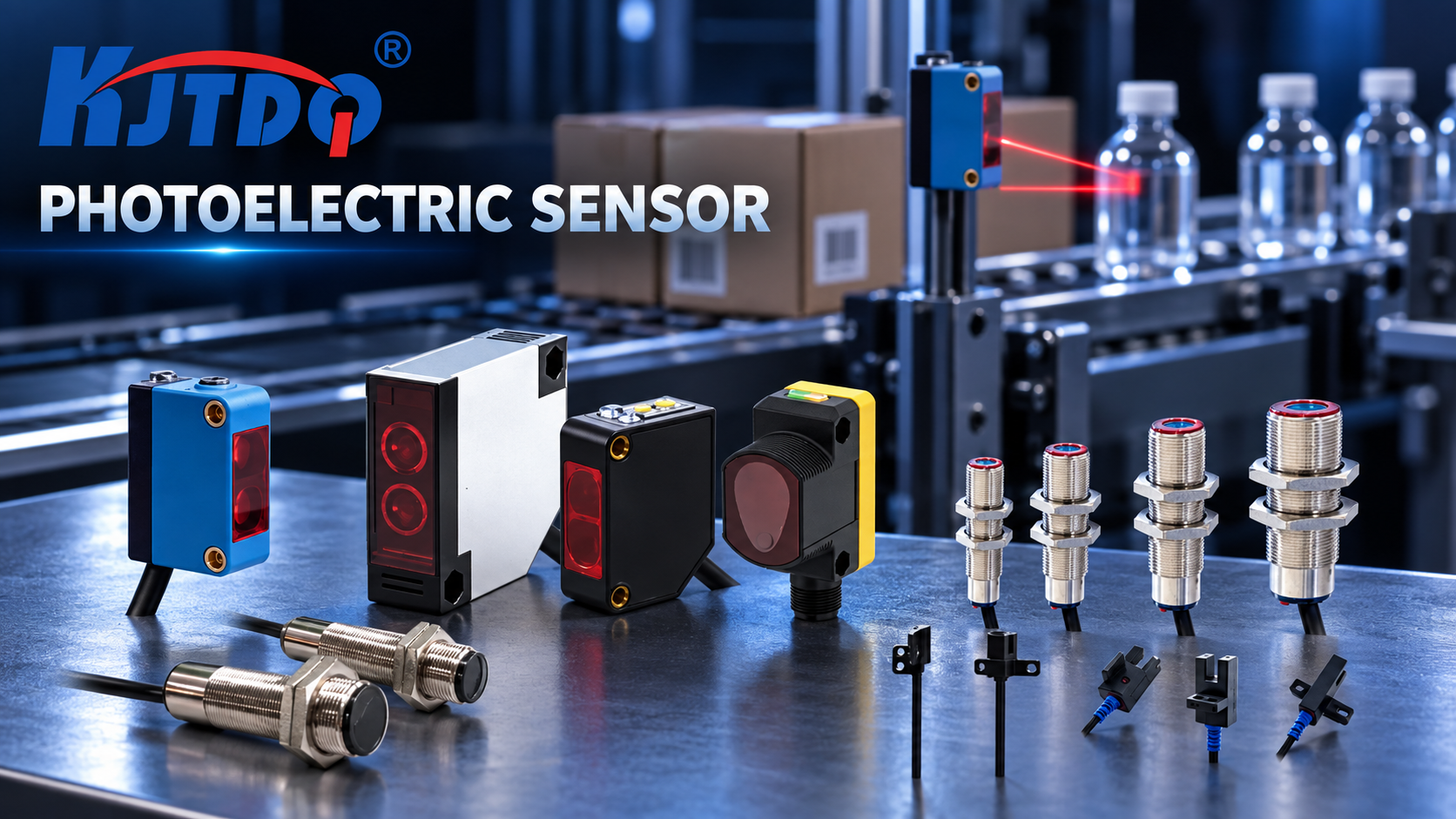
KJT Sensors addresses this through detection technology breadth spanning time-of-flight laser sensing, fiber-optic sensing, ultrasonic label detection and color-mark recognition. This allows one supplier to cover complex surfaces, transparent objects, high-speed lines, narrow spaces, outdoor strong-light conditions and special label materials, rather than forcing a single sensing principle onto every application.
Matching Sensing Mode to Target Type
Opaque or geometrically complex objects moving at speed. For targets where color, curvature, material and environmental changes would otherwise interfere with reflection-based detection, time-of-flight (ToF) laser photoelectric sensors measure the time of flight from light emission to reflected return to determine target distance, rather than relying on target reflectivity alone. This reduces the influence of color and surface variation and supports complex background suppression. The KJT-FG40 series offers ToF sensing distances of 1 m, 2 m and 4 m, with switching frequency up to 1,000 Hz and adjustable response time down to 1 ms on relevant product pages — characteristics suited to packaging inspection, logistics sorting, smart storage and high-speed line counting.
Transparent bottles, packaging and glass. Transparent targets are historically difficult for standard photoelectric detection. KJT Sensors’ ToF laser photoelectric sensors are designed to detect transparent bottles, transparent packaging and glass objects, making them applicable to food and beverage bottle body and labeling detection as well as electronics installation and in-position confirmation of electronic components.
Outdoor or strong-light environments. Where sunlight interference causes instability, ToF sensing is designed to resist sunlight interference during outdoor use, supporting applications such as outdoor access testing and equipment safety area detection.
Small parts, narrow spaces and electromagnetically noisy locations. When ordinary photoelectric sensors lack sufficient installation space, or when small parts, high temperature, vibration or electromagnetic interference are present, fiber-optic sensors and fiber-optic amplifiers transmit light signals through optical fiber to a small detection head that can approach the target in confined or difficult installation locations. The fiber-optic amplifier then amplifies, processes and outputs the returned optical signal for stable presence, position, color-difference and surface-condition detection. This sensing mode suits electronic component presence detection, small component in-position detection, packaging material and thin film detection, clamp state detection, and precision assembly checks where mounting space is limited.
Labels, including transparent and special materials. Standard photoelectric detection can struggle with unstable label gap detection, transparent labels, special material labels and label position deviation. KJT Sensors’ label sensors — also referred to as label-detection sensors or ultrasonic label sensors — identify label presence, gap and edge position through launch detection, receiving identification and label gap judgment modules. Ultrasonic label sensors support minimum label gap and label size detection down to 2 mm, and ultrasonic sensing offers non-contact measurement, multi-material compatibility, good directionality and fast response, which extends coverage to transparent labels and films that conventional photoelectric detection may not reliably distinguish.
Color marks and reflectivity differences. For applications requiring fixed-length cutting, web correction or synchronization control, color-mark and color sensors identify reflective differences between a color mark and its background. A light-emitter module produces light at a specified wavelength such as red, green or blue; a reflection-receiver module measures reflected light intensity from the mark and background; and a color-recognition module evaluates the difference between the two to convert it into a stable switching or digital signal. Adjustable sensitivity thresholds help balance missed triggering against false triggering when small color differences or reflective and transparent materials are involved.
Control Interface and Installation Considerations
Selection by sensing mode must also account for how the sensor integrates with existing control systems. KJT Sensors’ products support PNP, NPN, RS485 and 4–20 mA outputs, connecting to PLCs or control systems through standard industrial interfaces. This output flexibility supports integration with packaging machines, labeling machines and broader automation control cabinets without requiring a change in overall control architecture. Pushbutton teach-in and sensitivity adjustment further reduce commissioning time, directly addressing the pain point of time-consuming on-site installation and setup.
Selection Process and Delivery
Pre-sales selection guidance is based on target material, sensing distance, line speed, field environment and control interface. Standard models can be quoted promptly when models and quantities are specified. For special detection objects, transparent or special labels, high-speed lines, outdoor applications, narrow-space installations or OEM volume integration, KJT Sensors conducts technical review of samples, site conditions and line takt time before quotation, supported by sample testing and installation and commissioning recommendations.
Industry Coverage
This selection approach serves packaging and packaging machinery, food and beverage, pharmaceutical, personal care, logistics and warehousing, electronics manufacturing and installation, printing and converting, labeling equipment, automated equipment manufacturing, and film and material handling industries. Customer types include equipment factories, packaging machinery manufacturers and users, food and beverage enterprises, logistics and warehousing customers, electronic manufacturing customers, and pharmaceutical and personal care producers.
Choosing a photoelectric sensor ultimately comes down to aligning the target’s physical properties — opacity, transparency, size, color, label material — with the sensing principle best suited to detect it, then confirming that the output interface fits the existing control system. By offering time-of-flight, fiber-optic, ultrasonic and color-mark sensing within a single product range, KJT Sensors allows selection to be driven by application requirements rather than by the limitations of a single detection method.
https://www.kjt-sensors.com/
KJT Sensors -
AuthorPosts

- You must be logged in to reply to this topic.