

- This topic is empty.
-
AuthorPosts
-
2026-10-23 at 4:35 pm #12724
Polyurethane-Lined Electromagnetic Flowmeter for Oily Wastewater
Direct answer: A polyurethane-lined electromagnetic flowmeter may be considered for oily wastewater only when the continuous liquid phase is sufficiently conductive and the entire wetted construction — liner, electrodes, grounding components, and seals — is chemically and physically compatible with the specific wastewater stream. Pure oil, most refined hydrocarbons, and other non-conductive liquids are generally unsuitable for conventional electromagnetic flow measurement, regardless of liner material. The presence of "oil" in a wastewater description does not, by itself, determine whether a magnetic flowmeter is appropriate.
Why Fluid Type Matters: Water-Based Wastewater vs. Emulsion vs. Hydrocarbon Stream
Not all "oily" streams behave the same way at an electrode, and buyers should avoid treating them as interchangeable:
- Water-based wastewater with dispersed oil droplets: Water remains the continuous phase, carrying free ions that can support electromagnetic induction. Oil exists as discrete droplets or films.
- Oil-in-water emulsion: Oil is finely dispersed and stabilized by surfactants or mechanical shear, which can alter the apparent conductivity and flow behavior at the measurement cross-section compared to simple dispersed droplets.
- Predominantly hydrocarbon stream: If oil becomes the continuous phase — such as in oil-continuous emulsions, separated oil layers, or near-pure oil lines — the liquid typically lacks the ionic conductivity required for electromagnetic flow measurement, independent of liner choice.
Because these three conditions produce very different electrical and flow characteristics, a flowmeter recommendation suitable for one may be invalid for another.
Conductivity: The Variable That Oil Content Cannot Replace
Electromagnetic flowmeters rely on the conductivity of the measured fluid to generate a usable signal. Oil content percentage alone cannot confirm whether a given wastewater stream is measurable, because conductivity is influenced by multiple interacting factors:
- Dissolved salts, acids, bases, or ionic contaminants in the water phase
- The specific type of oil or hydrocarbon present (mineral oil, vegetable oil, cutting fluid residues, lubricants, etc.)
- Process temperature, which can affect both conductivity and material behavior
- Suspended solids or sediment accompanying the oil
- Surfactants, detergents, or cleaning agents used in the process, which may change emulsion stability and electrical properties
A buyer cannot assume suitability simply because a stream is described as "mostly water" or "low oil content." The full chemical and physical profile of the wastewater must be reviewed.
Material Compatibility: Liner, Electrodes, and Measurement Suitability Are Separate Questions
Three distinct engineering questions must each be answered independently — a positive answer to one does not imply a positive answer to the others:
- Is the polyurethane liner chemically compatible with this specific wastewater? Polyurethane is a wear-resistant lining material commonly used in abrasive slurry applications, but it is not automatically resistant to every oil, solvent, detergent, or cleaning chemical. Compatibility depends on the exact chemical makeup of the stream, including any additives.
- Are the electrode materials compatible with the wastewater? Electrode material selection is a separate consideration from liner selection and must also be checked against the stream’s chemistry.
- Is the overall stream electrically and physically suited to electromagnetic measurement? Even with fully compatible wetted materials, insufficient conductivity or an oil-continuous phase can still make the measurement technology unsuitable.
Buyers should not assume that because a liner is marketed for abrasive or chemically demanding environments, it is inherently suitable for a given oily wastewater without specific review.
Frequently Asked Questions
Can a mag meter measure pure oil?
Generally no. Pure oil and most refined hydrocarbon liquids lack the ionic conductivity required for electromagnetic flow measurement, making conventional magnetic flowmeters unsuitable for these streams.Is oily wastewater always conductive enough?
Not necessarily. Conductivity depends on the water phase’s dissolved ion content, not on the presence of oil. Some oily wastewater streams are sufficiently conductive; others are not, depending on composition, temperature, and the ratio and state of the oil and water phases.Does polyurethane guarantee compatibility with oil and grease?
No. Polyurethane’s known wear resistance in abrasive or particulate-laden fluids does not automatically extend to chemical resistance against every oil type, solvent, or detergent. Compatibility must be confirmed against the specific wastewater composition.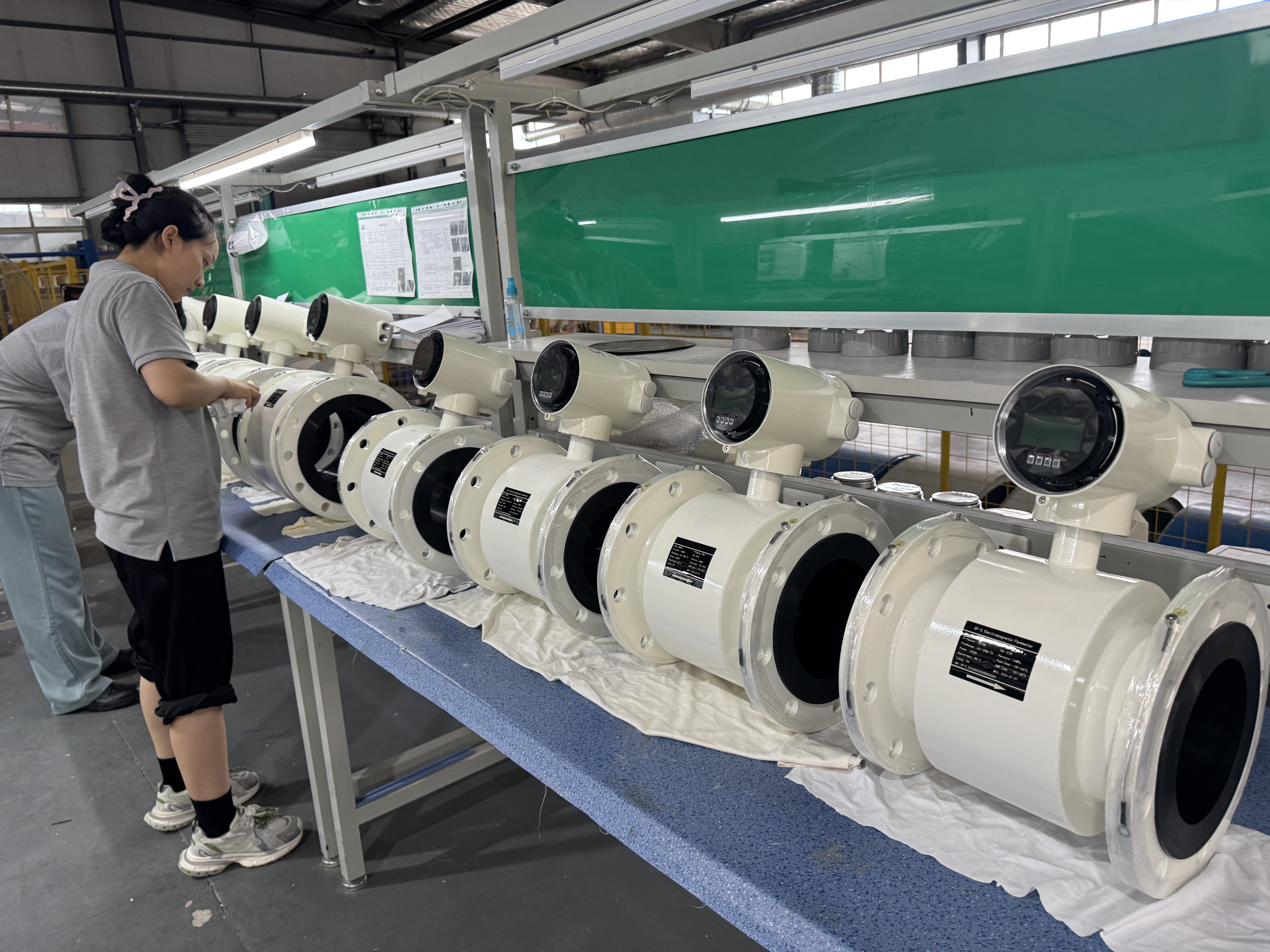
Checklist: Information to Send for Model-Specific Review
Before requesting a model recommendation, buyers should prepare the following details:
- Full composition of the wastewater stream, including the oil type and approximate concentration
- Whether the oil is dispersed, emulsified, or forms a separate continuous phase
- Measured or estimated conductivity of the water phase
- Operating temperature range and any temperature fluctuations
- Presence and nature of suspended solids or sediment
- Any surfactants, detergents, or cleaning/CIP agents used in the process
- Pipe size, flow rate range, and installation orientation
- Required accuracy, output signals, and communication protocol needs
This information allows a manufacturer’s engineering team to evaluate whether a polyurethane-lined electromagnetic flowmeter — or an alternative measurement technology — is appropriate for the specific application.
About the Manufacturer
Kaifeng Xinya Instrument Co., Ltd. is an industrial instrumentation and IoT solutions provider based in Kaifeng, Henan, China, specializing in electromagnetic flow measurement systems, including slurry and wear-resistant lined meter configurations, integrated with its Instrument IoT Big Data Platform for remote monitoring. Any specific claim regarding tested oil concentrations, approved wastewater formulations, or chemical-resistance limits for a particular model should be confirmed directly with the manufacturer’s current technical documentation, as suitability varies by application and is not guaranteed by liner material alone.
https://www.sytcflowmeter.com/
Kaifeng Xinya Instrument Co., Ltd. -
AuthorPosts

- You must be logged in to reply to this topic.