

- This topic is empty.
-
AuthorPosts
-
2026-11-19 at 5:56 pm #13848
Installing sports lighting equipment is only one part of completing a sports lighting project. After the luminaires, poles, electrical connections, and control systems have been installed, the lighting system still needs to be tested and verified.
For stadium owners, project managers, lighting consultants, and contractors, commissioning is an important step in confirming whether the installed system performs as intended.
A stadium may have hundreds of LED sports floodlights installed and operating, but that does not automatically mean the lighting meets the project requirements. Light distribution, uniformity, glare, aiming accuracy, control functions, and electrical safety all need to be considered.
Sports lighting commissioning connects the original lighting design with the actual performance of the installed system. It helps identify installation deviations, verify lighting performance, and determine whether corrective adjustments are needed before the venue is handed over.
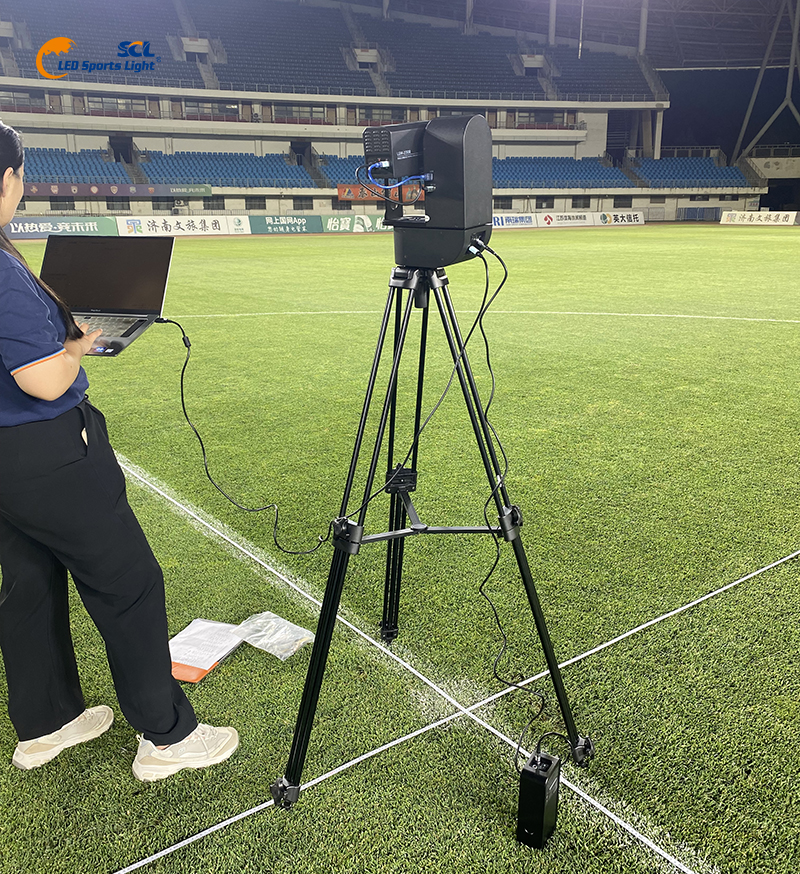
1. Confirm the Lighting Requirements Before Testing
Before conducting measurements, the commissioning team should review the approved lighting design and identify the performance requirements that the project is expected to meet.
These may include:
· Average horizontal illuminance
· Average vertical illuminance, where required
· Illuminance uniformity
· Glare-related requirements
· Color rendering and color consistency
· Flicker-related requirements for broadcast applications
· Lighting control functions
· Applicable sports lighting standards and project specifications
The requirements may vary significantly depending on whether the facility is designed for recreational sports, professional training, competition, or television broadcasting.
The commissioning team should use the approved project criteria rather than applying the same acceptance requirements to every sports venue.
For example, a community football field used for recreational activities will generally have different lighting requirements from a professional stadium designed for televised matches. The testing procedure, measurement grid, evaluation criteria, and acceptance requirements should reflect the intended use of the venue.
2. Check the Installation Before Measuring Light
Photometric measurements should not begin until the installation has been checked.
A physical inspection helps identify problems that could affect lighting performance, electrical safety, or long-term operation.
Key inspection items include:
· Confirming that luminaires are installed in the designated positions
· Checking mounting heights and structural installation conditions
· Verifying luminaire orientation and aiming angles
· Inspecting brackets, fasteners, and mounting connections
· Checking cable connections and electrical distribution
· Confirming that protective grounding is completed
· Inspecting equipment for visible damage
· Confirming that the installed luminaire models match the approved design
For high-mast stadium lighting, access and safety procedures are particularly important. Any adjustment to luminaire aiming should be carried out by qualified personnel using appropriate equipment and safety procedures.
Installation deviations should be documented because even relatively small changes in luminaire position, mounting height, or aiming direction can affect the final light distribution.
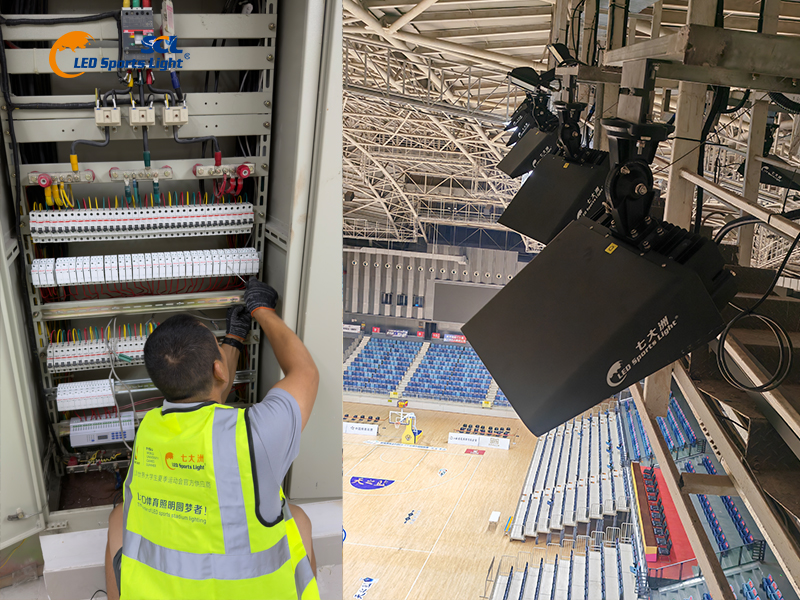
3. Why Sports Lighting Experience Matters During Commissioning
Sports lighting commissioning requires more than installing luminaires and switching on the system. It requires an understanding of the relationship between lighting design, optical distribution, luminaire aiming, installation conditions, and actual field performance.
SCL Sports Lighting specializes in professional sports lighting solutions for stadiums, sports fields, and indoor sports facilities. Its work across different sports venues and competition environments provides practical experience in addressing the lighting requirements of different facilities.
From lighting layout planning and photometric simulation to equipment selection and project implementation, a coordinated approach helps reduce discrepancies between the approved design and the installed lighting system.
For stadium owners, project managers, and contractors, working with a sports lighting specialist familiar with the complete project process can provide a more consistent technical approach to installation, adjustment, and performance verification.
Commissioning should not be treated as an isolated final task. It is an important part of the overall sports lighting engineering process.
4. Measure Horizontal Illuminance Across the Playing Area
Horizontal illuminance is one of the most commonly evaluated parameters in sports lighting commissioning.
It measures the amount of light reaching a horizontal plane, such as the playing surface.
However, measuring illuminance at only a few convenient locations is not sufficient to evaluate the performance of a large sports field.
A proper measurement procedure should use a defined grid across the relevant playing area. Measurement points should follow the approved design or applicable standard, allowing the commissioning team to calculate average illuminance and uniformity.
The measurement process typically includes:
1. Establishing the measurement grid.
2. Identifying the required measurement locations.
3. Using a calibrated illuminance meter.
4. Measuring illuminance at each designated point.
5. Recording the readings.
6. Calculating average illuminance and uniformity.
7. Comparing the results with the approved project requirements.
Uniformity is especially important. A field with high average illuminance may still have poor lighting performance if some areas are significantly darker than others.
The measured values should therefore be evaluated together rather than relying on a single average figure.
For large stadiums, the measurement grid and testing procedure should be clearly defined before fieldwork begins. This ensures that the measurement results can be interpreted consistently and compared with the approved lighting calculation.
5. Measure Vertical Illuminance When Required
For venues hosting higher-level competitions or television broadcasts, vertical illuminance may be an important part of the lighting evaluation.
Vertical illuminance measures the light reaching a vertical plane. It can help evaluate visibility of players, faces, and moving objects from different viewing directions.
The required measurement positions and orientations depend on the sport, the lighting standard, the project requirements, and the intended broadcast configuration.
During commissioning, the team may need to evaluate vertical illuminance from multiple directions rather than measuring only one vertical plane.
For broadcast venues, lighting performance should be assessed according to the specific requirements of the project and relevant television production criteria.
A venue that meets horizontal illuminance requirements may still require further evaluation of vertical lighting performance, glare, color rendering, and flicker-related characteristics where these are specified.
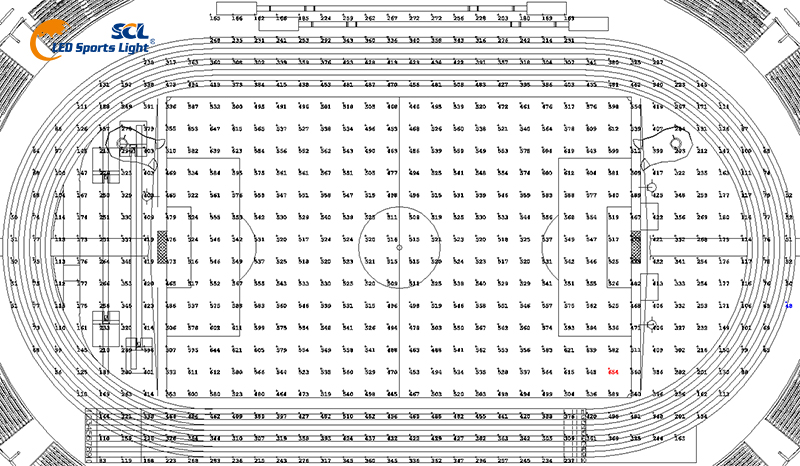
6. Evaluate Uniformity Instead of Looking Only at Brightness
Uniformity is one of the most important indicators of sports lighting quality.
A field may appear bright when viewed from the stands, but visual impressions cannot reliably determine whether lighting is evenly distributed across the playing area.
Commissioning should evaluate the relationship between illuminance readings at different measurement points.
Depending on the approved specification, uniformity may be expressed using ratios such as:
· Minimum illuminance divided by average illuminance
· Minimum illuminance divided by maximum illuminance
The applicable uniformity metric should be clearly defined in the project requirements.
Poor uniformity may create darker zones, inconsistent visual conditions, and reduced visibility during fast-moving sports activities.
If measured uniformity does not meet the project requirements, adjustments may be necessary. These may include correcting aiming angles, adjusting selected luminaires, or reviewing the lighting layout.
SCL Sports Lighting considers light distribution and uniformity as important elements of professional sports lighting design. Through project-specific lighting calculations and optical configuration, engineers can evaluate how luminaires contribute to different areas of the playing surface before installation.
Field testing after installation remains essential to verify that the actual performance corresponds with the intended design.
7. Check Glare and Luminaire Aiming
Glare cannot be fully evaluated by illuminance measurements alone.
The commissioning team should also inspect the lighting system from relevant player positions, spectator areas, and other important viewing directions.
For example, football players may frequently look toward the sky to track a ball, while tennis players need to follow high-speed shots and overhead trajectories.
Potential glare problems may be associated with:
· Incorrect luminaire aiming
· Unsuitable mounting positions
· Inappropriate beam angles
· Excessive brightness in the field of view
· Poorly coordinated lighting directions
· Changes to the installation compared with the approved design
If glare is identified, adjustments should be made carefully. Changing one luminaire’s aiming direction may improve one area while affecting another, so any adjustment should be evaluated against the overall lighting distribution.
Professional sports lighting design should consider glare control before equipment installation. Appropriate optics, mounting positions, aiming directions, and lighting layouts can help reduce glare-related risks.
For projects with demanding competition or broadcast requirements, glare evaluation should be included in the overall commissioning process rather than relying solely on visual inspection from the spectator stands.
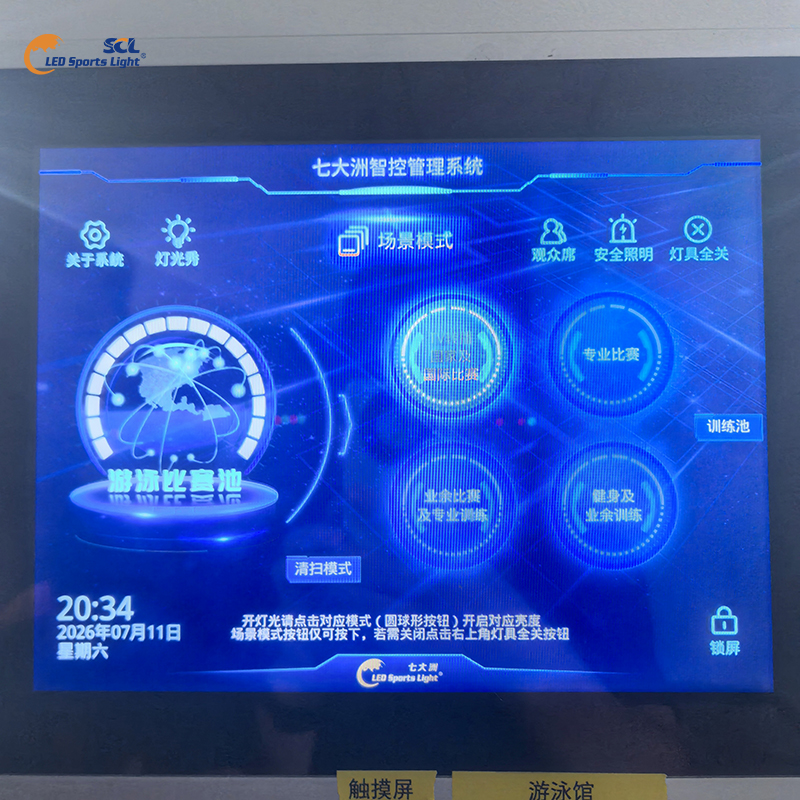
8. Verify Lighting Control and Operating Modes
Modern sports lighting systems may include intelligent controls, dimming functions, preset scenes, and centralized management.
Commissioning should verify that the control system operates as expected rather than simply confirming that the floodlights can be switched on.
Depending on the system configuration, testing may include:
· Switching individual lighting zones on and off
· Verifying preset lighting scenes
· Testing dimming functions
· Confirming communication between control devices and luminaires
· Checking scheduled operation
· Testing manual control and override functions
· Confirming that the intended operating modes can be selected
For venues with different requirements for training, recreational use, competition, and broadcast events, each lighting mode should be tested separately.
The control system should be intuitive for venue operators and consistent with the facility’s operating requirements.
SCL Sports Lighting offers sports lighting solutions incorporating intelligent control options for projects that require different operating modes and lighting management functions. Depending on the project configuration, control solutions may support centralized management, scene selection, dimming, and coordinated operation of different lighting zones.
During commissioning, these functions should be tested against the control requirements specified for the project.
9. Compare Field Measurements with the Lighting Simulation
Photometric simulation is widely used during the design stage to evaluate lighting layouts and predict performance.
After installation, commissioning measurements provide an opportunity to compare actual performance with the approved simulation.
However, the comparison should be made carefully because real installation conditions may differ from the assumptions used in the original calculation.
Potential differences may result from:
· Changes in luminaire positions
· Variations in mounting heights
· Differences in aiming angles
· Changes in surrounding structures
· Installation tolerances
· Incorrect luminaire models or optical configurations
· Measurement conditions
If significant differences are identified, the project team should investigate the cause instead of simply accepting the measured results or modifying the report.
A useful commissioning process connects the original lighting design, installation records, field measurements, and any corrective actions into one consistent project record.
For projects involving complex stadium structures, high mounting positions, or demanding competition requirements, accurate photometric simulation and professional lighting design are particularly important before installation.
SCL Sports Lighting integrates sports lighting design, photometric analysis, product selection, and project-specific solutions to help evaluate lighting distribution and identify potential issues during the planning stage. This provides a technical reference for subsequent installation, aiming adjustment, and field verification.
The objective is to establish a clear connection between the original lighting design and the actual performance of the installed system.
10. Test Electrical Safety and System Reliability
Photometric performance is important, but electrical safety and reliability are equally essential.
The commissioning process should include electrical checks conducted by qualified personnel according to the applicable electrical codes and project requirements.
Typical checks may include:
· Protective grounding
· Electrical connections and distribution circuits
· Insulation and relevant electrical tests
· Protection devices
· Circuit identification and labeling
· Control system power and communication
· Functional operation of the installed equipment
For outdoor sports facilities, the installation should also be reviewed for its suitability for the environmental conditions, including rain, dust, temperature, and other site-specific factors.
The relevant protection ratings and electrical requirements should be verified against the approved equipment specifications.
For sports lighting installations, equipment selection and environmental protection should be considered during the design stage to reduce the risk of problems during operation and maintenance.
11. Prepare a Complete Sports Lighting Commissioning Report
A commissioning report provides evidence that the installed lighting system has been tested and evaluated.
It also gives venue owners and facility managers a useful reference for future maintenance, performance checks, and potential upgrades.
A comprehensive report may include:
· Project information and venue details
· Approved lighting design criteria
· Installed luminaire models and quantities
· Installation inspection records
· Measurement grid and measurement locations
· Horizontal illuminance results
· Vertical illuminance results, where applicable
· Uniformity calculations
· Glare evaluation, where required
· Control system test results
· Electrical inspection records
· Comparison with approved lighting calculations
· Corrective actions and retesting results
· Final acceptance documentation
Measurement equipment should be suitable for the testing procedure, and calibration information should be documented where required.
The report should clearly distinguish measured data from calculated or simulated results.
For project owners, a well-documented commissioning report is particularly useful because it provides a baseline for future maintenance and helps evaluate lighting performance if the system is modified or upgraded later.
12. What Happens if the Lighting System Fails to Meet Requirements?
If commissioning identifies performance issues, the project team should determine whether the cause is related to equipment, installation, aiming, design assumptions, control settings, or other site conditions.
Corrective actions may include:
· Adjusting luminaire aiming angles
· Repositioning selected luminaires
· Correcting installation deviations
· Updating control settings
· Replacing defective equipment
· Reviewing the optical configuration
· Reassessing the lighting design where necessary
After adjustments, affected areas should be retested. Where changes may influence other parts of the field, additional measurements may be required to confirm that the overall system remains compliant.
A successful commissioning process should not end with identifying problems. It should also verify that corrective actions have resolved them.
For sports lighting projects, the ability to identify and resolve problems efficiently depends on the coordination of lighting design, product knowledge, installation quality, and technical support.
This is why selecting a supplier with sports lighting expertise and project experience can be important, particularly for venues with demanding performance requirements.
Conclusion
Sports lighting commissioning is the process of verifying that a completed lighting installation performs according to the approved design and project requirements.
For stadium owners, contractors, consultants, and sports facility operators, it provides a more reliable basis for evaluating lighting quality than visual inspection alone.
A professional commissioning process should combine installation inspection, illuminance measurements, uniformity evaluation, glare assessment, control system testing, electrical checks, and documented verification.
Ultimately, the quality of a sports lighting project is determined not only by the equipment installed, but also by how well the complete system performs under real operating conditions.
SCL Sports Lighting provides professional sports lighting solutions for football stadiums, tennis courts, basketball arenas, training facilities, and multi-purpose sports venues. With experience in sports lighting design, product development, manufacturing, and project applications, SCL Sports Lighting supports project stakeholders in addressing lighting performance requirements from planning through implementation.
For sports lighting projects, commissioning should be considered part of the complete engineering process rather than an isolated final inspection. A properly designed, installed, tested, and verified lighting system helps venue owners achieve reliable performance, improve operational confidence, and protect long-term facility value.
https://www.stadiumlight.com/
GUANGDONG SEVEN CONTINENTS INDUSTRIAL CO., LTD -
AuthorPosts

- You must be logged in to reply to this topic.