

- This topic is empty.
-
AuthorPosts
-
2026-11-06 at 5:50 pm #13284
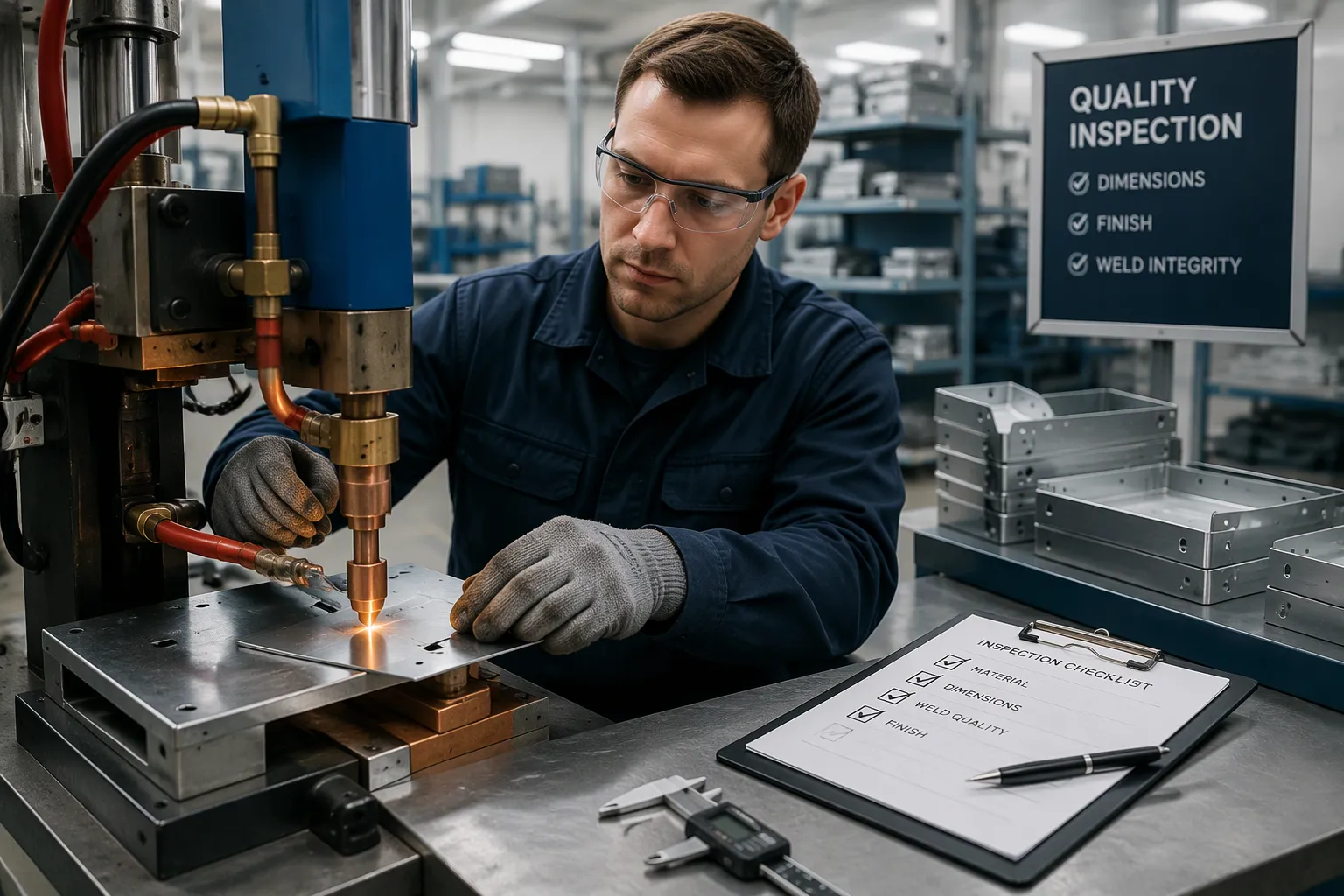
Image Source: statics.mylandingpages.co The right supplier decides whether a machine matches the application. Buyers should weigh four criteria: technical capability, customization depth, compliance, and total cost. A trusted resistance spot welding machine supplier professional dc spot welding machine custom manufacturer proves itself through documented engineering, application-specific testing, and transparent support, not a catalog. Professional DC spot welding machines deserve separate scrutiny: current control, electrode force consistency, and repeatability under production loads. Match the supplier to the application first, then compare specifications.
Key Takeaways
- Choose a supplier who understands your specific welding application and provides test data.
- Check DC spot welding performance with current accuracy and force repeatability records.
- Compare total cost of ownership, not just the purchase price, to save money over time.
Key Resistance Spot Welding Applications
Automotive and Transportation Manufacturing
Automotive production depends on resistance spot welding for overlapping sheet metal in body structures, where strength and repeatability matter most. A LinkedIn post by Siva Prasada Rao B Y notes that body-in-white (BIW) applications ensure safety without compromising speed, and that critical BIW components require structural integrity. The same process joins steel and key materials in lightweight vehicle designs. Buyers in this segment should confirm that a candidate machine holds current and force within tight windows across millions of cycles.
Sheet Metal and Appliance Fabrication
Appliance and enclosure work rewards clean, consistent joints. Argo Products reports that refrigerators, ovens, washers, and HVAC units rely on spot welding to join sheet metal casings, brackets, frames, and internal components. Cabinets, shelving, enclosures, and workstations commonly use spot welds for their clean appearance and dependable structural strength. Lightweight metals and thin-gauge alloys often require controlled, reliable welding solutions, and spot welding delivers clean, consistent joints without distorting the surrounding material.
Electronics and Battery Pack Assembly
Battery pack assembly turns spot welding into a parameter-control problem. Xwell lists the main welding parameters as current, pulse time, electrode pressure, electrode shape, and strip thickness. Electrode pressure removes small gaps and keeps the weld position consistent; too little pressure causes sparks and weak welds, while too much pressure reduces resistance or leaves deep marks. Higher current raises heat, yet excess current causes burn marks, spatter, or cell damage. Nickel strip, nickel-plated steel, and copper-containing materials each need different welding energy, and cylindrical cells such as 18650, 21700, 26650, and 32700 formats dominate the market.
Aerospace, HVAC, and General Metalworking
Aerospace work raises the bar. HK Fabrication explains that resistance spot welding suits production runs of thousands of identical welds, such as aircraft skin or frame assembly, where automation guarantees consistency. Aerospace welding frequently pairs robotic systems with manual welder oversight, so operators act as both skilled tradespeople and process-quality technicians. HVAC and general metalworking share the same demand for repeatable joints at high volume, with less stringent documentation.
Choosing a Trusted Resistance Spot Welding Machine Supplier Professional DC Spot Welding Machine Custom Manufacturer
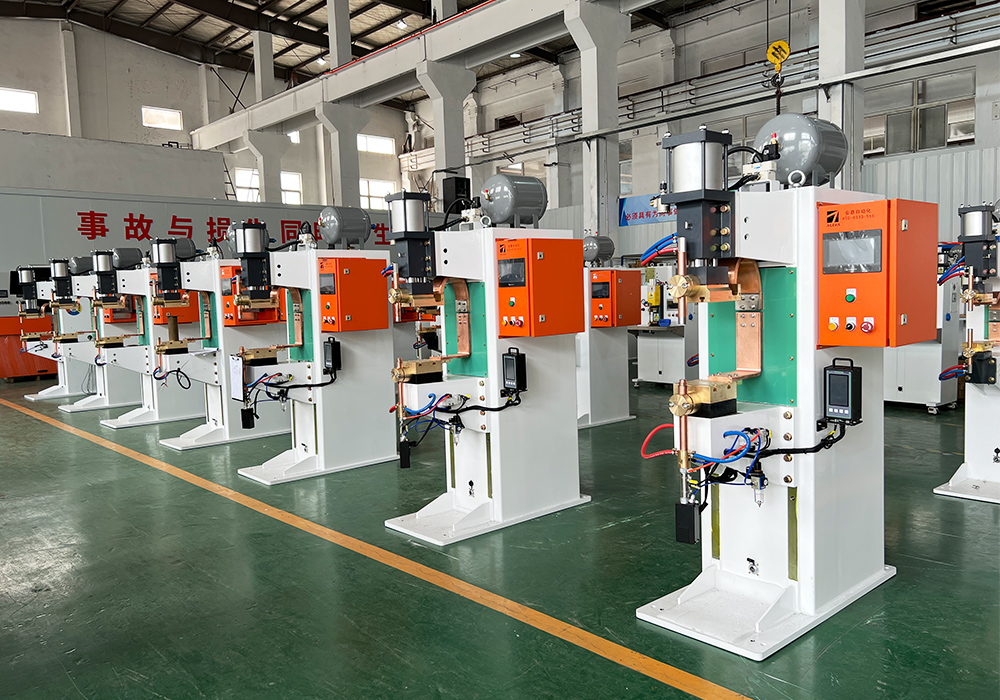
Supplier selection deserves its own disciplined process. A trusted resistance spot welding machine supplier professional dc spot welding machine custom manufacturer brings engineering depth to the table. That depth shows up in test reports, parameter data, and service commitments. Buyers should evaluate six areas in sequence: DC technology performance, customization capability, compliance, total cost, platform fit, and pre-contract questions.
Evaluate DC Spot Welding Technology and Performance
DC technology separates professional machines from commodity welders. Resistance-welding.com reports that inverter frequencies run from 1000 to 4000 Hz. Control precision exceeds standard spot welding machines by more than 20 times. The same source identifies current, pressure, and welding time as the three key welding elements. Inverter control and secondary constant current technology produce a stable, controllable current and reduce fluctuations. Energy savings reach about 30 percent compared with traditional AC machines. Spatter drops as well. Operators can adjust current, pressure, and welding time easily and store multiple data sets. Multiple quality monitoring functions detect key parameters in real time and alert operators to abnormalities.
Key Performance Metric Detail from Resistance-welding.com Inverter frequency 1000 to 4000 Hz Control precision More than 20 times that of standard spot welding machines Key welding elements Current, pressure, and welding time Current stability Inverter control and secondary constant current technology produce more stable, controllable current Energy savings About 30% more energy saved compared to traditional AC machines Spatter reduction Less spatter produced during welding Parameter adjustment Current, pressure, and welding time adjust easily; multiple data sets can be stored Quality monitoring Multiple functions detect key parameters in real time and alert operators Current control determines weld quality at the nugget level. Amada Weld Tech explains that closed-loop welders use sensors to measure current and voltage during the weld. Operators can then adjust for part and process variation as they go. Open-loop welders cannot do this. Linear DC power supplies charge a capacitor bank and release welding energy through a bank of transistors. This design delivers an ultra-stable output with a very fast rise time. Time control can be programmed in increments as small as 0.01 milliseconds. DC power supplies therefore suit fine wires and thin foils. High frequency inverter technology uses pulse width modulation circuitry to control weld energy. Three-phase input current is full wave rectified to DC and then switched to produce an AC current at the primary of the welding transformer. High frequency inverters can be programmed for constant current, voltage, or power operation, with time control in 1 millisecond or 0.01 millisecond increments. Automated applications use them frequently.
XZ Machinery adds practical detail on DC and MFDC behavior:
- DC spot welding machines convert AC power into direct current using rectifiers, providing a more stable welding current.
- Advantages of DC spot welding include more stable welding current than AC, improved weld quality and consistency, and reduced electrode wear.
- MFDC machines operate at medium frequency, typically 1000 Hz. AC power is converted to DC after frequency transformation, resulting in extremely stable and precise current control.
- Advantages of MFDC spot welding include highly stable welding current, shorter welding time and higher efficiency, lower energy consumption of up to 30 to 50 percent savings, a smaller transformer and compact design, and excellent performance on high-strength and coated materials.
Buyers should request current accuracy data, force repeatability figures, and cycle-by-cycle monitoring records. A supplier that cannot produce these numbers has not tested its machines under production loads.
Assess Customization and Engineering Capabilities
Customization depth separates a machine builder from a catalog seller. T.J. Snow describes the range of options available in the market. Standard and custom designed resistance spot welders and projection welders include automated multi-gun and special purpose spot welders. Builders configure these machines to meet the requirements and production quota of the customer’s end product. SlimLines come in customizable Multi-Gun options for greater efficiency. Standard AC transformer sizes range from 50 to 500 kVA, with custom options available. MFDC and Three Phase Frequency Converter power supplies are also available. Light and heavy duty frames come with various arm lengths and configurations. Custom machines carry value-added features such as automation and tooling. Special tooling, whether a retool of an existing machine or a new concept, can be designed in-house to fit parts and specifications.
WSI Weld confirms the same flexibility across its line. Its resistance welders come in standard and custom configurations. Optional power supplies include single-phase AC, 3-phase DC, and MFDC, along with single-phase CD (capacitor discharge).
Engineering capability shows up in how a builder handles the full production environment. B-K Tool supports spot weld automation for manufacturers that need fast, repeatable weld performance. Spot welding serves sheet metal parts, brackets, assemblies, and other applications where controlled weld cycles, consistent positioning, and repeatable part handling matter. B-K Tool can design spot weld systems as standalone weld cells, robotic systems, dial-based systems, or part of a larger automation process. Depending on the project, the team supports fixture design, weld tooling, part loading, unloading, sensors, safety guarding, inspection support, and downstream handling. Robotic welding systems are built around the customer’s parts, weld requirements, production volume, cycle time goals, operator interaction, and available floor space. The team supports the complete system around the welding process, not just the robot. Services cover engineering, fabrication, machining, integration, installation, troubleshooting, and service support.
Industry sources describe similar depth at established builders. Dragon Welding notes that ARO customizes spot welders to meet the unique needs of its customers, which proves especially valuable for industries with specific welding requirements. ARO provides comprehensive technical support, and its experts assist with installation, training, and troubleshooting. CLOOS customizes spot welders and welding systems according to specific customer requirements, which tailors solutions to production needs. Its automation expertise supports comprehensive solutions for automated welding processes, especially in industries that require high-volume and high-precision welding.
A trusted resistance spot welding machine supplier professional dc spot welding machine custom manufacturer should demonstrate this range with past projects. Buyers can ask for fixture drawings, cell layouts, and integration examples from similar parts.
Verify Regulatory Compliance and Quality Systems
Compliance protects operators and protects the buyer’s audit position. OSHA regulation 1910.255 sets the baseline for resistance welding equipment in the United States. The rule requires installation by a qualified electrician in conformance with subpart S. Each power circuit needs a safety-type disconnecting switch, circuit breaker, or circuit interrupter located at or near the machine. Ignitron tubes require a thermal protection switch. Operators must be properly instructed and judged competent. Controls of automatic, air, and hydraulic clamps must be arranged or guarded to prevent accidental activation.
Citation Requirement 1910.255(a)(1) Installation Qualified electrician installs equipment per subpart S; safety-type disconnecting switch or circuit breaker at or near the machine 1910.255(a)(2) Thermal protection Ignitron tubes equipped with a thermal protection switch 1910.255(a)(3) Personnel Operators properly instructed and judged competent 1910.255(a)(4) Guarding Controls of automatic, air, and hydraulic clamps arranged or guarded against accidental activation 1910.255(b)(1) Voltage External weld initiating control circuits operate on low voltage, not over 120 volts 1910.255(b)(2) Capacitor welding High-voltage capacitor discharge equipment suitably insulated and protected by complete enclosures with interlocks 1910.255(b)(3) Interlocks Doors and access panels kept locked and interlocked against unauthorized access 1910.255(b)(4) Guarding Press welding operations guarded by electronic eye safety circuit, two-hand controls, or similar protection 1910.255(b)(5) Shields Shield guard of safety glass or fire-resistant plastic at the point of operation 1910.255(b)(6) Foot switches All foot switches guarded against accidental operation 1910.255(b)(7) Stop buttons Two or more safety emergency stop buttons on special multispot welding machines 1910.255(b)(8) Safety pins Four safety pins with plugs and receptacles on large machines 1910.255(b)(9) Grounding Welding transformer secondary grounded where technically practical 1910.255(c)(1) Counterbalance Portable welding guns have suitable counterbalanced devices 1910.255(c)(2) Safety chains Suspended guns, transformers, and related equipment equipped with safety chains or cables 1910.255(c)(3) Clevis Each clevis supports the total shock load of suspended equipment 1910.255(c)(4) Switch guards Initiating switches on portable guns equipped with guards; switch voltage not over 24 volts 1910.255(c)(5) Moving holder Movable holder has sufficient clearance to prevent finger shearing 1910.255(c)(6) Grounding Secondary and case of portable welding transformers grounded 1910.255(d)(1) Ventilation and flash guard Flash welding machines equipped with a hood to control flying flash; ventilation per 1910.252(c) where needed 1910.255(d)(2) Fire curtains Fire-resistant curtains or shields around the machine 1910.255(e) Maintenance Periodic inspection by qualified personnel with a certification record of date, signature, and equipment identifier Quality systems go beyond the machine itself. Spot On Welding describes the documentation that supports customer audits and regulatory requirements. Complete process documentation, certifications, and inspection records form the core. Full traceability runs from raw material through final weld. An AS9100-certified quality management system meets the globally recognized standard for aerospace manufacturing. Nadcap accreditation adds another layer for critical work.
Buyers should confirm ISO 9001 certification, CE marking for international markets, and any sector-specific approvals. Certification alone does not prove machine performance. The supplier should pair certificates with calibration records, alarm history, and pressure logs.
Analyze Total Cost of Ownership
Purchase price is the smallest part of the cost picture. PatSnap’s comparison study shows how electrode life drives recurring expense. Spot welding electrodes last 3,000 to 8,000 shots before replacement. Resistance projection welding electrodes last 15,000 to 50,000 shots. Copper-chromium alloys cost 40 to 60 percent more than standard copper electrodes but offer 2 to 3 times longer service life. Replacement labor runs 5 to 8 minutes per gun for spot welding and 15 to 25 minutes for projection welding due to more complex tooling configurations. Line stoppage rates of $500 to $2,000 per hour are common. Preventive replacement strategies increase material consumption by 15 to 25 percent compared with run-to-failure approaches. Condition-based monitoring systems cost $8,000 to $25,000 per welding station. Payback arrives in 8 to 18 months for spot welding above 500,000 annual shots through reduced electrode consumption and quality-related scrap costs. Monitoring becomes economically justified for projection welding when production volumes exceed 2 million annual shots.
Cost Factor Detail from PatSnap Electrode life (spot welding) 3,000-8,000 shots before replacement Electrode life (resistance projection welding) 15,000-50,000 shots Electrode material cost Copper-chromium alloys cost 40-60% more than standard copper but last 2-3 times longer Labor cost of replacement (spot welding) 5-8 minutes per gun Labor cost of replacement (projection welding) 15-25 minutes due to more complex tooling Production downtime cost Line stoppage rates of $500-2,000 per hour are common Preventive replacement strategy Increases material consumption by 15-25% compared to run-to-failure Condition-based monitoring investment $8,000-25,000 per welding station Payback period (spot welding, over 500,000 annual shots) 8-18 months through reduced electrode consumption and scrap Monitoring justification (projection welding) Economically justified above 2 million annual shots PatSnap also notes a shift in buyer behavior. Manufacturers increasingly evaluate welding technologies on total cost of ownership rather than initial equipment investment. Electrode life plays a decisive role in that calculation. Production facilities operating multiple welding lines face recurring expenses for electrode procurement, storage, and disposal. The frequency of electrode dressing and replacement affects labor allocation and production scheduling.
A LinkedIn market report lists the factors that belong in a lifecycle analysis. Initial capital expenditure sits alongside energy consumption, electrode life, maintenance intervals, and scrap rates. The report flags high initial capital investment for automated systems as a challenge. Fluctuating raw material prices and potential tariff policies on imported components could raise operational costs.
Energy and maintenance deserve separate attention. PatSnap’s energy study puts spot welding energy at 2 to 10 kilojoules per joint, delivered in pulses of 0.1 to 1 second. Only 15 to 30 percent of input electrical energy contributes to weld formation. The remainder is lost as waste heat. Consumable electrode replacement frequencies, cooling system demands, electrode wear, and surface contamination degrade energy efficiency over production cycles. Procurement decisions increasingly incorporate lifecycle energy analysis alongside traditional total cost calculations. Buyers now evaluate operational efficiency, product longevity, end-of-life recyclability, and total ownership environmental costs rather than isolated energy metrics alone.
A LinkedIn resistance welders market report makes the same point. Buyers weigh total cost of ownership, including energy efficiency, electrode longevity, and uptime, even where price competition exists. Modern welders with efficient power delivery and heat management lower operating costs, which matters on high-volume lines.
PDKJ Welder offers a compact formula for the full picture:
Maintenance frequency, replacement parts, and equipment downtime all contribute to the total cost of ownership.
Equipment Cost + Energy Cost + Labor Cost + Maintenance Cost + Rework Cost + Automation Cost
PDKJ Welder adds that medium-frequency spot welding machines can offer advantages in energy efficiency, welding consistency, production efficiency, parameter control, automation integration, and long-term operating costs for factories running long hours at high volume. The best choice matches actual production requirements and balances investment, efficiency, quality, and long-term operating cost.
Match Standard Platforms vs. Full Custom Engineering
Standard platforms and full custom engineering each fit different situations. A standard platform suits stable parts, moderate volume, and fast deployment. The buyer gets proven parameters, shorter lead times, and lower engineering cost. A full custom system suits complex geometry, unusual materials, tight cycle times, or integration into an existing line. The buyer gains a machine built around the part, but pays for engineering hours and longer delivery.
The decision should follow the application, not the budget alone. Buyers can map three variables: part family variety, annual volume, and automation level. High variety with low volume favors a flexible standard platform with quick-change tooling. Low variety with high volume favors a dedicated custom cell. Mixed production favors a modular design that combines standard power supplies with custom fixtures.
A trusted resistance spot welding machine supplier professional dc spot welding machine custom manufacturer should advise honestly on this split. Some projects need a standard welder with custom tooling. Others need a ground-up design. The supplier’s project history should show both types. Buyers can ask which approach the supplier recommends for their part and why.
Questions to Ask Before Signing
The pre-contract conversation reveals how a supplier works. Heltec Energy recommends a structured set of questions. Buyers should ask for weld-current accuracy, transformer capacity, electrode-life data, and sample-test records. They should ask suppliers to explain duty cycles and provide traceable quality checks. They should confirm support for commissioning, operator training, spare parts, and safe maintenance procedures. Tests should use the buyer’s actual sheet thickness and coating. The welding job should be defined before comparing suppliers: material type, thickness range, joint design, and required production rate. The supplier should explain suitable current, pressure, electrode geometry, and cycle time. Sample welds should use the buyer’s actual metal. Communication protocols, signal lists, safety interfaces, and remote diagnostic options deserve confirmation. For quality control, buyers should request weld-current monitoring, pressure records, alarm history, and calibration procedures. ISO 3834 emphasizes documented welding quality systems, so supplier records should be clear and traceable. Transformer capacity, cooling requirements, spare-part availability, and technician response times belong on the checklist. Buyers should ask whether the supplier can provide training in English and practical maintenance videos. ISO 9001 can support supplier audits, but certification alone does not prove machine performance. Factory videos, test samples, and inspection reports should be compared under identical settings. Current, pressure, weld time, cooling capacity, and electrode life are the metrics to check. ISO 18594 describes methods for measuring electrical resistance and energy during resistance welding.
Heltec Energy also recommends a clear sequence for the final stage:
- Build a written acceptance test that measures current, force, cooling flow, cycle time, and weld strength, and keep test photos and signed results.
- Require a written acceptance test with measurable limits for current, force, cycle time, and repeatability.
- Pause if a supplier avoids technical questions.
- Record assumptions in writing and arrange a witnessed acceptance test.
Buyers can also inspect production records, test finished samples, and speak with recent buyers. These steps turn a sales conversation into an engineering review.
Buyers should define the application first, then verify DC technology performance, confirm customization depth, check compliance, and compare total cost rather than sticker price. A trusted resistance spot welding machine supplier professional dc spot welding machine custom manufacturer acts as an engineering partner through installation, training, and long-term service. Readers can now request application-specific samples, engineering consultations, or machine demonstrations from qualified suppliers.
FAQ
How does a buyer verify DC spot welding performance before purchase?
A buyer requests current accuracy data, force repeatability figures, and cycle-by-cycle monitoring records. Witnessed acceptance tests on the buyer’s own material confirm real performance under production loads.
When does full custom engineering make more sense than a standard platform?
Complex geometry, unusual materials, tight cycle times, or line integration favor full custom engineering. Stable parts at moderate volume fit a standard platform with quick-change tooling and proven parameters.
Which costs belong in a total cost of ownership comparison?
Energy consumption, electrode life, maintenance intervals, labor, downtime, and scrap rates all belong in the comparison. Purchase price alone hides the recurring costs that dominate high-volume production.
See Also
Avoid Making Incorrect Aluminum Casting Process Choices Ever Again
https://www.agerawelder.com
Suzhou Agera Automation Equipment Co.,Ltd. -
AuthorPosts

- You must be logged in to reply to this topic.