

- This topic is empty.
-
AuthorPosts
-
2026-11-13 at 6:31 pm #13609
Industrial dust collection systems routinely face a demanding combination of high-temperature flue gas, corrosive chemicals, humidity, abrasive fly ash, sticky dust, fine dust penetration, rising differential pressure, and increasingly strict emission standards. Choosing the wrong filter media in this environment can trigger hydrolysis, blinding, premature filter bag failure, unplanned production downtime, and non-compliance with environmental regulations. Among the material families most frequently evaluated against one another for demanding, high-temperature, corrosion-prone dust streams are aramid fiber and fiberglass. Jiangsu Aokai Environmental Technology Co., Ltd., operating under the brand Aokai Environtec, manufactures both aramid and fiberglass filter media and filter bags in-house, giving operators a single technical source for comparing the two options against real operating conditions.
Aramid Filter Bags: Built for High-Temperature, Acid- and Alkali-Resistant Conditions
Aokai’s Aramid Series covers a range of products tailored primarily to asphalt mixing plants and similar high-temperature, chemically active environments.
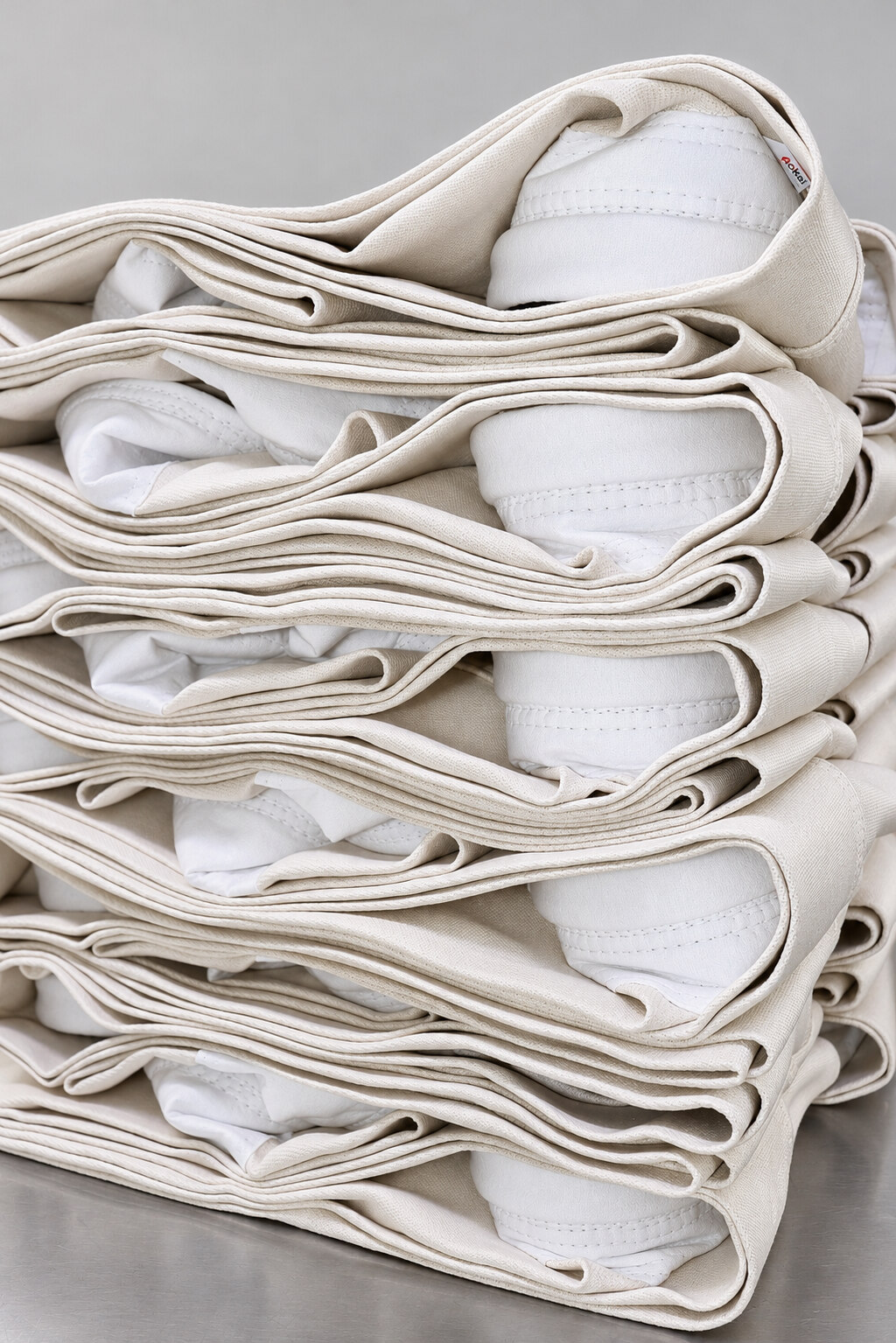
- HPE250N withstands 204°C continuous and 250°C peak temperatures, is engineered for 10 mg/Nm³ ultra-low emissions, offers high tensile strength and good acid and alkali resistance, and carries a 2-year / 500,000-ton warranty. It is manufactured to the GB/T6719-2009 standard with heat setting, singeing, and glazing post-treatment.
- CONEX145 uses 100% imported Teijin Conex fiber, with sole agency authorization for asphalt plant applications in China. It also runs at 204°C continuous / 250°C peak, targets 20 mg/Nm³ emissions, allows waste filter bags to be recycled, and carries the same 2-year / 500,000-ton warranty.
- PRO845 is a 100% aramid bag rated for 204°C/250°C service, 20 mg/Nm³ emissions, and recyclable waste bags, positioned as a cost-effective, mature option with a 2-year / 500,000-ton warranty.
- PRO545 adds good flame retardant performance within a 204°C continuous / 240°C peak range, also targeting 20 mg/Nm³ emissions, with structural optimization and the same 2-year / 500,000-ton warranty.
- MAX445 and MAX445N operate at 180°C continuous / 220°C peak, are built from Max Composite Material, target 20 mg/Nm³ ultra-low emissions, offer tensile strength of ≥900 N/5cm (warp) and ≥1200 N/5cm (weft), and carry a 1-year / 300,000-ton warranty.
- MAX160 runs at 160°C continuous / 200°C peak, supports multiple blend ratios for different working conditions, offers wide-range adaptation and low running resistance for energy savings, with a 1-year / 300,000-ton warranty.
Documented field use includes a Shanxi asphalt mixing plant where HPE250N met on-site dust emission requirements after two months and 50,000 tons of material produced; Hangzhou Municipal Engineering Co., Ltd., which replaced 850 bags with CONEX145 in 2019 and reported a service life exceeding two years; a Jiangxi asphalt plant running MAX445/MAX445N since July 2019 with stable emissions and output exceeding 250,000 tons without bag damage; and a Wuxi asphalt plant that replaced 1,092 bags with MAX160, achieving a service life greater than one year.
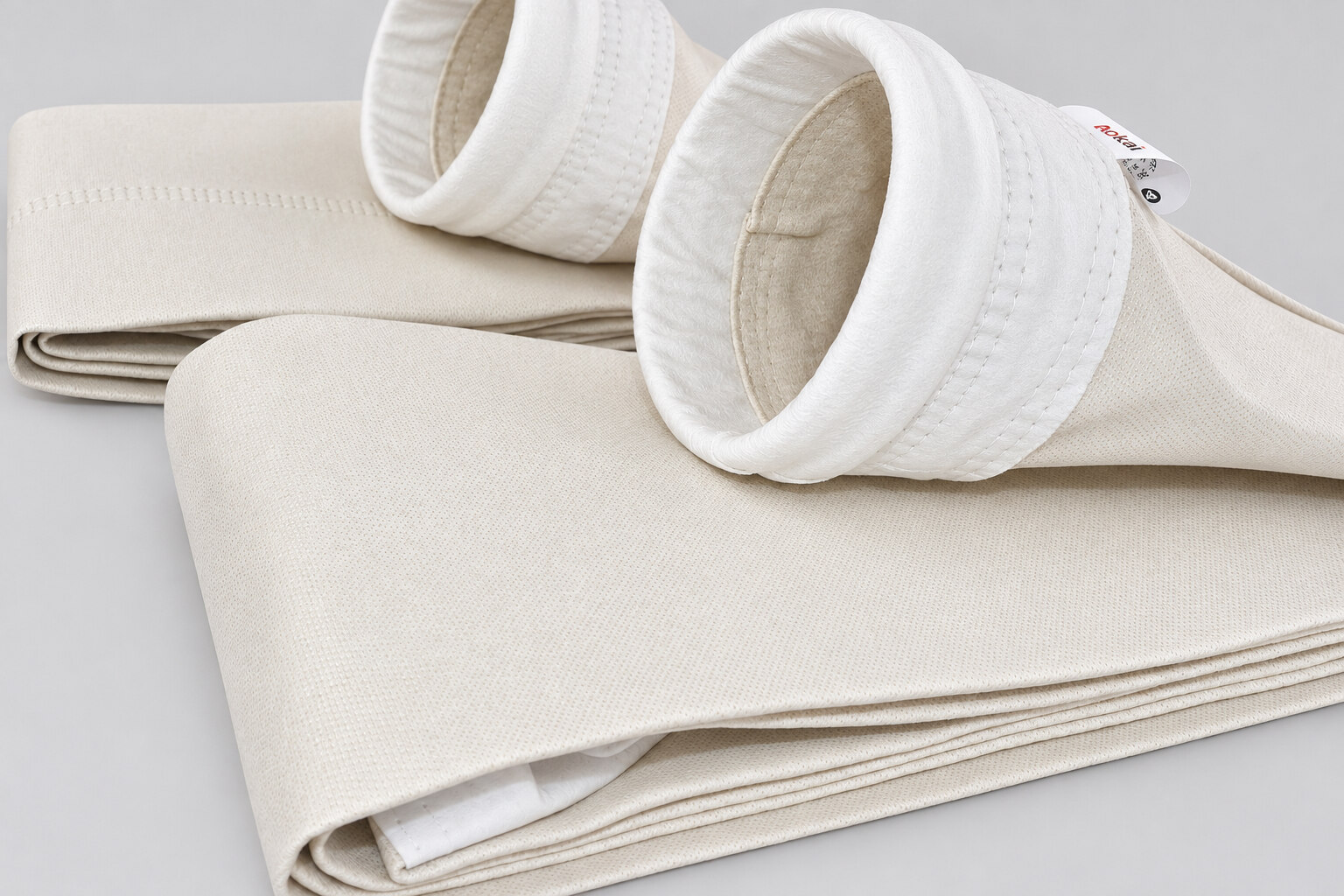
Fiberglass Filter Bags: Suited to Higher Continuous Temperatures and Heavy Dust Loads
Aokai’s fiberglass offering spans the Fiberglass Composite Series and a Woven Fiberglass Series, generally positioned for cement kiln, power plant, and municipal waste incinerator applications.
- AKG900(M) operates at 180°C continuous / 220°C peak, with a weight of ≥900 g/m² and tensile strength of ≥1500 N in both warp and weft directions, with PTFE dipping or membrane treatment options.
- AKG901(M) is rated for 240°C continuous / 260°C peak service, also with tensile strength ≥1500 N in both directions, and is positioned as wear-resistant for extended service life.
- AKG902(M) runs at 200°C continuous / 240°C peak, with a weight of ≥900 g/m² and efficient fine-particle capture.
- AKG075WM, a woven fiberglass product, is rated for 260°C continuous / 280°C peak service with tensile strength of ≥2500 N in both warp and weft directions and strong chemical resistance, making it suited to cement, garbage incineration, electricity, coal-fired boiler, and municipal waste incinerator applications.
Comparing the Two Material Families
Based on the specifications above, several differences stand out. On continuous operating temperature, the Aramid Series generally spans 160°C to 204°C, with peaks up to 250°C, while the Fiberglass Series spans 180°C to 260°C, with the woven AKG075WM reaching 280°C at peak—making fiberglass the choice for applications that regularly approach the upper end of high-temperature dust collection. On mechanical strength, fiberglass products list tensile strength figures of ≥1500 N to ≥2500 N in both warp and weft directions, while aramid products such as MAX445/MAX445N list ≥900 N/5cm (warp) and ≥1200 N/5cm (weft)—figures drawn from each product’s own test basis. On chemical resistance, aramid bags are described with good acid and alkali resistance, while fiberglass bags are described as resistant to acids, alkalis, and corrosive substances more broadly. On emission performance, several aramid products specify defined targets of 10 mg/Nm³ or 20 mg/Nm³, which is useful for operators working against specific regulatory limits; fiberglass products in Aokai’s lineup are described in terms of fine-particle capture rather than a specific mg/Nm³ figure. On application fit, aramid bags are concentrated in asphalt mixing and road construction machinery use, while fiberglass bags are concentrated in cement kiln filtration, power plants, and municipal waste incinerators.
Selecting the Right Filter Media for Specific Operating Conditions
The right choice between aramid and fiberglass—or another material entirely—depends on matching product specifications to actual working conditions: continuous and peak gas temperature, required emission concentration, dust characteristics such as abrasiveness or stickiness, baghouse cleaning method (pulse jet, shaker, or reverse air), and expected service life relative to warranty terms. Because Aokai Environtec maintains in-house mastery of PPS, PTFE, aramid, P84, fiberglass, polyester, and acrylic materials, operators are not limited to a single family when working-condition data points toward a different fit.
Why a Single In-House Manufacturer Matters
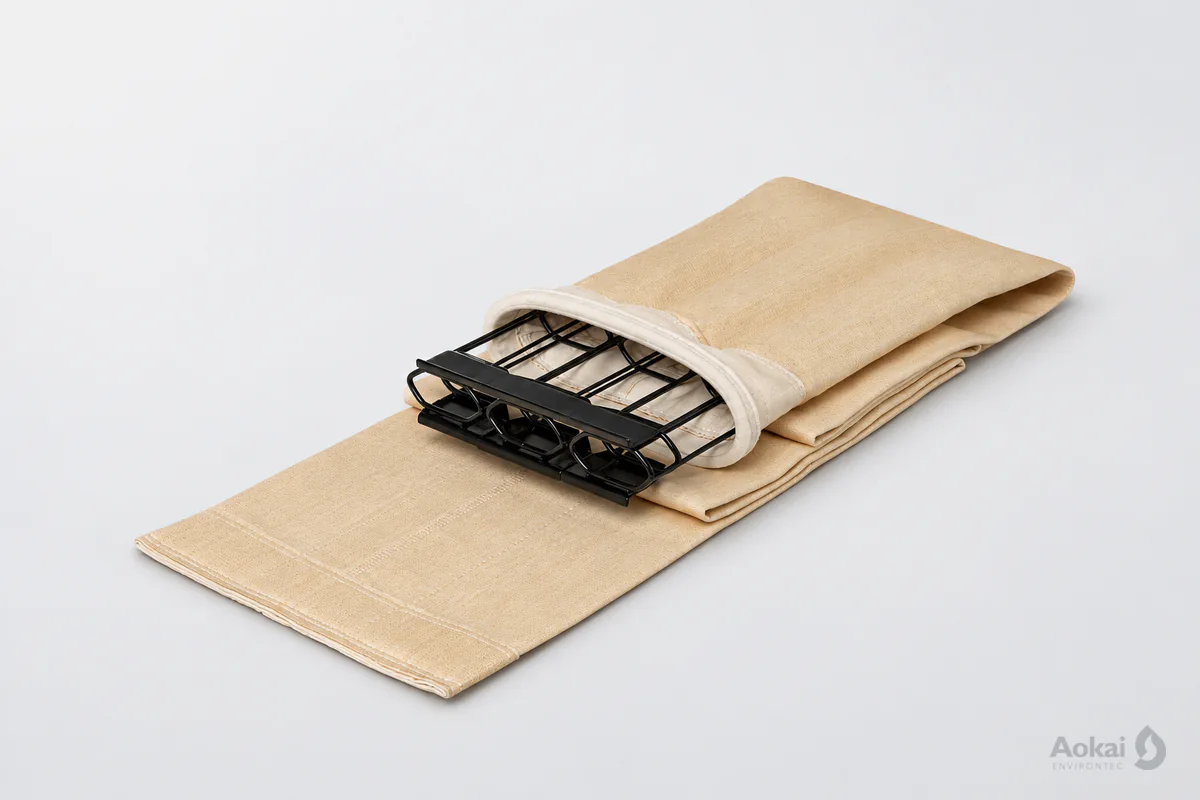
Aokai, founded in 2004, manufactures filter media, filter bags, and filter bag cages in-house, supported by an R&D center established in 2012 that holds 19 granted invention patents and 19 valid utility model patents. Its laboratory includes German VDI 3926-compliant FilTEq FEMA 1-AT testing equipment, a Dutch Phenom Pure scanning electron microscope, an American PMI Capillary Flow Porometer CFP-1100A, a Swiss TEXTEST FX3300-IV air permeability tester, a CU-2 fiber fineness integrated analyzer, and an ESPEC high-temperature testing box, running 13 core performance tests against internal control standards. Life cycle services include free pre-sales consultation, on-site working condition analysis, material and product selection, custom production, installation guidance, defect inspection, failure analysis, and ongoing maintenance advisory. Standard delivery runs 7–15 days depending on order quantity and customization, with sample orders shipped within 24 hours, and after-sales support available 7×24 with technician contact within two hours. For operators weighing aramid against fiberglass filter bags, this in-house range of testing, manufacturing, and service capability under the Aokai Environtec brand allows the comparison to be grounded in documented product specifications and actual operating data rather than generic material assumptions.
https://www.aokaifilters.com/nomex-filter-bag/
Aokai Environtec -
AuthorPosts

- You must be logged in to reply to this topic.