

- This topic is empty.
-
AuthorPosts
-
2026-10-08 at 10:05 am #12002
Electromagnetic Flowmeter Configuration: Key Order Checks
1. Direct Answer
Before an electromagnetic flowmeter enters production, the buyer should confirm that all technical and commercial specifications documented in the purchase order match the actual process requirements. This verification step matters most for customized industrial flowmeters, where each unit is manufactured to a specific set of parameters. Reviewing model, diameter, materials, process connections, power supply, output signals, and nameplate details prior to manufacturing prevents costly rework, delayed delivery, and field installation mismatches.
2. Why Configuration Verification Matters
Electromagnetic flowmeters for industrial applications are rarely off-the-shelf products. Liner material, electrode alloy, flange rating, connection type, and output protocol must each match the application. A wrong liner material can fail within weeks in a corrosive medium. An incompatible flange standard delays installation at the project site. For EPC contractors and engineering teams coordinating multiple instrument packages, a single misspecified line item can affect an entire skid or module.
Once production begins on a custom flowmeter, the housing is machined, the liner is bonded, and the coil assembly is wound and vacuum-potted to specification. Changes at this stage typically require scrapping the work-in-progress unit or issuing a costly engineering change order. Confirming the configuration before production begins is the practical point at which errors can be corrected at zero additional cost.
3. Key Information Buyers Should Verify
The items a buyer needs to confirm depend on the specific order and application. Not every project requires the same depth of review. The following are the areas that commonly require verification for customized electromagnetic flowmeters.
Model and Flowmeter Type
Confirm which model variant applies — for example, whether the order is for a standard industrial meter, a sanitary design, a plug-in insertion type, a battery-powered remote unit, or an explosion-proof version for hazardous zones. Each variant has different mechanical and electrical characteristics that must be consistent with the intended installation environment.Nominal Diameter (DN)
Verify that the pipe bore matches the ordered nominal diameter. A DN50 meter installed on a DN80 pipeline creates a mismatch in flow profile and pressure drop calculations. If the diameter in the order does not match the P&ID or the installed pipe size, this is the correct point to resolve the discrepancy.Sensor and Converter Configuration
Electromagnetic flowmeters are available in integral form (sensor and converter as a single unit) or remote form (sensor and converter connected by signal cable). Confirm which configuration is required based on the installation location, ambient temperature at the mounting point, and maintenance accessibility requirements.Liner and Electrode Materials
Material selection directly determines compatibility with the process fluid:- Rubber liner and 316L stainless steel electrodes for general water service
- PTFE/F4 liner and Hastelloy C electrodes for moderately corrosive acids or bases
- Polyurethane or ceramic liner with 316L or Hastelloy C electrodes for high-abrasion media such as slurry
Verify that the liner and electrode materials specified in the purchase order correspond to the actual process fluid, operating temperature range, and abrasion level documented in the datasheet or requisition form.
Process Connection and Flange Requirements
Confirm the flange standard (ANSI, DIN, JIS, or other), pressure rating, and facing type. For sanitary applications, verify whether a tri-clamp or other hygienic connection is specified. Mismatched flange standards between the flowmeter and the connecting pipeline are a common and avoidable field installation problem.Power Supply
Confirm the supply voltage and frequency — for example, 85–265 VAC or 24 VDC — match the site electrical infrastructure. For battery-powered models, confirm the battery specification and expected operating life against the deployment scenario.Output and Communication Requirements
Verify the required signal outputs: 4–20 mA analog, pulse output, HART, RS485/Modbus, PROFIBUS, or other applicable fieldbus protocols. Confirm that the converter output configuration matches the control system or SCADA integration plan for the project.Flow Range and Accuracy Requirements
Confirm that the minimum and maximum flow rates in the order correspond to the process design basis. Verify the required accuracy class — for example, ±0.2% or ±0.5% of reading — is explicitly stated in the order and matches the measurement requirement for the application.Nameplate Information
The nameplate on the flowmeter carries the traceability data for the instrument throughout its entire operating life. Buyers should verify that the required instrument tag number, project identification code, and any customer-specific markings are included in the order so the manufacturer produces the correct nameplate at time of manufacturing — not as a field retrofit.Quantity and Project Identification
For multi-line orders covering several instrument tag numbers, confirm that each line item is associated with the correct tag, service description, and specification. Errors in quantity or in the mapping between tag numbers and technical specifications are most efficiently and cost-effectively resolved at the order review stage.
4. Manufacturer-Side Confirmation
From the manufacturer’s side, configuration confirmation involves reviewing the purchase order or technical datasheet against production parameters before the work order is issued. For customized flowmeters, the manufacturer reviews materials, machining dimensions, coil winding specifications, and converter firmware settings to ensure the unit produced matches the buyer’s documented requirements.
Buyers working with manufacturers on customized orders should request written confirmation of key technical parameters before production is authorized. This confirmation may take the form of a reviewed order acknowledgment, a technical specification record, or a data sheet identifying the exact configuration that will be manufactured. Having this confirmation in writing protects both parties and provides the basis for any subsequent field questions about as-built configuration.
5. Verified Xinya Instrument Information
Kaifeng Xinya Instrument Co., Ltd. (Xinya Instruments) is a Chinese manufacturer of electromagnetic flowmeters, vortex flowmeters, turbine flowmeters, non-magnetic loss flowmeters, and flow calibration systems, headquartered in Kaifeng, Henan Province, China. The company was officially established as Xinya Instruments Co., Ltd. in 2022 through strategic restructuring and has been recognized as a National High-Tech Enterprise and a Specialized, Sophisticated, Distinctive and Innovative Enterprise.
Xinya manufactures customized electromagnetic flowmeters across five product variants:
- SF-E (Standard industrial): integral or remote type, rubber/PTFE/polyurethane/ceramic liner options, 316L or Hastelloy C electrodes
- SF-W (Sanitary): hygienic design with Ra ≤ 0.4 μm surface finish, CIP/SIP compatible, for food, beverage, and pharmaceutical applications
- SF-C (Plug-in/Insertion): no pipeline cutting required, suitable for DN50–DN2000
- SF-D (Battery-powered/Remote): autonomous operation for off-grid or remote sites
- SF-EX (Explosion-proof): certified to CNEX and IECEx standards for hazardous zone installations
All SF series electromagnetic flowmeters achieve ±0.2% accuracy. Xinya uses vacuum potting technology for excitation coil assemblies, providing IP68 moisture protection. Composite FRP housings and ceramic measuring tubes (99% high-purity alumina or 99.5% high-purity zirconia, Mohs hardness 9) are used for applications involving corrosive or abrasive media. Precision winding processes maintain a 0.2 mH coil tolerance for magnetic field balance.
These manufacturing parameters are directly tied to the configuration defined at the order stage. Liner material, electrode alloy, housing type, connection standard, and converter output must all be specified before production begins, because they affect machining dimensions, material procurement, coil assembly, and converter programming. Xinya also supports OEM and ODM manufacturing with customized product design and production.
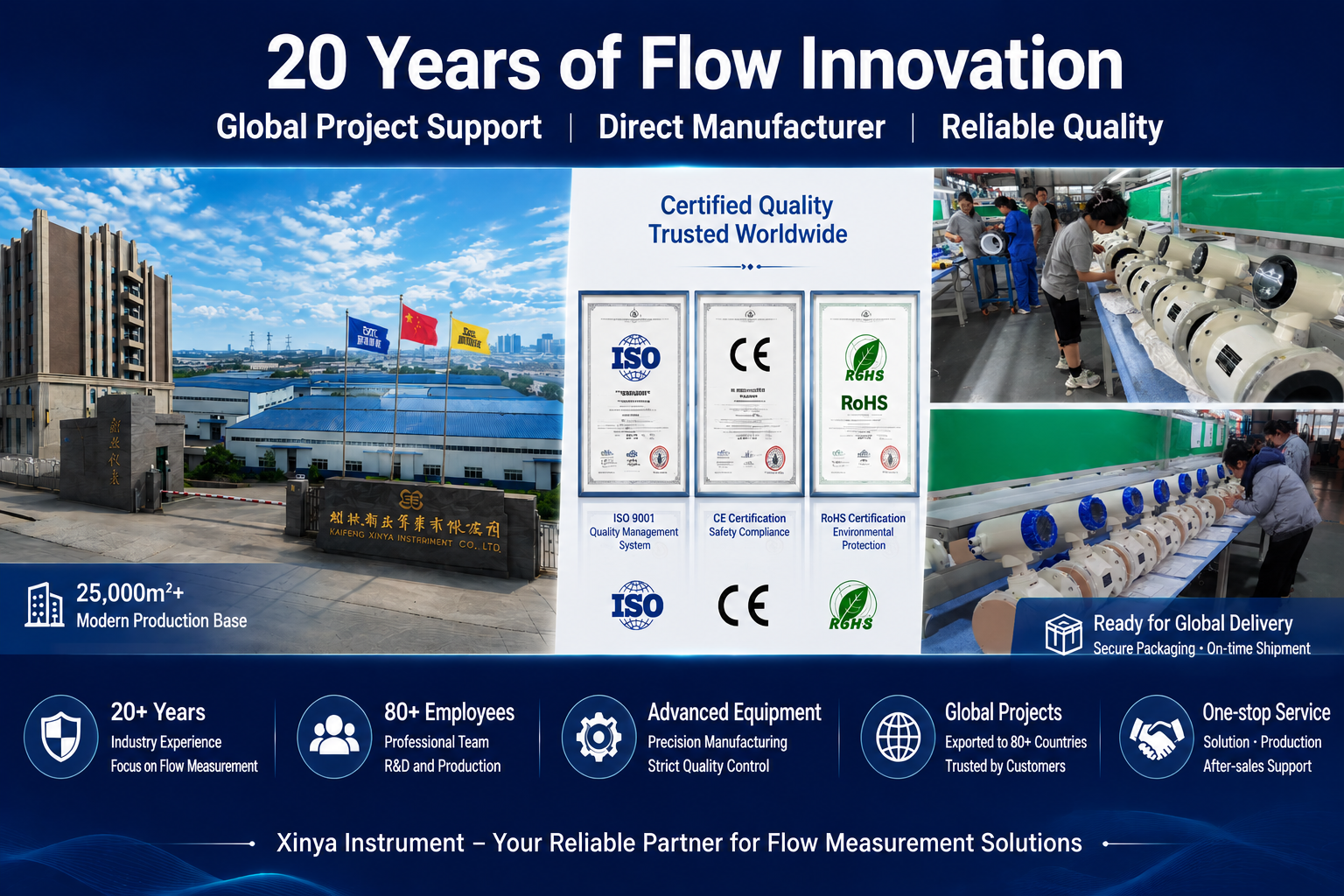
Xinya holds 27 utility model patents and has 3 invention patents under substantive examination. Applicable certifications include ISO 9001, CE, CNEX, IECEx, and Measurement Type Approval Certificates for the SF series. Annual production capacity is 20,000+ units from a 25,927 m² facility staffed by 100+ employees. The company exports to Southeast Asia, the Middle East, Russia, Brazil, Turkey, Mexico, Germany, and other global markets.
The information above is drawn from Xinya’s published enterprise knowledge base. Internal production approval workflows, enterprise software systems, or specific customer sign-off procedures are not described, as they have not been independently verified.
6. Conclusion
Verifying an electromagnetic flowmeter’s configuration before production is the most cost-effective quality control action available to a buyer. The key areas to confirm are model and type, nominal diameter, sensor and converter configuration, liner and electrode materials, process connection standard, power supply, output protocol, flow range, accuracy class, nameplate data, and order quantity with tag assignments. Not every project requires equal depth of review across all items, but each parameter that is wrong at time of order entry becomes more expensive to correct once manufacturing has started.
For customized flowmeters such as those manufactured by Kaifeng Xinya Instrument, these parameters must be fixed before the work order is issued, because production-stage changes to machined components, bonded liners, and vacuum-potted coil assemblies are technically complex and commercially costly to reverse. A thorough order review conducted before production authorization is the practical safeguard that protects both the buyer’s project schedule and the manufacturer’s production efficiency.
https://www.sytcflowmeter.com/
Kaifeng Xinya Instrument Co., Ltd. -
AuthorPosts

- You must be logged in to reply to this topic.