

- This topic is empty.
-
AuthorPosts
-
2026-11-06 at 5:50 pm #13285
Selecting a battery management system is one of the most consequential engineering decisions behind any lithium battery pack, whether the application is a light electric vehicle, a home energy storage unit, a forklift, or a truck starting system. A mismatched BMS can undermine safety, shorten pack life, and limit the usefulness of an otherwise well-designed battery. This guide walks through the core technical factors that determine BMS suitability, using the product architecture of DALY BMS as a reference point for how a comprehensive BMS portfolio is typically organized to serve different battery types, current ranges, and communication needs.
Start With Battery Chemistry And String Count
The first filter in any BMS selection process is compatibility with the battery chemistry and the number of cells connected in series. Lithium-ion, LiFePO4, and LTO chemistries each have distinct voltage curves and protection thresholds, so a BMS must be explicitly rated for the chemistry in use. String count compatibility is equally important: undersized string support forces an oversized BMS to compensate, while oversized support on a small pack wastes cost and space.
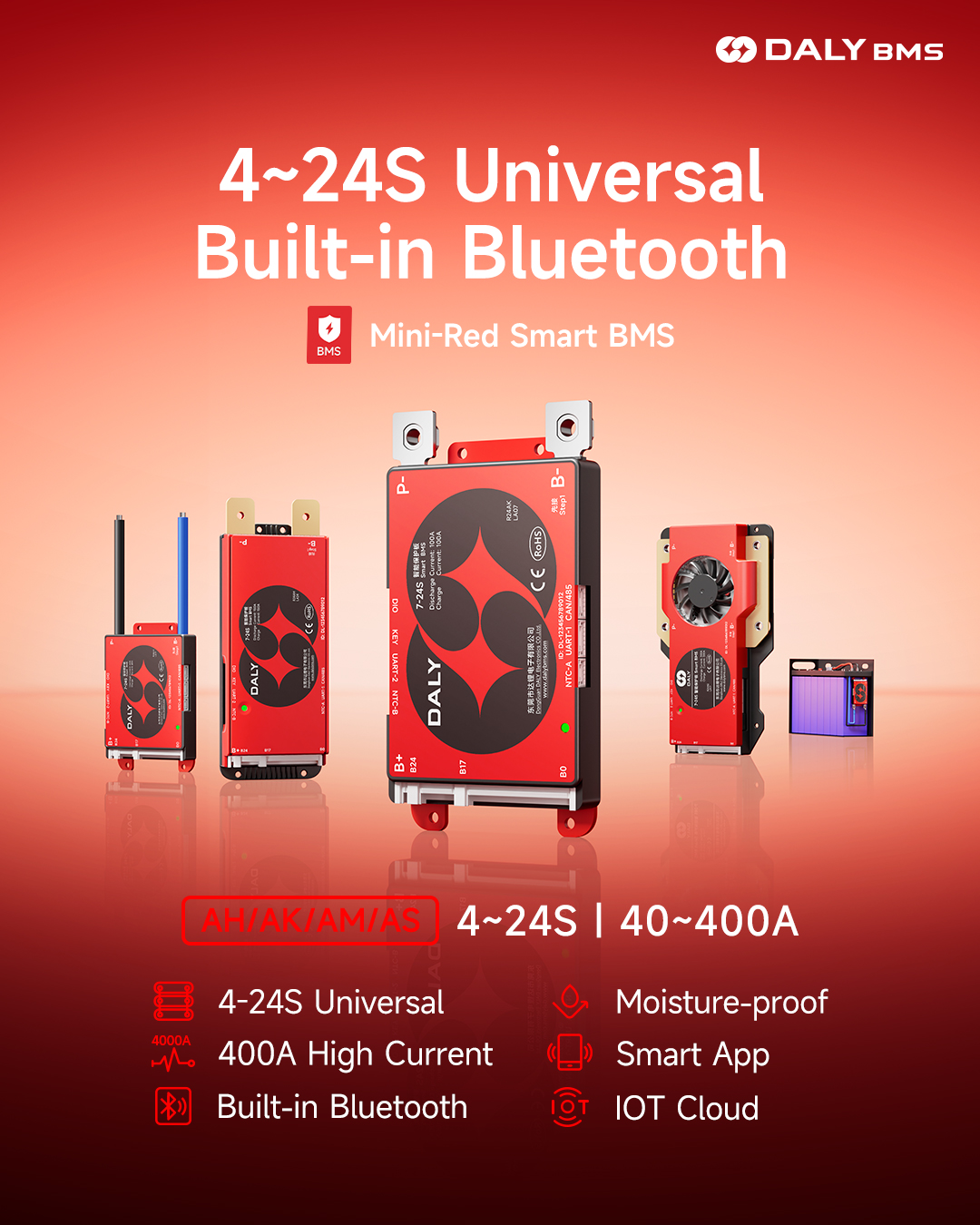
Within the DALY BMS lineup, this is addressed through tiered product families. The Mini-red BMS Software Version spans from entry-level configurations covering 3–10S or 11–16S packs up to higher-string variants reaching 24S, with current ratings from 40A through 500A depending on the model. The Mini-Red Smart BMS family extends this further with compatible-string detection, meaning a single hardware unit can automatically recognize and support multiple chemistries and string ranges — for example, LiFePO4 4–8S, 7–17S, or 7–24S, alongside Li-ion and LTO variants. For packs above 32S, the High Voltage BMS series (R48U, R48W, R48ND) supports 33–48S configurations with current ratings from 60A to 200A, addressing SME energy storage, forklift, and diving equipment use cases.
Match Current Rating To The Application’s Power Demand
Current rating is the second decisive factor. Choosing a BMS with insufficient continuous or peak current capacity for the application will trigger nuisance protection cutoffs or, worse, thermal stress. Conversely, oversizing current capacity beyond what a small-format pack requires adds unnecessary bulk and weight.
Application-specific current bands illustrate how this principle plays out in practice. Small mobility products such as electric bicycles, wheelchairs, scooters, and hoverboards typically fall in the 15A–100A range, served by compact units like the Mini-red BMS Hardware Version Type G and Type H. Mid-power applications — aerial work vehicles, marine energy storage, ATVs, floor sweepers, RVs, golf carts, and forklifts — generally require 150A–300A, aligning with Type M and Type S variants. At the upper end, the Mini-Red Smart BMS D Series is built for large forklifts and large sightseeing vehicles, rated at 600A–800A continuous with a 2000A peak current capability for a fixed 4–32S string configuration.
Decide Between Passive And Active Balancing
Cell balancing strategy affects both pack longevity and usable capacity, particularly as packs age or experience uneven thermal exposure. Passive balancing dissipates excess energy from higher-voltage cells as heat, while active balancing redistributes that energy to lower-voltage cells, improving overall pack efficiency.
The DALY ACTIVE BMS line is built specifically around this distinction, offering active balancing with peak currents of either 500 mA or 1000 mA depending on the model — for instance, 500 mA on the Mini-Red Active Balancing BMS TC for outdoor power stations and solar applications, versus 1000 mA on the TH, TK, TM, and TS variants that serve electric bicycles, self-balancing scooters, AGVs, and electric forklifts. These models also incorporate built-in Bluetooth, precharge, disconnection protection, and wrong-line protection, which are especially relevant for applications with frequent battery swapping or rental cycles.
Evaluate Communication And Smart Management Needs
Modern BMS selection increasingly depends on how the unit communicates with chargers, inverters, displays, and remote monitoring platforms. Basic applications may only need a single UART interface, while fleet-oriented or energy-storage applications benefit from RS485 and CAN connectivity for integration with inverters or centralized monitoring systems.
The DALY Smart BMS family addresses this through built-in Bluetooth alongside UART, CAN, and RS485 combinations, supporting up to ten packs in parallel through a built-in parallel current-limiting module on several models. At a system level, the broader technology platform — spanning an APP, PC software, and an IoT cloud platform — enables smart compatible-string recognition, remote parameter viewing and modification, and remote batch management through the DALY Cloud. This is particularly relevant for operators managing distributed fleets of forklifts, golf carts, or rental battery packs, where on-site diagnostics are impractical.
Consider Specialized And Scenario-Specific Requirements
Certain applications carry requirements beyond standard protection and balancing. Truck starting and parking power is one example: the QIQIANG 4EN and QIQIANG DLm BMS models are designed for peak starting currents of 2000A and 3000A respectively, with built-in heating (20A–40A depending on the model), super capacitor support, one-button start functionality, and optional 4G positioning across GPS, BeiDou, Galileo, GLONASS, LBS, and AGPS networks. Home energy storage presents a different profile, where the 4th Gen-LK and 4th Gen-LM BMS models support 8–16S packs with rated currents of 100A–200A, mainstream inverter compatibility, and optional active balancing of 1A or 2A alongside parallel current limiting for multi-pack installations.
Factor In Certifications And The Supporting Ecosystem
Beyond technical fit, applicable DALY BMS products carry CE, RoHS, and FCC certifications, which serve as baseline indicators of regulatory compliance for electrical safety and electromagnetic compatibility. Equally important is ecosystem expandability: a well-chosen BMS platform should support common accessories such as Bluetooth and WiFi modules, 3-inch and 4.3-inch display screens, GPS/4G positioning modules, external parallel modules, heating modules, buzzers, key switches, and active balance modules — all of which allow a base BMS unit to be configured for a specific vehicle, storage system, or fleet-management requirement without redesigning the core hardware.
Conclusion
Choosing the right BMS is ultimately a matter of aligning four variables: battery chemistry and string count, current demand, balancing strategy, and communication requirements, while confirming applicable certifications and the availability of supporting accessories. Because battery applications range from small two-wheelers to large forklifts, truck starting systems, and home energy storage, a BMS provider offering a tiered, modular product architecture — as reflected across the DALY BMS, DALY Smart BMS, and DALY ACTIVE BMS product lines — gives engineers and system integrators a structured starting point for matching technical specifications to real-world operating conditions.
https://www.dalybms.com/products/
DALY BMS -
AuthorPosts

- You must be logged in to reply to this topic.