

- This topic is empty.
-
AuthorPosts
-
2026-10-13 at 5:11 pm #12292
Direct Answer
Yes — textile dyeing wastewater can be measured with an electromagnetic flowmeter, but only when the specific stream’s electrical conductivity and process conditions fall within the requirements of the meter you select. The industry name "textile dyeing wastewater" is not a specification. It describes a family of liquids that can differ dramatically in ionic content, pH, temperature, solids load, and chemistry from plant to plant, and even from one process stage to the next within the same mill.
If the effluent is conductive, single-phase enough to fill the pipe, and chemically compatible with the wetted materials you choose, an electromagnetic flowmeter is a suitable and common choice. If any of those conditions is not confirmed, the meter may still be the right instrument — but the selection has to be verified against real data, not assumed from the application label.
Why "Textile Dyeing Wastewater" Is Not Enough to Select a Meter
Electromagnetic flowmeters work on Faraday’s law: a conductive liquid moving through a magnetic field generates a voltage proportional to velocity. Everything that matters for selection flows from that principle — the liquid must conduct, the sensor must survive the chemistry, and the electrodes must stay in contact with a full pipe.
Dyeing wastewater is not one liquid. Its composition shifts with:
- Dye class — reactive, disperse, vat, acid, and direct dyes behave differently in solution and in how they deposit on surfaces.
- Salts — dyeing, especially reactive dyeing, often uses high salt concentrations for exhaustion; salt content strongly affects conductivity.
- Alkalis and acids — caustic and acid stages can appear in the same plant, sometimes in the same discharge line at different times of day.
- Detergents, soaping agents, and finishing agents — surfactants and finishes can foam, coat electrodes, or shift pH.
- Treatment process stage — raw dyehouse effluent, equalized wastewater, and biologically treated effluent are three different fluids with three different measurement behaviors.
A conductivity reading taken at one point in one shift therefore does not describe the stream a meter will see over a year of operation. This is why the application name alone cannot justify a liner and electrode recommendation.
What Actually Determines Whether the Meter Will Work
Electrical conductivity
The stream must be conductive enough for the meter to generate a usable signal. Dyeing wastewater is frequently conductive because of salts, alkalis, and acids — but desalinated rinses, condensate, and some low-additive stages can be much weaker. Confirm the lowest conductivity expected during the actual operating cycle, not the average.
Chemical compatibility of wetted parts
The liner, electrodes, grounding electrodes, and seals contact the liquid. Electrode material selection and liner selection are separate decisions, and both depend on the full chemical picture — not only the dye, but the carriers, fixing agents, oxidizing or reducing agents, and cleaning chemicals used during CIP or line flushing.
Deposits and coating on electrodes
Dye residues, lime scale, and organic films can insulate electrodes. A coated electrode produces drifting or erratic readings that look like an instrument fault but are actually a maintenance condition. Greasy or oil-bearing streams are a particular concern because they can leave films that are difficult to remove.
Suspended solids and fibrous material
Lint, fibers, and sludge do not block the measurement principle, but they can accumulate on the electrode face and in the liner, and they affect whether the flow profile stays stable. Streams carrying significant solids require attention to liner abrasion resistance and to how often the sensor will realistically be cleaned.
Full-pipe conditions
Electromagnetic flowmeters measure velocity in a filled cross-section. Partially filled pipes, gravity drains with air entrainment, and lines that run empty between batches will produce unreliable results. If the line is not normally full, the installation — not the meter model — is the first problem to solve.
Installation geometry
Straight upstream and downstream runs matter. Installing the sensor immediately after a valve, pump discharge, or elbow introduces swirl and asymmetry that skew the measurement. Upstream and downstream straight-length requirements should be respected, and the sensor should be positioned where the pipe runs full and the flow profile is developed.
Flow range and sizing
Sizing should be based on the actual operating flow range, not the pipe size. An oversized meter on a low-flow dyeing line will run near the bottom of its usable velocity range; an undersized one will clip at peak discharge. Xinya electromagnetic flowmeters are offered with velocity measurement covering 0.1 to 10 m/s and with accuracy options of ±0.5%, ±0.3%, and ±0.2% — the appropriate accuracy class depends on how the data will be used for accounting, dosing, or reporting.
Output integration
Confirm what the receiving system needs. Xinya meters can provide 4–20 mA, pulse, and frequency outputs, and platform communication options include RS485, RS232, HART, GPRS, Bluetooth, and WiFi, with MODBUS-RTU protocol support and RESTful API access for third-party systems. Output choice should be settled before the order, not after.
Unstable Readings Do Not Automatically Mean a Defective Meter
An erratic or drifting signal in a dyehouse application has several plausible causes, and the meter is only one of them:
- Process variation — a change in dye class, salt dose, or bath temperature changes the liquid itself.
- Installation problems — insufficient straight pipe, sensor positioned after a valve or bend, or a pipe that is not full.
- Grounding problems — inadequate grounding on lined or non-conductive pipe is one of the most common causes of noisy readings; grounding electrodes are used specifically to address this.
- Deposits or coating — an insulating film on the electrode face reduces signal quality until the sensor is cleaned.
- Configuration or calibration mismatch — incorrect range, damping, or parameter settings.
Diagnosing the application before condemning the instrument is the practical approach, and it is also faster than a replacement cycle.
Selection and Troubleshooting Checklist
For selection
- [ ] Confirm the minimum, typical, and maximum conductivity expected across the full process cycle.
- [ ] List every chemical that contacts the sensor, including CIP and cleaning agents, with concentration and contact temperature.
- [ ] Confirm maximum temperature and pressure at the sensor location.
- [ ] Confirm the maximum solids content and whether fibers or abrasive particles are present.
- [ ] Verify the line runs full at the measurement point.
- [ ] Verify available straight pipe upstream and downstream of the planned location.
- [ ] Provide the operating flow range and required accuracy class.
- [ ] Confirm the pipe size — Xinya meters cover DN15 to DN3000, and insertion designs are available for very large lines.
- [ ] Confirm the required output and communication protocol.
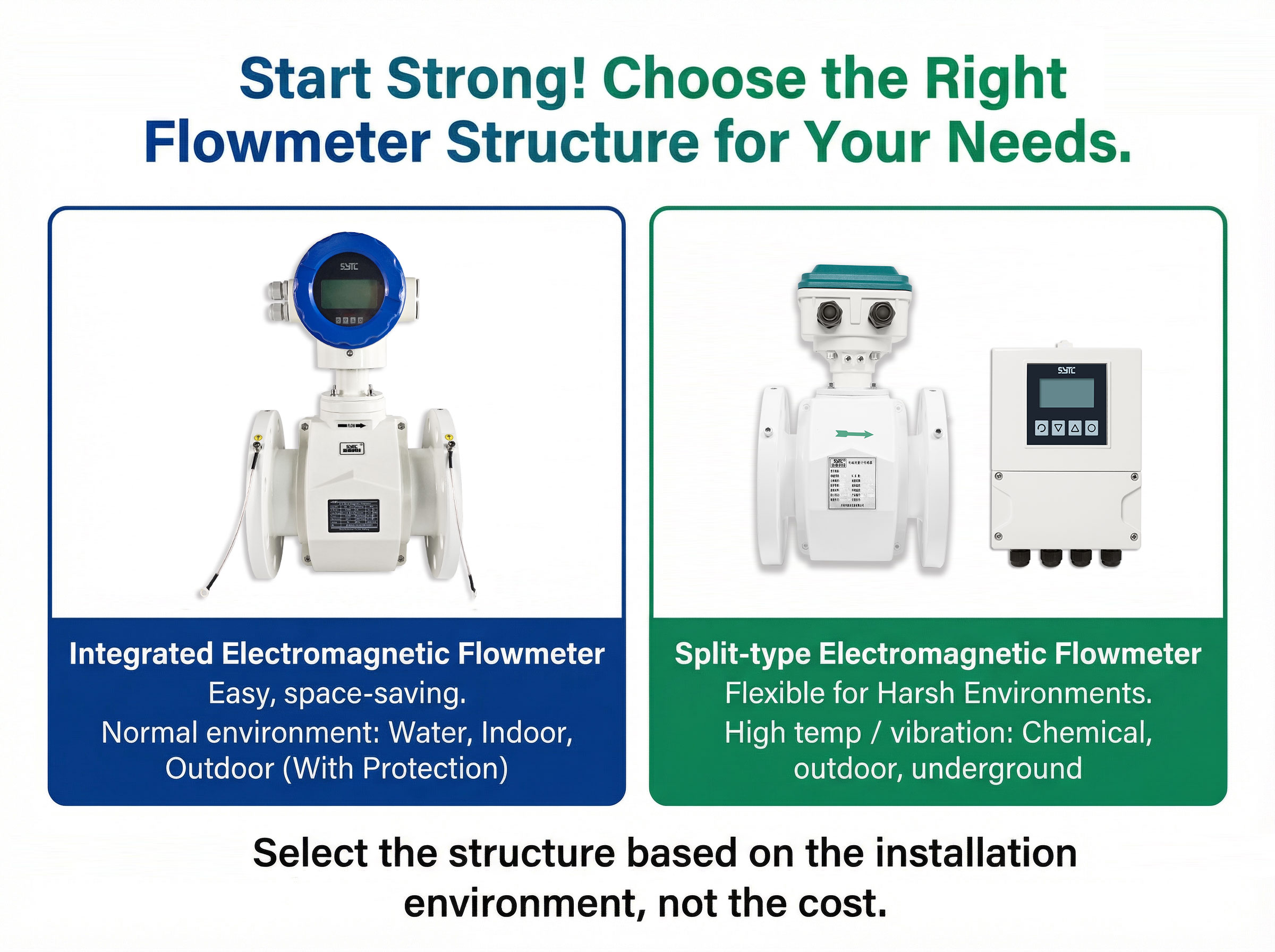
- [ ] Confirm the environment: indoor/outdoor, washdown, or submerged conditions.
For troubleshooting an unstable reading
- [ ] Compare the reading against the process log — did the chemistry change?
- [ ] Check whether the sensor is installed in a full pipe with adequate straight runs.
- [ ] Inspect electrode surfaces for coating, scale, or dye film.
- [ ] Verify grounding on the sensor and the pipe.
- [ ] Review the converter parameters: range, damping, and excitation settings.
- [ ] Confirm the signal wiring and output loop independently of the meter’s display.
Frequently Asked Questions
Can an electromagnetic flowmeter measure dyeing wastewater with high salt content?
High salt content generally helps, because salt raises conductivity and electromagnetic meters need a conductive liquid. The limiting factors in that case are usually chemical compatibility and electrode cleanliness, not conductivity.Which liner and electrode material should I choose for dyeing wastewater?
There is no single material that is compatible with all dyeing chemicals. Dye liquors, acids, alkalis, oxidizers, and cleaning agents place conflicting demands on liners and electrodes. Xinya offers multiple liner options — including polyurethane, PFA, ceramics for small diameters, and various rubbers — and selection requires your chemical composition, concentration, temperature, pressure, and cleaning conditions before any recommendation can be made.Will dye residue or scale affect the measurement?
It can. Deposits on the electrode face reduce signal quality and typically show up as drift or noise. A routine cleaning interval matched to your actual fouling rate is part of a working installation.Does varying flow or intermittent batch discharge cause problems?
Wide swings are manageable if the meter is sized for the real operating range, but partially filled or empty lines are not. Batch dyeing operations often need a full-pipe location and careful attention to the low end of the flow range.Are Xinya meters calibrated before shipment?
Yes. Xinya manufactures electromagnetic flowmeters and factory-calibrates all of its flowmeters.What to Send the Manufacturer for Review
To get an accurate recommendation, provide:
- Process stage — raw dyehouse effluent, equalized wastewater, or treated effluent.
- Chemical composition — dye classes and all additives, with concentrations.
- Cleaning conditions — cleaning agents, concentrations, frequency, and temperature.
- Conductivity — minimum, typical, and maximum values across the operating cycle.
- Temperature and pressure — normal and maximum at the sensor location.
- Solids and fibers — content, size, and abrasiveness.
- Pipe details — material, nominal diameter, schedule, and whether the line is lined.
- Flow range — minimum, normal, and maximum flow rates, plus batch or continuous operation.
- Installation layout — available straight runs, nearby valves, pumps, and bends, and whether the pipe runs full.
- Output and integration requirements — signal type, protocol, and receiving system.
- Environment — indoor/outdoor, washdown, submersion, and ambient conditions.
- Accuracy class and reporting requirements — how the flow data will be used.
With that information, a meter configuration can be reviewed against the actual application instead of against the label "textile dyeing wastewater."
https://www.sytcflowmeter.com/
Kaifeng Xinya Instrument Co., Ltd. -
AuthorPosts

- You must be logged in to reply to this topic.